
For an Indian exporter, getting the goods or services delivered is only half the job.
The other half is getting the money back into India—and getting the foreign-exchange compliance trail closed properly.
That second part has become particularly important in 2026 because India’s FEMA export framework is going through a major transition.
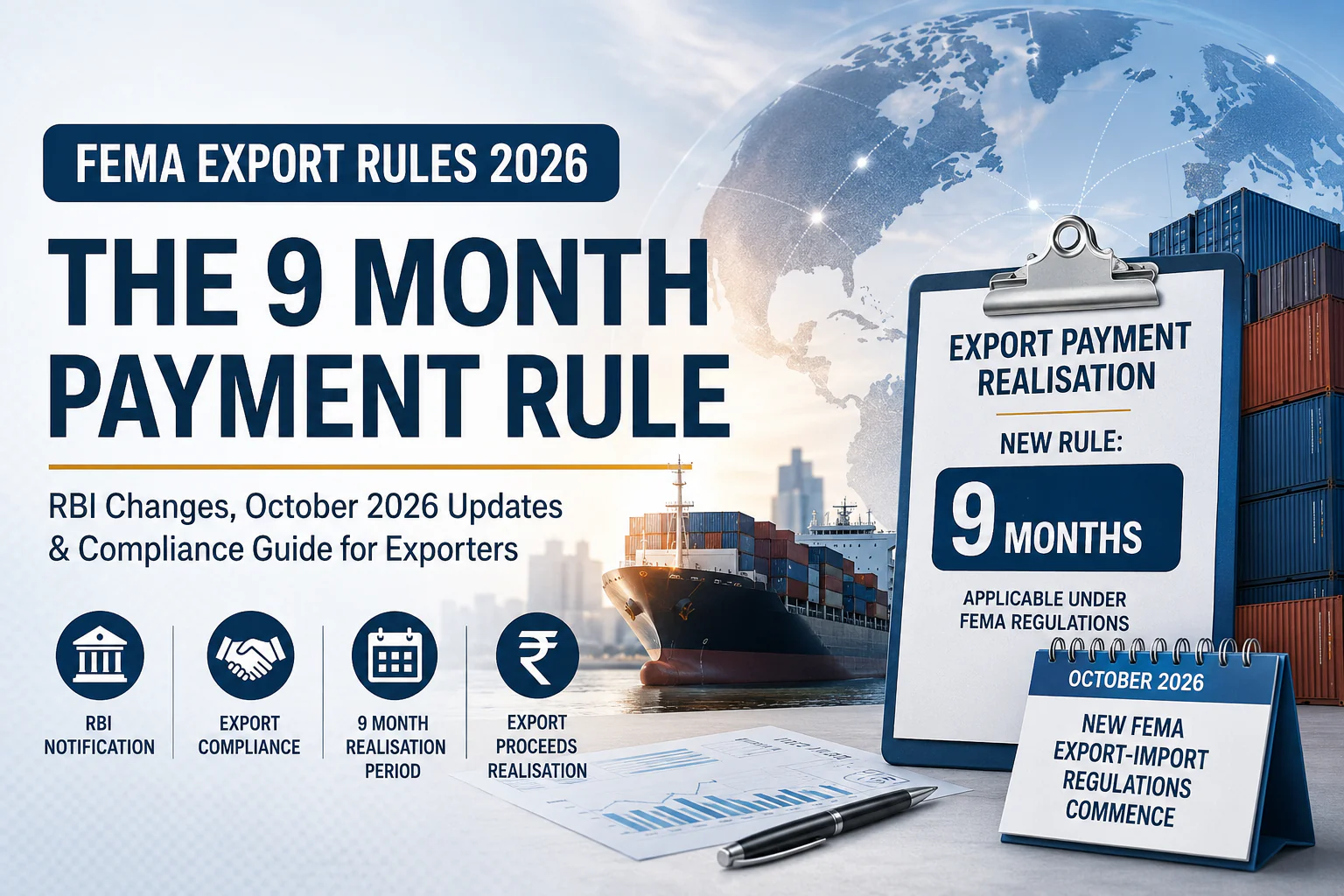
On 5 June 2026, the Reserve Bank of India amended the existing Foreign Exchange Management (Export of Goods and Services) Regulations, 2015 and replaced “fifteen months” with “nine months” in Regulation 9(1) and Regulation 9(2)(a). The amendment took effect from the date of publication in the Official Gazette.
At first glance, this looks like a straightforward reduction in the time available to exporters.
But there is an important second layer.
RBI had already notified a new Foreign Exchange Management (Export and Import of Goods and Services) Regulations, 2026, which are scheduled to come into force on 1 October 2026. The new framework is intended to replace the existing 2015 export regulations and consolidate the rules governing exports and imports of goods and services.
So Indian exporters now need to understand which rules apply based on the relevant transaction date, rather than simply remembering one number such as “nine months” or “15 months.”
This is particularly important for exporters carrying long receivable cycles, software and IT-service exporters, consultants, manufacturers, merchant exporters, exporters supplying overseas warehouses, and businesses whose customers routinely take several months to pay.
The key change exporters need to understand
The immediate 2026 amendment is Notification No. FEMA 23(R)/(8)/2026-RB dated 5 June 2026, titled the Foreign Exchange Management (Export of Goods and Services) (First Amendment) Regulations, 2026.
The amendment specifically changes Regulation 9 of the 2015 regulations.
The words “fifteen months” have been substituted with “nine months” in:
- Regulation 9(1); and
- Regulation 9(2)(a).
The RBI notification states that the amendment comes into force from the date of publication in the Official Gazette.
That means exporters cannot simply rely on the 15-month period that had been available after the November 2025 amendment.
For the relevant transactions governed by the amended 2015 framework, the applicable period is again nine months.
Why are exporters seeing both 9 months and 15 months in 2026?
This is where the 2026 transition becomes confusing.
The regulatory history is roughly as follows.
| Period | Relevant framework | General export realisation period |
|---|---|---|
| Before 13 November 2025 | 2015 Regulations as then applicable | 9 months |
| From 13 November 2025 | Second Amendment, 2025 | 15 months |
| From 5 June 2026 under amended 2015 framework | First Amendment, 2026 | 9 months |
| From 1 October 2026 | New 2026 Export & Import Regulations | New framework |
The November 2025 amendment had extended the period from nine months to 15 months. The June 2026 amendment subsequently changed the wording back to nine months under the 2015 Regulations.
Meanwhile, the new 2026 regulations were notified in January 2026 and are scheduled to come into force from 1 October 2026. They provide a new consolidated framework for export and import transactions.
For businesses, therefore, 2026 is not a year in which one generic “export realisation deadline” can safely be applied to every transaction.
What does “realisation and repatriation” actually mean?
An exporter may receive payment in a foreign bank account, through a payment platform or through another permitted channel.
But FEMA compliance is not simply a question of whether the foreign customer has technically paid.
The regulatory framework deals with the realisation and repatriation of export proceeds to India through the permitted banking and foreign-exchange system.
In practical terms, an exporter should be able to establish:
- What was exported?
- When was it exported?
- What was the export value?
- Who was the overseas customer?
- When was the amount received?
- Through which authorised banking channel was it received?
- How was the export entry reported?
- Has the relevant outstanding entry been appropriately closed or reconciled?
This becomes especially important when a company has hundreds of export invoices.
The problem is rarely one invoice.
The problem is usually the ageing of the entire export receivables book.
Example: a software exporter with overseas customers
Consider an Indian software company that provides development services to customers in the US, UK and Singapore.
Its standard customer contract says:
Payment within 120 days of invoice.
At first, this appears comfortably manageable.
But one customer starts taking six months.
Another takes eight months.
A third customer disputes part of an invoice.
The finance team continues to carry the receivables because management expects payment.
This is where FEMA compliance needs to be considered separately from ordinary commercial credit control.
The accounting team may say:
“The receivable is still outstanding.”
The FEMA compliance team has to ask:
“How long has it been outstanding, what is the applicable realisation period, and what action is required if payment will not arrive within that period?”
Those are different questions.
The 5 June 2026 amendment matters immediately
Businesses sometimes assume that because the new FEMA framework is coming into effect from October, they can wait until October to review their export receivables.
That would be a risky approach.
The June 2026 notification is already relevant under the existing framework. RBI’s official notification expressly substitutes the 15-month period with nine months in the specified provisions.
An exporter with transactions governed by the current 2015 regulations should therefore review the applicable period based on the transaction date and the law applicable to that transaction.
This is especially important for exports made during the transition period.
A simple timeline example
Suppose an Indian manufacturer exports goods on 10 June 2026.
If the transaction falls under the amended 2015 framework, the nine-month period becomes relevant.
A simple illustration would be:
10 June 2026 + 9 months = 10 March 2027
Now consider another export made before the June amendment, during the period when the 15-month amendment was applicable.
Its deadline can be materially different.
This is why companies should not take one export invoice from the sales register and apply today’s rule mechanically.
The date of export and the applicable regulatory framework need to be established first.
What about exports made before June 2026?
This is an area where businesses need transaction-level review.
The June 2026 amendment changes the wording of the 2015 regulations from 15 months to nine months. It does not mean that every historical export automatically has its original deadline rewritten without considering when the transaction occurred and which provision governed it.
For example, exports made during the period when the November 2025 amendment was applicable should be reviewed with reference to that amendment and the applicable transition.
Where an exporter has a significant amount outstanding, it is sensible to maintain a transaction-date matrix rather than applying a blanket rule.
The October 2026 transition is equally important
The next major change comes on 1 October 2026.
RBI’s new Foreign Exchange Management (Export and Import of Goods and Services) Regulations, 2026 are scheduled to come into force from that date. The new framework consolidates export and import rules and replaces the earlier export-focused framework.
The new framework is intended to simplify and consolidate cross-border trade compliance.
According to the notified framework as summarised by professional sources, the new regime provides a 15-month realisation period for exports, with a longer period of 18 months where invoicing or settlement is in Indian rupees, subject to the conditions of the new framework.
This creates an unusual 2026 situation.
The existing framework has moved back to nine months from June, while the new framework is scheduled to provide a different framework from October.
For an exporter, that means the transition cannot be ignored.
What changes under the new FEMA export-import framework?
The new 2026 regulations are broader than merely changing the number of months.
They bring exports and imports into a more consolidated framework.
One important change is the introduction of a common Export Declaration Form (EDF) framework for goods, services and software.
The new system also formalises reporting for service exporters.
This is particularly relevant for:
- IT companies;
- software developers;
- BPOs;
- consultants;
- engineering service providers;
- digital service businesses; and
- other Indian businesses earning foreign exchange from services.
The new framework provides for service and software export reporting and corresponding electronic monitoring through the banking and reporting infrastructure.
For a small service exporter that has historically focused almost entirely on GST invoices and income-tax accounting, this deserves attention.
Why service exporters should not assume FEMA is mainly a goods-export issue
A common misconception is that FEMA export compliance is primarily a customs problem.
That may be understandable for a traditional manufacturer.
But India’s export economy includes a huge service sector.
A consultant may invoice a US customer.
A software company may bill a European client.
An Indian design agency may receive payments from Australia.
A cloud-services business may provide services to customers in multiple countries.
There may be no physical container, shipping bill or truck.
That does not mean there is no foreign-exchange compliance.
The 2026 framework’s broader export declaration architecture is therefore particularly relevant to service exporters.
The export receivables ageing report every exporter should maintain
If your company exports regularly, one of the most useful internal controls is a FEMA receivables ageing report.
It can be as simple as this:
| Export Invoice | Customer | Export Date | Amount | Currency | Amount Received | Balance | Age | FEMA Action |
|---|---|---|---|---|---|---|---|---|
| INV-101 | US Customer | 15-Jun-2026 | $25,000 | USD | $25,000 | Nil | Closed | Reconcile |
| INV-102 | UK Customer | 20-Jun-2026 | £40,000 | GBP | £10,000 | £30,000 | 2+ months | Monitor |
| INV-103 | UAE Customer | 01-Jul-2026 | AED 75,000 | AED | Nil | AED 75,000 | 2 months | Follow up |
| INV-104 | Singapore Customer | 10-Aug-2026 | SGD 50,000 | SGD | Nil | SGD 50,000 | 1 month | Monitor |
The exact FEMA deadline should be determined according to the framework applicable to each transaction.
The purpose of the table is not to replace the regulatory system.
It is to prevent the finance department from discovering six months later that nobody was monitoring a large overdue export receivable.
What should exporters do with old outstanding invoices?
Start with classification.
Divide outstanding invoices into at least four groups.
Group 1: Recently exported
These require ordinary monitoring.
Group 2: Approaching the applicable FEMA deadline
These need active customer follow-up.
Group 3: Customer dispute
Document the dispute.
Do not merely mark the invoice “pending.”
Keep:
- customer correspondence;
- credit notes, where applicable;
- revised invoices;
- settlement negotiations; and
- management approvals.
Group 4: Unlikely to be recovered
This requires immediate professional review.
The exporter should examine the available FEMA mechanisms and the requirements for dealing with reduction, non-realisation, write-off or extension, as applicable.
The new 2026 framework is expected to give authorised dealer banks a more prominent role in several such processes.
What if the foreign customer simply refuses to pay?
This is a real business problem.
Suppose an Indian exporter supplied goods worth ₹80 lakh to a foreign customer.
The customer later claims that ₹20 lakh worth of goods were defective and refuses to pay the disputed amount.
The company cannot simply leave the ₹20 lakh outstanding forever.
The finance team should document:
- the original invoice;
- export documentation;
- correspondence;
- quality dispute;
- customer claim;
- settlement negotiations;
- credit note, if commercially and legally appropriate;
- amount actually received; and
- the treatment of the remaining amount under the applicable FEMA framework.
The objective is to ensure that an unresolved commercial dispute does not silently become a FEMA compliance problem.
What if the exporter expects payment after nine months?
The first mistake would be to wait until the deadline arrives.
If the exporter already knows that payment is likely to be delayed, the matter should be discussed proactively with the Authorised Dealer (AD) bank.
The appropriate extension or other permitted route depends on the applicable regulations, directions and facts.
This is one reason exporters should not treat their bank merely as the place where foreign currency arrives.
For FEMA purposes, the AD bank is an important part of the compliance process.
Why the AD bank relationship matters more from October 2026
The new 2026 framework gives AD banks an enhanced operational role.
Professional analysis of the new framework notes that AD banks will have internal policies and standard operating procedures covering matters such as:
- extensions;
- reductions;
- under-realisation;
- non-realisation;
- set-off arrangements;
- third-party payments; and
- certain advance-payment matters.
This is significant for exporters.
The practical question may increasingly become:
“What does my AD bank’s current FEMA process require?”
rather than:
“Do I need to approach RBI directly for everything?”
Businesses should therefore understand their bank’s process well before a compliance deadline is reached.
Export contracts should also be reviewed
Tax teams often focus on GST and FEMA after the invoice has already been raised.
A better approach begins with the export contract.
Review:
- payment period;
- currency;
- advance-payment provisions;
- milestone payments;
- retention money;
- acceptance clauses;
- dispute clauses;
- deductions;
- credit notes;
- set-off provisions;
- third-party payment arrangements; and
- termination provisions.
Why?
Because a contract that says “payment within 18 months” may be commercially acceptable to both parties but could create a FEMA timing issue if the applicable regulatory period is shorter.
The finance team should therefore review FEMA implications before agreeing to unusually long overseas credit terms.
Advance payment against exports needs separate attention
Exporters sometimes receive money before shipping goods.
This creates a different compliance situation from ordinary post-export receivables.
The November 2025 amendment had also changed the relevant advance-payment shipment period under the 2015 regulations, extending the period for shipment against advance payment to three years. The June 2026 amendment discussed in this article specifically amended Regulation 9; it did not itself reverse the separate Regulation 15 change.
Therefore, businesses should not assume that changing the export-proceeds realisation period automatically changes every other FEMA timeline.
This is a good example of why compliance teams should read the actual amendment rather than relying on a headline such as:
“RBI changes export period to nine months.”
One amendment can change one provision without changing another.
How GST and FEMA interact in export businesses
Exporters often manage several compliance systems simultaneously.
For a typical Indian exporter, the transaction may touch:
- GST;
- e-invoicing, where applicable;
- shipping/customs documentation;
- FEMA;
- AD bank reporting;
- accounting;
- foreign-currency accounting;
- income-tax;
- transfer pricing, where relevant; and
- export incentives or refund processes, depending on the business.
These are connected, but they are not the same compliance.
For example, receiving export proceeds is relevant to FEMA, while GST export treatment and refund eligibility involve separate GST provisions and documentation.
A company should therefore avoid using one reconciliation as proof that every regulatory requirement has been satisfied.
A practical export compliance checklist for September 2026
Before the October transition, an exporter should ideally perform the following review.
Step 1: Extract all open export receivables
Get the list from the accounting system.
Step 2: Add the export date
Do not rely only on invoice date.
Identify the legally relevant transaction date for the applicable FEMA rule.
Step 3: Identify the governing framework
Classify transactions according to the regulations applicable to them.
Step 4: Calculate the applicable realisation deadline
Do not apply nine months or 15 months mechanically to every invoice.
Step 5: Identify overdue or high-risk invoices
Create an ageing report.
Step 6: Contact customers early
Do not wait for the FEMA deadline before asking for payment.
Step 7: Speak with the AD bank
Where payment delays are expected, discuss the appropriate FEMA process.
Step 8: Document disputes
Maintain a proper evidence file for disputed receivables.
Step 9: Review contracts
Flag customer arrangements with unusually long credit periods.
Step 10: Prepare for 1 October 2026
Train the finance and export teams on the new FEMA export-import framework.
What should an IT company do differently?
An IT company should map its invoice process to its FEMA reporting process.
For every overseas service invoice, the company should ideally know:
- customer;
- country;
- invoice date;
- currency;
- invoice amount;
- service description;
- payment terms;
- payment date;
- amount received;
- outstanding amount;
- FEMA reporting status; and
- bank/EDPMS status, as applicable.
A company that invoices 500 overseas customers cannot realistically manage this through manual memory.
Automation is not a luxury here.
It is a compliance control.
What should a small exporter do differently?
Small exporters sometimes think FEMA compliance is only for large companies.
That is not a safe assumption.
A small manufacturer exporting ₹2 crore annually may have fewer transactions than a large multinational, but one overdue foreign receivable can still be significant relative to its working capital.
For a small exporter, a simple monthly process can be enough:
Export register → receivables ageing → FEMA deadline check → AD bank follow-up → reconciliation.
The important part is consistency.
Common mistakes exporters should avoid
Mistake 1: Looking only at GST
GST compliance does not replace FEMA compliance.
Mistake 2: Assuming the customer payment date is the only issue
The regulatory timeline matters even when the commercial contract allows a longer period.
Mistake 3: Waiting until the deadline
If a payment problem is obvious, act early.
Mistake 4: Ignoring old export entries
Old outstanding entries can create compliance headaches long after the original sale.
Mistake 5: Applying one rule to all 2026 exports
The 2026 transition requires transaction-date analysis.
Mistake 6: Treating the AD bank as an afterthought
The AD bank is an important part of FEMA export compliance.
Mistake 7: Failing to document commercial disputes
A disputed receivable should have evidence.
Mistake 8: Ignoring service exports
Software, consulting and other service exports are increasingly important under the evolving FEMA reporting framework.
Frequently asked questions
Has RBI reduced the export realisation period to nine months?
Under the amended 2015 framework, RBI’s 5 June 2026 notification substituted 15 months with nine months in Regulation 9(1) and Regulation 9(2)(a).
Does the nine-month period apply forever?
No. The 2026 regulatory framework is transitioning again. The new Foreign Exchange Management (Export and Import of Goods and Services) Regulations, 2026 are scheduled to come into force from 1 October 2026.
Why did the period change from 9 to 15 months and then back to 9 months?
The November 2025 amendment extended the 2015 framework to 15 months. The June 2026 amendment subsequently substituted 15 months with nine months. A new consolidated 2026 framework is scheduled to take over from October 2026.
What should an exporter do if payment will not arrive within the applicable period?
The exporter should review the applicable FEMA provisions and approach its AD bank proactively regarding any permitted extension, reduction, write-off or other applicable process.
Do service exporters need to pay attention to the new FEMA framework?
Yes. The new 2026 framework specifically introduces a more formal and consolidated export declaration and reporting structure covering services and software as well as goods.
Is FEMA compliance separate from GST compliance?
Yes. An export transaction can simultaneously involve GST, customs, FEMA, banking and income-tax requirements. Compliance under one framework does not automatically establish compliance under another.
What is an AD bank?
An Authorised Dealer bank is a bank authorised under FEMA to deal in foreign exchange transactions within the permitted framework. Exporters commonly interact with their AD bank for foreign-exchange reporting and related compliance.
Should exporters change customer payment terms because of the 2026 changes?
Not automatically. Payment terms should be reviewed against the FEMA framework applicable to the transaction and the company’s commercial requirements. Where long credit periods are proposed, finance and FEMA compliance should be involved before the contract is finalised.
Is the October 2026 framework already applicable?
The new Foreign Exchange Management (Export and Import of Goods and Services) Regulations, 2026 were notified earlier in 2026 but are scheduled to come into force on 1 October 2026. Until then, the applicable existing framework and amendments must be considered for transactions falling within their scope.
Official Sources
The primary source for the June 2026 change is the Reserve Bank of India’s Notification No. FEMA 23(R)/(8)/2026-RB dated 5 June 2026, which expressly changes Regulation 9 from 15 months to nine months in the specified provisions.
RBI’s official FEMA notification archive also lists the June 2026 amendment alongside the new 2026 export-import regulations and other FEMA changes.
The RBI had also notified the Foreign Exchange Management (Export and Import of Goods and Services) Regulations, 2026, which are scheduled to come into force from 1 October 2026. Professional summaries based on the RBI notification explain the consolidated framework and its treatment of export realisation, export declarations and the role of AD banks.
For actual compliance, exporters should rely on the latest RBI notification, applicable FEMA regulations/directions and instructions issued by their AD bank rather than relying solely on secondary summaries.
Key takeaways
- RBI’s 5 June 2026 amendment changed the specified export realisation period under the 2015 FEMA framework from 15 months back to nine months.
- The amendment affects Regulation 9(1) and Regulation 9(2)(a).
- The change became effective from publication in the Official Gazette.
- Exporters should not assume that every 2026 transaction has the same deadline.
- The date of export and the regulatory framework applicable to that transaction are important.
- The new Foreign Exchange Management (Export and Import of Goods and Services) Regulations, 2026 are scheduled to come into force from 1 October 2026.
- The new framework consolidates export and import rules and expands the formal reporting structure for goods, services and software.
- Service exporters should pay particular attention to the new reporting architecture.
- Businesses should maintain a detailed export-receivables ageing report.
- Expected payment delays should be discussed with the AD bank before the applicable deadline.
- Commercial disputes should be properly documented.
- GST compliance and FEMA compliance should be reconciled separately.
- Export contracts with long payment periods deserve review before renewal or execution.
- The safest approach during this transition is transaction-by-transaction FEMA mapping, rather than relying on a single headline rule.
Conclusion
The most important thing for Indian exporters in 2026 is not simply remembering that the FEMA export realisation period is “nine months” or “15 months.”
The real lesson is that the answer depends on the regulatory framework applicable to the transaction and the date on which the export took place.
RBI’s June 2026 amendment has brought the existing 2015 framework back to a nine-month period for the specified provisions. At the same time, the new 2026 Export and Import Regulations are scheduled to replace the existing framework from 1 October 2026.
For an exporter with a clean, well-managed receivables system, this transition can be handled without much difficulty.
For a business carrying dozens or hundreds of old export invoices, however, this is the right time to perform a proper FEMA health check.
Pull the outstanding export report.
Age every receivable.
Identify the applicable regulatory period.
Document customer disputes.
Contact the AD bank where delays are expected.
And prepare the finance team for the October 2026 framework.
The biggest FEMA problems often do not begin with an intentional violation. They begin with an invoice that nobody followed up, a payment that was expected “next month,” or an old export entry that disappeared into the accounting system.
A disciplined export-receivables review now can prevent that small administrative oversight from becoming a much bigger compliance problem later.
Get expert assistance with GST, Income Tax, FEMA, ROC/MCA and business compliance.
Explore Our Professional Services →