
For many Indian MSMEs, the biggest financial problem is not lack of orders. It is the gap between raising an invoice and actually receiving the money.
A manufacturer may supply ₹25 lakh worth of goods to a large corporate customer on 60-day credit. The invoice is genuine, the customer is financially sound and the payment is expected. Yet the MSME still has to fund salaries, GST, raw materials, electricity and the next production cycle while waiting for that ₹25 lakh.
This is where the Trade Receivables Discounting System (TReDS) can make a real difference.
In June 2026, the Reserve Bank of India issued the Reserve Bank of India (Trade Receivables Discounting System) Directions, 2026. The framework consolidated the earlier TReDS instructions and introduced several changes affecting MSME onboarding, financiers, insurance, credit guarantees, platform operators and the treatment of receivables transactions. The directions became effective immediately from 23 June 2026.
For an MSME owner, however, the important question is not simply, “What did RBI change?”
The practical question is:
Can my business use TReDS to convert outstanding invoices into working capital faster, and what should I understand before using it?
The answer is yes, provided the transaction, documentation, buyer acceptance and financing terms are properly managed.
This article explains the 2026 TReDS framework in practical terms, including how TReDS works, what changed, who can participate, how the “without recourse” model works, what businesses should check before discounting invoices, and how the arrangement can affect accounting and working-capital management.
What Is TReDS?
TReDS stands for Trade Receivables Discounting System.
In simple terms, it is an electronic platform through which eligible MSME sellers can get their trade receivables financed by financiers such as banks and other permitted financial institutions.
Instead of waiting 60 or 90 days for a customer to pay an invoice, an MSME can place the receivable on the TReDS platform. Once the buyer accepts the underlying obligation, financiers can bid to finance that receivable.
The MSME can then receive funds earlier, after the applicable financing or discounting cost.
The buyer subsequently pays the financier on the due date.
The basic flow looks like this:
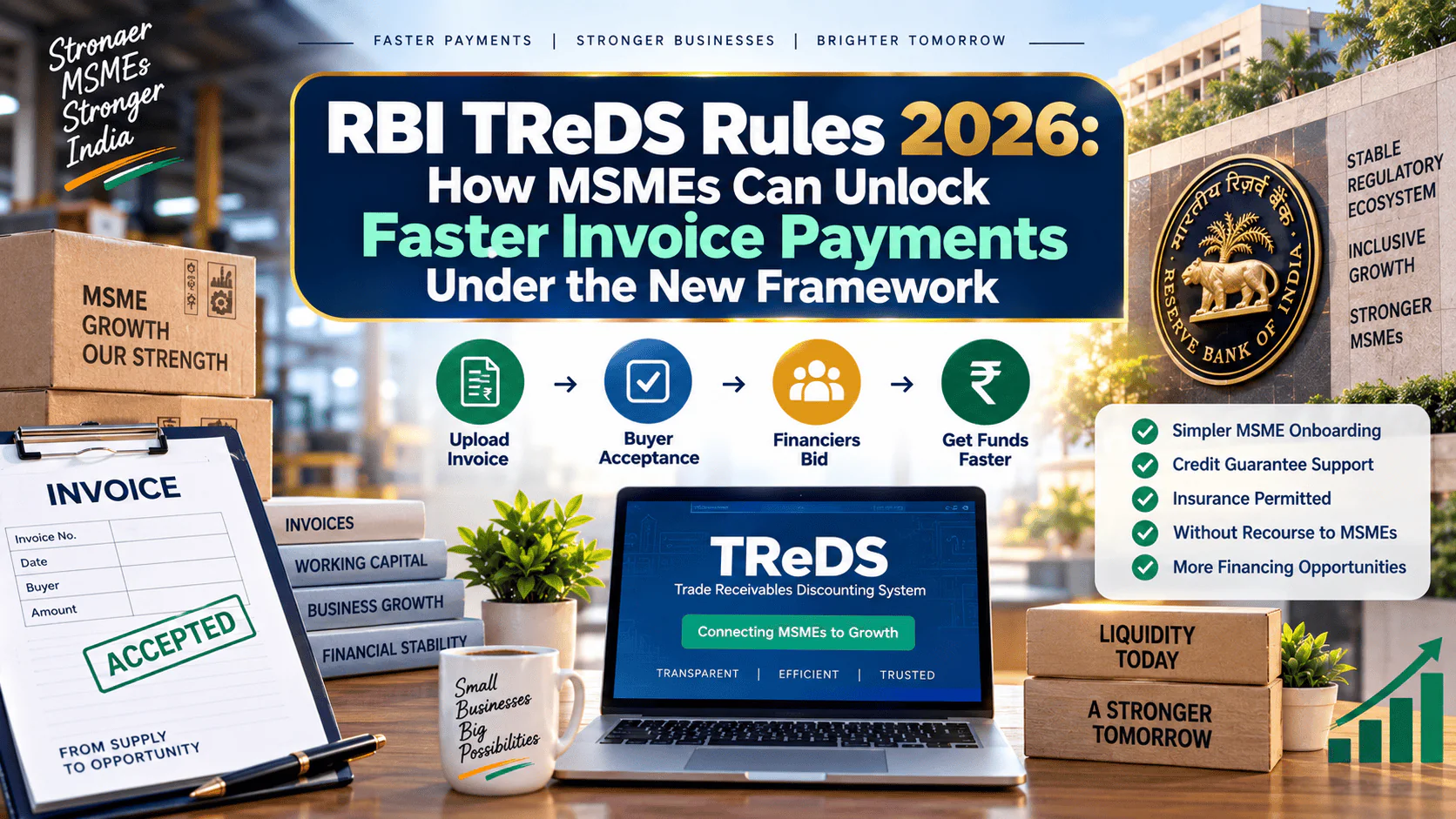
MSME supplies goods/services → invoice is raised → receivable is uploaded as a Factoring Unit → buyer accepts → financiers bid → MSME selects the financing offer → financier pays MSME → buyer pays financier on the due date.
ICAI’s MSME guidance similarly describes TReDS around the creation and acceptance of a Factoring Unit, financier bidding, payment to the MSME seller and eventual payment by the buyer.
The important point is that TReDS is not simply another loan application.
It is primarily a mechanism for financing eligible trade receivables.
Why the 2026 TReDS Directions Matter
Before the 2026 framework, TReDS requirements were spread across the original framework and subsequent regulatory changes.
RBI’s June 2026 Master Direction brings the applicable requirements into a consolidated framework.
RBI specifically highlighted three important objectives:
- rationalising and harmonising the TReDS framework;
- simplifying the onboarding process for MSME sellers; and
- revising capital requirements for TReDS operators.
The final directions also provide for greater flexibility for authorised TReDS entities to frame operational and procedural guidelines within the regulatory framework.
For businesses, the change matters because TReDS becomes easier to understand as a structured working-capital tool rather than a fragmented regulatory mechanism.
What Changed Under the TReDS Framework 2026?
The most relevant changes can be summarised as follows:
| Area | 2026 position |
|---|---|
| Governing framework | Consolidated RBI Master Direction |
| Effective date | 23 June 2026 |
| MSME seller onboarding | Mandatory seller due-diligence requirement removed |
| TReDS operator net worth | Minimum ₹25 crore |
| Existing operators | Time until 31 March 2028 to meet net-worth requirement |
| Credit guarantee | Financiers may obtain eligible guarantee cover |
| Insurance | Permitted for TReDS transactions, subject to RBI conditions |
| Insurance premium | Cannot be charged to the MSME seller |
| Re-discounting | Permitted subject to applicable RBI instructions |
| Financing structure | TReDS factoring remains without recourse to MSME sellers |
The directions apply primarily to authorised TReDS platforms and participants. They came into force immediately on 23 June 2026.
Who Can Use TReDS?
The seller side of TReDS is specifically designed around MSME sellers.
The buyer can be a corporate, government department, PSU or another eligible entity.
Financiers can include banks, NBFC-Factors and other permitted financial institutions.
RBI’s 2026 framework also recognises insurance companies and Government-notified credit guarantee fund trusts as participants in the relevant TReDS ecosystem.
A simplified participant structure is:
| Participant | Practical role |
|---|---|
| MSME seller | Supplies goods/services and holds receivable |
| Buyer | Accepts the invoice/obligation and pays on due date |
| Financier | Provides funds against the receivable |
| TReDS platform | Facilitates uploading, acceptance, bidding and settlement |
| Insurance company | May provide permitted insurance cover |
| Credit guarantee fund trust | May provide eligible guarantee support |
This makes TReDS particularly relevant for MSMEs selling regularly to large companies or institutional buyers.
Starting or Formalising Your MSME Business?
GST and Udyam (MSME) registration are important parts of setting up and formalising many Indian businesses. The registrations that apply can depend on your business structure, activity and circumstances.
If you are unsure which registrations your business may need, you can review the registration requirements and documentation with a professional before starting the application process.
GST & MSME Registration →What Is a Factoring Unit?
A Factoring Unit (FU) is the standard TReDS representation of a trade receivable in the system.
It can represent an invoice or bill of exchange relating to the MSME’s supply.
For example, suppose ABC Components, an eligible MSME, supplies components worth ₹18 lakh to XYZ Auto Ltd.
ABC raises an invoice for ₹18 lakh payable after 60 days.
Instead of simply waiting for the 60-day payment cycle, the transaction can be brought onto TReDS.
Once the buyer accepts the Factoring Unit, financiers can bid to finance it.
If a financier offers funding at an agreed discount, ABC can receive the funds earlier.
XYZ Auto Ltd then pays the financier on the due date.
This is one of the central practical advantages of TReDS.
Factoring and Reverse Factoring Are Both Possible
TReDS is not limited to a single transaction structure.
A Factoring Unit can be created by the MSME seller or by the buyer, depending on the arrangement.
When the MSME seller initiates the transaction, it is generally referred to as factoring.
When the buyer initiates the transaction, it is generally referred to as reverse factoring.
The underlying objective remains similar: financing a confirmed trade receivable through the TReDS mechanism.
ICAI’s MSME FAQ confirms that TReDS can facilitate both receivables factoring and reverse factoring.
The Most Important Feature: Financing Is Without Recourse to the MSME
This point deserves special attention.
Under TReDS, the discounted factoring unit is structured on a without-recourse basis to the MSME seller.
That means the MSME seller is not ordinarily expected to repay the financier merely because the buyer subsequently defaults.
The RBI framework expressly provides that factoring units discounted under TReDS are without recourse to the sellers.
Consider this example.
A small engineering company supplies ₹10 lakh of goods to a large corporate customer.
The invoice is accepted and discounted through TReDS.
The financier pays the MSME after applying the agreed discount.
Later, the buyer fails to make payment on the due date.
Under the TReDS structure, the financing is without recourse to the MSME seller.
That does not mean the transaction is risk-free for everyone. The buyer remains responsible for its payment obligation, and disputes, fraud, defective documentation or other contractual issues can still create complications.
But the credit risk associated with the buyer’s payment obligation is not simply pushed back onto the MSME seller.
That is one reason TReDS can be attractive to small suppliers.
RBI Has Simplified MSME Seller Onboarding
One of the notable 2026 changes is the removal of the mandatory due-diligence requirement for MSME sellers at the TReDS platform level.
This should not be misunderstood as saying that all compliance checks disappear.
The 2026 framework still requires the platform to put appropriate validation mechanisms in place, including mechanisms to ensure that the seller is an MSME and that funds due to the seller are credited to the seller’s bank account.
So the practical message is:
Less duplication does not mean no verification.
An MSME should still expect to provide correct registration, banking and business information and satisfy the platform’s applicable onboarding requirements.
Credit Guarantee Support for Financiers
Another important change is that financiers may obtain guarantee support for eligible TReDS factoring units from Government-notified credit guarantee fund trusts.
This can potentially improve the risk profile for financiers.
Why does that matter to an MSME?
Because greater financier participation can potentially improve competition for eligible receivables.
Suppose a ₹50 lakh invoice is accepted by a strong corporate buyer.
If several financiers are willing to bid for that receivable, the MSME may have an opportunity to compare the financing cost rather than accepting a single financing quote.
The actual rate will depend on the buyer, receivable, tenor, financier, market conditions and other commercial factors.
Therefore, MSMEs should not assume that TReDS financing is automatically cheaper than a cash-credit facility.
The right comparison is the effective cost of funds.
Insurance Is Also Permitted
The 2026 directions permit financiers to obtain insurance for TReDS transactions, subject to the prescribed conditions.
An important protection for MSME sellers is that the insurance premium cannot be charged to the seller.
If an MSME receives a commercial quote involving an unexplained insurance-related charge, it should ask the financier or platform to clearly identify the nature of the charge.
The contract and applicable platform terms should always be reviewed rather than relying on verbal explanations.
TReDS Operators Now Have a ₹25 Crore Net-Worth Requirement
The 2026 framework also rationalises the capital requirement for TReDS operators.
A new applicant must have a minimum net worth of ₹25 crore.
Existing authorised TReDS entities have time until 31 March 2028 to meet the prescribed net-worth requirement. The minimum net worth is required to be maintained on an ongoing basis.
This requirement primarily affects platform operators rather than ordinary MSME sellers.
For an MSME using TReDS, the practical takeaway is simply that the platform operates within a more clearly aligned regulatory and capital framework.
A Practical Example: How TReDS Can Improve Working Capital
Imagine a manufacturing MSME with the following monthly numbers:
| Particular | Amount |
|---|---|
| Monthly sales | ₹1.20 crore |
| Average credit period | 60 days |
| Receivables outstanding | ₹2.40 crore |
| Immediate operating requirement | ₹1.00 crore |
The business may be profitable, but ₹2.40 crore is sitting in receivables.
If a portion of eligible invoices can be financed through TReDS, the business can potentially bring cash forward instead of waiting for the entire 60-day cycle.
The MSME will incur a financing cost, so it should not think of TReDS as “free money”.
But if the financing cost is commercially reasonable and the funds allow the business to:
- purchase raw materials,
- accept additional orders,
- reduce expensive overdraft borrowing,
- pay suppliers on time, or
- avoid production delays,
the overall financial benefit can be meaningful.
The right question is therefore not:
“What is the discount rate?”
It is:
“What is the total cost of accelerating this receivable, and what return will the business generate from the released working capital?”
What MSMEs Should Check Before Discounting an Invoice
TReDS can improve liquidity, but the quality of the underlying invoice still matters.
Before putting receivables on the platform, the MSME should check:
1. Is the buyer’s acceptance clear?
An invoice that is disputed by the customer is very different from a clean, accepted receivable.
The seller should reconcile the invoice with the purchase order, delivery records and buyer’s acceptance.
2. Are there any commercial disputes?
If the buyer is disputing quantity, quality, pricing, warranty or delivery, financing the invoice may create complications.
3. Are GST documents consistent?
The tax invoice, GST records, e-invoice information where applicable, delivery documents and accounting records should tell the same story.
TReDS financing does not remove the seller’s normal GST compliance obligations.
4. Is the invoice genuinely outstanding?
The accounting ledger should agree with the amount placed on TReDS.
Old, cancelled, adjusted or already-settled invoices should not accidentally remain in the receivable pool.
5. What is the effective financing cost?
Compare the financing cost with:
- bank working-capital rates,
- overdraft cost,
- other invoice-financing products,
- supplier-credit benefits, and
- the commercial return expected from using the money.
6. What happens if the transaction is disputed?
Read the platform agreement and financier documentation carefully.
“Without recourse” should not be interpreted as a blanket waiver of every possible contractual obligation.
Accounting Treatment Needs Separate Attention
One area that businesses sometimes overlook is accounting.
TReDS financing is not automatically treated in the same way in every financial statement merely because money has been received early.
For entities applying Ind AS, the accounting treatment can depend on whether the transfer of the receivable qualifies for derecognition under the applicable financial-instrument requirements.
Ind AS 109 contains detailed derecognition principles for financial assets.
ICAI educational material also illustrates the distinction between factoring with recourse and without recourse for accounting purposes.
Therefore, a company should not simply pass an entry such as:
Bank Dr.
To Sales
when the actual transaction is financing of an existing receivable.
The original sale, receivable, financing/discounting cost and any applicable derecognition treatment need to be evaluated correctly.
For companies preparing financial statements under Ind AS, the finance and accounting team should review the contractual terms with the statutory auditor or accounting adviser.
Does TReDS Change GST on the Original Sale?
No.
TReDS is a mechanism for financing trade receivables. It does not by itself change the underlying supply transaction.
Suppose an MSME sells goods worth ₹10 lakh plus applicable GST to a customer.
The GST liability arises from the underlying supply according to the GST law and applicable timing rules.
If the receivable is subsequently discounted through TReDS, the financing arrangement does not turn the original supply into a different GST transaction merely because the money is received earlier.
The business should continue to maintain proper GST invoices, returns, e-invoice/e-way bill compliance where applicable, and reconciliation records.
This distinction is important because some businesses mistakenly think that invoice financing somehow changes the taxability of the original sale.
It does not.
TReDS and Income Tax: What Should Businesses Understand?
Similarly, TReDS does not create a new income-tax regime for the original business sale.
The MSME still recognises its business income and related receivable according to applicable accounting and tax principles.
The discounting or financing cost may have tax implications depending on the precise structure and applicable provisions.
However, businesses should not assume that every amount deducted by a financier automatically qualifies as a deductible business expense in every situation.
The accounting entry, contractual nature of the charge and applicable tax provisions should be reviewed before finalising the tax treatment.
For businesses with substantial TReDS activity, the finance team should maintain a clear reconciliation between:
- original sales,
- trade receivables,
- Factoring Units,
- amounts received from financiers,
- discounting/financing charges,
- buyer settlements, and
- bank entries.
That reconciliation becomes particularly important at year-end.
TReDS and MSME Payment Compliance
TReDS should also be considered alongside India’s broader framework governing payment timelines to MSMEs.
A business should not use invoice discounting as a substitute for proper vendor-payment discipline.
For buyers, accepting a Factoring Unit creates a serious payment obligation under the financing structure.
For sellers, TReDS can provide an additional route to improve cash flow without waiting for the normal customer credit period.
This is especially useful where the buyer is financially strong but the MSME supplier has limited working capital.
A Practical TReDS Checklist for MSMEs
Before using TReDS regularly, consider the following checklist:
Business and eligibility
- Confirm that the seller qualifies as an MSME.
- Keep MSME registration and business details updated.
- Ensure the bank account belongs to the eligible seller.
- Maintain accurate customer master data.
Invoice documentation
- Match invoice with purchase order.
- Verify delivery proof.
- Confirm buyer acceptance.
- Check GST and e-invoice records where applicable.
- Reconcile invoice with the accounts receivable ledger.
Financing
- Compare bids from available financiers.
- Calculate the effective financing cost.
- Check the financing period.
- Understand all platform and transaction charges.
- Review insurance-related terms.
- Understand what “without recourse” means under the actual documentation.
Accounting
- Record the transaction according to the applicable accounting framework.
- Review Ind AS 109 implications where relevant.
- Reconcile receivables after discounting.
- Track financing costs separately.
- Maintain year-end confirmations and supporting documents.
Tax and compliance
- Continue normal GST compliance.
- Continue proper income-tax accounting.
- Preserve invoices and supporting documents.
- Reconcile bank receipts with TReDS settlements.
- Ensure books, GST records and TReDS records agree.
Common Mistakes to Avoid
Treating TReDS as a normal bank loan
The commercial and accounting structure can be different. Read the documents before deciding how to record it.
Discounting disputed invoices
A receivable with unresolved commercial issues may create unnecessary complications.
Ignoring the financing cost
Getting money early is useful, but it comes at a price. Compare that price with alternative funding.
Assuming “without recourse” means “no responsibility”
The structure protects the MSME against certain buyer-default risks, but it does not excuse fraud, incorrect invoices, contractual breaches or other obligations.
Failing to reconcile the receivable ledger
Once an invoice is discounted, the accounts team must know exactly what has happened to that receivable.
Mixing GST and financing entries
The underlying sale and the subsequent financing arrangement should be separately understood and documented.
Frequently Asked Questions About TReDS Rules 2026
What is TReDS in India?
TReDS is an electronic system for facilitating financing of trade receivables of eligible MSME sellers through multiple financiers.
What changed in TReDS in 2026?
RBI issued the Trade Receivables Discounting System Directions, 2026 on 23 June 2026. The framework consolidated the regulatory requirements, simplified MSME seller onboarding, revised capital requirements for operators and permitted eligible credit-guarantee support and insurance arrangements.
From when are the new TReDS rules effective?
The 2026 directions are effective from 23 June 2026, unless a particular provision specifies otherwise.
Can a non-MSME company sell receivables through TReDS?
The seller side of TReDS is designed around MSME sellers. Businesses should verify their eligibility and the requirements of the authorised platform before attempting to use the facility.
Is TReDS financing without recourse?
Yes. The 2026 RBI framework states that factoring units discounted under TReDS are without recourse to the MSME sellers.
Can financiers obtain credit guarantees for TReDS transactions?
The 2026 framework permits financiers to avail eligible guarantees in respect of factoring units from Government-notified credit guarantee fund trusts, subject to the applicable requirements.
Can insurance be taken for TReDS transactions?
Yes. The framework permits financiers to avail insurance facilities for TReDS transactions, subject to specified conditions. The premium cannot be charged to the MSME seller.
Does TReDS change GST on the invoice?
No. TReDS is a financing mechanism for trade receivables. The underlying supply continues to be governed by applicable GST provisions.
Does TReDS automatically mean that the receivable is derecognised from the books?
Not necessarily. Accounting treatment depends on the contractual terms and the applicable accounting framework. For Ind AS entities, the derecognition requirements of Ind AS 109 need to be considered.
Is TReDS suitable for every MSME?
Not necessarily. It is particularly useful for MSMEs with genuine trade receivables from eligible and creditworthy buyers. Businesses should compare the financing cost with their other working-capital options before using it.
Key Takeaways
- RBI issued the Trade Receivables Discounting System Directions, 2026 on 23 June 2026.
- The framework is effective immediately from that date.
- TReDS helps eligible MSME sellers convert accepted trade receivables into earlier working capital.
- Factoring Units can be created through factoring or reverse-factoring structures.
- TReDS financing is designed to be without recourse to MSME sellers.
- MSME seller onboarding has been simplified by removing the mandatory seller due-diligence requirement at the platform level.
- TReDS platforms must still maintain appropriate validation mechanisms.
- Financiers may obtain eligible credit guarantee cover.
- Insurance arrangements are permitted, but insurance premiums cannot be charged to MSME sellers under the specified framework.
- TReDS operators are subject to a ₹25 crore minimum net-worth requirement, with existing operators getting time until 31 March 2028 to meet it.
- MSMEs should compare the effective financing cost before discounting invoices.
- Proper GST, accounting and receivable reconciliation remains essential.
- Ind AS entities should separately evaluate derecognition and financial-instrument accounting under Ind AS 109.
- TReDS should be viewed as a working-capital management tool, not simply as another form of borrowing.
Official Sources
For the latest regulatory position, businesses should rely primarily on RBI’s official publications and the applicable legal framework.
The governing document for the 2026 TReDS framework is the Reserve Bank of India (Trade Receivables Discounting System) Directions, 2026, issued under the Payment and Settlement Systems Act, 2007. The directions should be read together with the applicable contractual, accounting, tax and commercial requirements.
Conclusion
For an MSME, a profitable order is only useful when it eventually becomes cash.
Long customer credit periods can put a surprisingly heavy strain on an otherwise healthy business. TReDS provides a regulated mechanism for converting eligible trade receivables into working capital earlier, while allowing financiers to compete for those receivables.
The 2026 RBI framework makes the ecosystem more consolidated and introduces changes intended to simplify MSME participation and strengthen the financing side of the platform.
But the smartest approach is not to discount every invoice simply because the facility is available.
An MSME should first understand its receivables, verify buyer acceptance, compare the financing cost, maintain proper GST and accounting records, and understand the contractual consequences of the transaction.
Used properly, TReDS can become more than an emergency funding option. For businesses with regular B2B sales and predictable receivables, it can become a practical part of day-to-day working-capital management.