
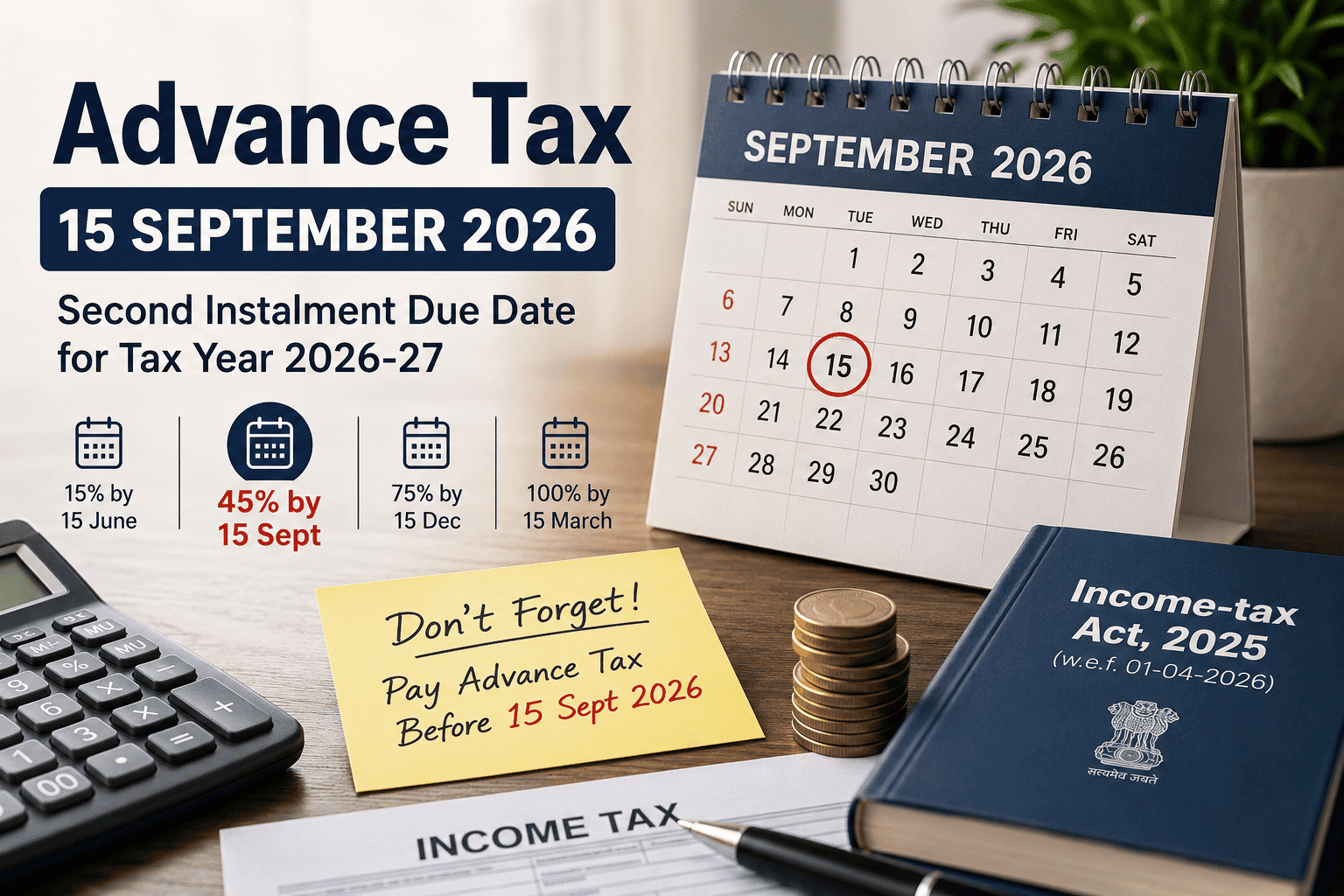
September is not just another month on the Indian tax calendar this year.
For taxpayers earning income during FY 2026-27, the second advance-tax instalment is due on 15 September 2026. More importantly, this is the first September advance-tax cycle being handled under the Income-tax Act, 2025, which came into force on 1 April 2026.
The Income Tax Department has specifically listed 15 September 2026 as the due date for the second instalment of advance tax for Tax Year 2026-27.
At first glance, not much appears to have changed. The familiar 15%-45%-75%-100% advance-tax schedule continues. The ₹10,000 threshold also remains. But the terminology has changed, the governing legislation has changed for income earned from FY 2026-27 onwards, and taxpayers now need to be careful about one important transition: FY 2025-26 / AY 2026-27 continues to be governed by the Income-tax Act, 1961, while FY 2026-27 is governed by the Income-tax Act, 2025.
That distinction matters when you are reviewing old tax computations, making payments, calculating interest or discussing tax positions with your accountant.
This article explains what taxpayers should do before 15 September 2026, how much advance tax is expected to be paid, who is covered, how to estimate the liability and what mistakes can create unnecessary interest later.
Need Help With Advance Tax?
Need help calculating advance tax, reviewing your tax liability or staying compliant with income-tax requirements? Our tax professionals can assist you.
Get Tax & Compliance Assistance →The important date: 15 September 2026
For ordinary taxpayers who are liable to pay advance tax, the second instalment is due on or before 15 September 2026.
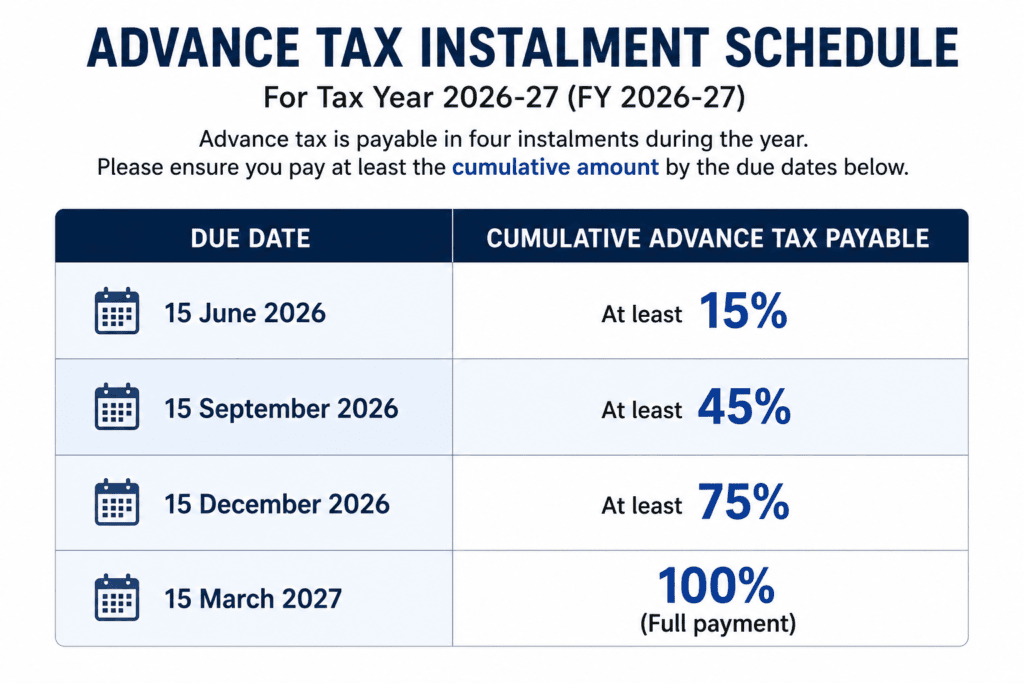
Under Section 408 of the Income-tax Act, 2025, the cumulative advance tax payable by 15 September should be at least 45% of the total advance-tax liability for the year, after reducing the amount already paid in the first instalment.
The complete schedule is:
| Due date | Cumulative advance tax payable |
|---|---|
| 15 June 2026 | At least 15% |
| 15 September 2026 | At least 45% |
| 15 December 2026 | At least 75% |
| 15 March 2027 | 100% |
This means the September payment is not necessarily 45% of your total tax again.
It is the amount required to bring your cumulative advance-tax payment up to 45%.
For example, if your estimated advance-tax liability for Tax Year 2026-27 is ₹2,00,000 and you paid ₹30,000 in June, your September payment would generally be:
- Total required by September: ₹90,000
- Already paid: ₹30,000
- September instalment: ₹60,000
The Income Tax Department’s transition FAQ confirms that the quarterly instalment dates and percentages remain unchanged under the new Act.
What changed with the Income-tax Act, 2025?
The biggest change is not the percentage schedule.
The Income-tax Act, 2025 came into force on 1 April 2026, replacing the Income-tax Act, 1961 for the new tax framework. CBDT stated that the new Act is intended to simplify and modernise the legislation, while retaining the underlying tax policy in many areas. The Income-tax Rules, 2026 and corresponding forms were also notified to operationalise the new framework.
Advance tax is a good example of a provision where taxpayers should understand the new numbering without assuming that the basic tax mechanics have been reinvented.
Under the new Act:
- Section 404 deals with the liability to pay advance tax.
- Section 405 deals with computation.
- Section 406 covers payment by the taxpayer on their own accord.
- Section 408 prescribes instalments and due dates.
The Department has expressly clarified that there are no policy changes to advance-tax payment provisions merely because the new Act has come into force.
The important conceptual change is that the new law uses the term Tax Year rather than the old Assessment Year framework for the relevant current-year income.
So, for income earned during FY 2026-27, you are dealing with Tax Year 2026-27 under the Income-tax Act, 2025.
Do not confuse FY 2025-26 with FY 2026-27
This is perhaps the most important point for taxpayers and professionals dealing with the 2026 transition.
There are two different situations:
| Income period | Relevant terminology | Governing law |
|---|---|---|
| FY 2025-26 | AY 2026-27 | Income-tax Act, 1961 |
| FY 2026-27 | Tax Year 2026-27 | Income-tax Act, 2025 |
The fact that you may be paying tax or filing something during FY 2026-27 does not automatically mean that the Income-tax Act, 2025 applies to the underlying income.
CBDT’s transition FAQ specifically explains that tax obligations are linked to the tax year to which the income relates. Advance-tax obligations for FY 2025-26 arose under the 1961 Act, while advance tax relating to income earned during FY 2026-27 is governed by the 2025 Act.
This distinction becomes especially relevant when a taxpayer is looking at:
- outstanding tax for FY 2025-26;
- self-assessment tax for AY 2026-27;
- advance tax for FY 2026-27;
- interest arising from an earlier year’s short payment;
- old tax challans;
- capital gains earned before 1 April 2026; or
- tax computations prepared under the previous law.
A simple rule is useful:
First identify the year in which the income arose. Then identify the law applicable to that income.
Do not decide the applicable Act merely by looking at the date on which you are making the payment.
Who needs to pay advance tax?
Under Section 404 of the Income-tax Act, 2025, advance tax becomes payable when the amount of tax payable during the financial year, as computed under the relevant provisions, is ₹10,000 or more.
The ₹10,000 threshold has not been increased merely because the new Act has started.
In practical terms, advance tax can become relevant to:
- salaried individuals with substantial income outside salary;
- professionals;
- freelancers;
- consultants;
- business owners;
- partners receiving taxable income;
- investors with taxable capital gains;
- landlords with significant taxable rental income;
- NRIs having taxable income in India;
- companies and other entities.
A common misconception is that salaried taxpayers never have to pay advance tax.
That is not correct.
If an employer’s TDS does not adequately cover the employee’s final tax liability—for example, because the employee earns significant interest income, capital gains, rental income or other taxable income—the taxpayer may have an advance-tax exposure.
What exactly should you calculate before 15 September?
Do not simply look at your June payment and repeat a percentage.
Instead, prepare a fresh estimate of your full-year taxable income for FY 2026-27.
Your calculation should broadly consider:
- Salary or professional income earned or expected.
- Business profits.
- Interest income.
- Rental income.
- Dividend income.
- Capital gains.
- Other taxable income.
- Eligible deductions or exemptions, where applicable.
- Tax already deducted or collected.
- Advance tax already paid.
This is particularly important for taxpayers whose income changes during the year.
A business may have had a weak April-to-June quarter and a strong July-August quarter. An investor may have sold shares at a substantial profit in August. A consultant may have received a large professional fee after June.
The advance-tax computation should reflect the current estimate, not blindly follow an old spreadsheet.
The new Act itself permits a taxpayer who has already paid an instalment to increase or reduce the amount payable in the remaining instalments to align with the estimated current income and advance-tax liability.
A practical example for a salaried taxpayer
Suppose Rahul is a salaried employee.
His employer deducts TDS from salary, but Rahul also earns:
- ₹1,20,000 interest from fixed deposits;
- ₹80,000 interest from savings and other deposits;
- ₹2,00,000 taxable capital gains during the year.
After considering his salary TDS and other relevant tax credits, Rahul estimates that his net advance-tax liability for FY 2026-27 is ₹1,00,000.
Assume he paid ₹15,000 by 15 June.
By 15 September, cumulative advance tax should reach at least:
45% × ₹1,00,000 = ₹45,000
Since Rahul has already paid ₹15,000, the September instalment would be:
₹45,000 − ₹15,000 = ₹30,000
The calculation is simple.
The difficult part is arriving at a sensible full-year tax estimate.
What if your income increased after June?
This is where advance tax becomes a practical exercise rather than a fixed calendar payment.
Suppose a professional estimated taxable income of ₹12 lakh in June and calculated advance tax accordingly.
By September, two major clients have paid additional fees and the professional now expects taxable income of ₹20 lakh for the year.
Continuing to pay advance tax based on the June estimate could leave a substantial shortfall.
The better approach is to recompute the full-year liability before the September instalment.
The Income Tax Department expressly states that a taxpayer may increase or reduce the amount payable in subsequent instalments so that the payments correspond with the estimated current income and advance-tax liability.
In other words, June’s estimate is not carved in stone.
What if income has fallen?
The same principle works in the other direction.
Suppose a business expected taxable profits of ₹30 lakh in June but by August has suffered a significant fall in sales and now expects taxable profits of only ₹15 lakh.
The taxpayer should not mechanically calculate September tax using the old ₹30 lakh estimate.
A revised estimate can be prepared based on the current position, while keeping proper records supporting the assumptions.
This is one reason advance-tax working papers should be updated throughout the year.
Capital gains can create a surprise tax bill
Investors should pay particular attention before September.
Salary and business income are usually easier to estimate because they arrive periodically. Capital gains are different.
A taxpayer can go through several months with no taxable capital gain and then sell a property, mutual fund investment or securities at a significant profit.
For someone who normally relies on TDS to cover most of their tax, that transaction can suddenly create an advance-tax liability.
Consider an investor who earns salary throughout the year and receives regular TDS deductions. In August, the investor sells an investment and realises a significant taxable capital gain.
The correct response is not to wait until the income-tax return is filed.
The taxpayer should assess whether the transaction has created additional tax payable and incorporate the resulting liability into the remaining advance-tax instalments.
The exact tax treatment of the capital gain will depend on the asset, acquisition and transfer dates, applicable provisions and the tax regime governing the transaction. Therefore, taxpayers should not apply a generic capital-gains rate without checking the specific transaction.
Business owners should review GST and income-tax numbers separately
For businesses, another common mistake is assuming that GST turnover and taxable income are the same thing.
They are not.
GST records can be useful for estimating business activity, but income-tax advance tax is ultimately concerned with taxable income under income-tax law.
A business owner preparing the September advance-tax calculation should therefore review:
- sales;
- gross profit;
- operating expenses;
- depreciation;
- interest;
- disallowable expenses;
- related-party transactions;
- capital expenditure;
- other income;
- tax deducted at source;
- advance tax already paid.
A GST return may help identify revenue trends, but it should not simply be copied into an income-tax computation.
Presumptive taxpayers have a different payment pattern
Taxpayers using the presumptive taxation provisions should not automatically apply the normal four-instalment schedule.
Section 408(2) of the Income-tax Act, 2025 provides that an assessee declaring profits under the specified presumptive provisions of Section 58(2) is required to pay the whole advance-tax amount on current income on or before 15 March of the relevant financial year.
This is an important distinction for eligible taxpayers under presumptive taxation.
Therefore, before making a September payment, check whether your income is actually being computed under a presumptive scheme covered by the relevant provision.
Do not assume that every business or professional taxpayer has to follow the same payment timetable.
What about NRIs?
NRIs can also have advance-tax obligations in India.
The key question is not simply whether a person is an NRI. The relevant issue is whether the person has taxable income in India and whether the resulting tax payable meets the advance-tax conditions after considering applicable TDS and other credits.
For example, an NRI may have:
- rental income from Indian property;
- capital gains from Indian investments;
- interest income;
- business or professional income taxable in India;
- other Indian-source income.
TDS may cover part of the liability, but it does not automatically eliminate advance-tax obligations in every situation.
NRIs should also be particularly careful with capital gains and tax deducted on property-related transactions because the amount actually received and the final tax liability are not always identical.
Where a Double Taxation Avoidance Agreement is relevant, the analysis may require additional consideration.
How much should you pay if your estimate is uncertain?
This is a very real question.
Many taxpayers do not know their exact annual income in September.
A business owner cannot know the final March profit with certainty. An investor cannot know whether another investment will be sold. A professional may have fees that are still under negotiation.
The answer is not to wait for perfect information.
Instead, prepare a reasonable current estimate using the information available.
For a business, this could mean using year-to-date results plus a reasonable projection for the remaining months.
For an employee, it could mean taking expected salary and known additional income.
For an investor, it could mean including realised taxable gains already known and adjusting later if more transactions occur.
The law’s structure itself recognises that estimates can change during the year.
What happens if you underpay advance tax?
Underpayment can result in interest.
The Income Tax Department’s transition FAQ states that the interest provisions under the new Act retain the earlier framework, including interest for failure to pay sufficient advance tax and interest for deferment of instalments.
For the relevant provisions under the new Act:
- Section 424 corresponds broadly to the earlier Section 234B framework.
- Section 425 corresponds broadly to the earlier Section 234C framework.
The Department’s FAQ states that the applicable interest rate remains unchanged at the relevant rate of 1% per month or part of a month for the specified defaults.
This is why a taxpayer should not treat advance tax as an optional payment simply because the return will be filed later.
The return is where the final liability is determined.
Advance tax is about paying the tax during the year in which the income is earned.
An important point about TDS
Before calculating advance tax, check your expected TDS.
Suppose your estimated gross tax liability is ₹3,00,000, but you expect ₹2,20,000 to be correctly deducted as TDS.
The amount that needs to be covered through advance tax may be substantially lower than ₹3,00,000.
However, do not rely on a TDS figure merely because it appears in an old salary statement or because someone told you that TDS “will be deducted”.
Check the expected deduction and, where available, reconcile it with the relevant tax information.
A practical advance-tax worksheet should therefore include a separate line for:
Estimated tax liability − expected eligible TDS/TCS and other applicable credits = estimated advance-tax requirement.
The exact computation can be more detailed depending on the taxpayer and income sources.
The new tax regime matters for individual taxpayers
For individuals and HUFs, the tax regime selected or applicable can materially affect the tax computation.
For AY 2026-27, the new tax regime under the earlier Section 115BAC framework had revised slabs, including a nil rate up to ₹4 lakh and subsequent slabs at 5%, 10%, 15%, 20%, 25% and 30%.
However, do not automatically use the AY 2026-27 slab table for income earned in FY 2026-27.
The 2026 transition requires taxpayers to distinguish between the old Act’s AY 2026-27 computation and the new Act’s Tax Year 2026-27 framework.
When preparing an advance-tax calculation now, use the applicable provisions and rates for the relevant Tax Year rather than copying last year’s return computation.
This is one of the easiest mistakes to make during the first year of the new law.
A simple September advance-tax checklist
Before 15 September 2026, a taxpayer can use the following checklist.
Step 1: Identify the correct year
Confirm that the calculation relates to:
FY 2026-27 / Tax Year 2026-27
and not FY 2025-26 / AY 2026-27.
Step 2: Estimate total income
Bring together expected income from:
- salary;
- business;
- profession;
- house property;
- interest;
- dividends;
- capital gains;
- other taxable sources.
Step 3: Review tax deductions and exemptions
Apply only those deductions, exemptions and allowances that are actually available under the applicable tax regime and law.
Step 4: Calculate estimated tax
Calculate tax using the provisions applicable to Tax Year 2026-27.
Step 5: Reduce relevant tax credits
Consider TDS, TCS and other credits that are legitimately available.
Step 6: Check June payment
Verify the actual advance tax paid on or before 15 June 2026.
Do not rely only on memory.
Step 7: Calculate the September requirement
Bring cumulative advance tax paid up to at least 45% of the estimated advance-tax liability, subject to the applicable provisions.
Step 8: Preserve the working
Save the calculation, assumptions, supporting documents and challan.
This becomes particularly valuable if your estimate changes later.
Common mistakes taxpayers should avoid
Copying last year’s advance-tax calculation
Tax rates, income and transactions change.
Last year’s spreadsheet is a starting point—not this year’s answer.
Treating TDS as the final tax liability
TDS is a mechanism for collection of tax. It does not necessarily equal your final tax liability.
Ignoring capital gains
A single sale can materially change the year’s tax position.
Forgetting interest income
Bank and deposit interest is often overlooked because it is not part of salary.
Mixing AY 2026-27 and Tax Year 2026-27
This is especially risky during the 2026 transition.
Assuming September means paying exactly 45%
The September requirement is about reaching the cumulative 45% level, after adjusting for the June payment.
Ignoring revised estimates
If your income changes materially after June, update the remaining instalments.
What should businesses do before the deadline?
For companies, firms and larger businesses, September advance tax should be treated as part of the monthly tax-compliance review rather than a last-minute payment.
Finance teams should ideally reconcile:
- year-to-date profit;
- forecast for the balance year;
- depreciation;
- disallowances;
- TDS/TCS;
- previous advance-tax payments;
- special-rate income;
- capital gains;
- tax incentives or deductions;
- applicable corporate tax provisions.
A useful control is to compare the September computation with the previous forecast and document the reasons for any major movement.
For example:
June forecast: taxable profit ₹1.5 crore
August revised forecast: taxable profit ₹2.1 crore
The increase should be explainable through actual business data.
That kind of documentation makes future tax review much easier.
What if you miss 15 September?
Missing the due date should not be treated as a reason to stop paying.
If the payment is delayed or insufficient, calculate the amount required and make the payment as soon as possible, while assessing the applicable interest consequences.
The precise interest impact depends on the nature and extent of the shortfall and the applicable statutory provisions.
If the issue is significant, particularly for a company, professional or taxpayer with substantial capital gains, it is sensible to have the tax computation reviewed rather than making a random payment simply to “clear the deadline.”
Frequently asked questions
Is 15 September 2026 an important income-tax deadline?
Yes. The Income Tax Department’s current tax calendar identifies 15 September 2026 as the due date for the second advance-tax instalment for Tax Year 2026-27.
How much advance tax must be paid by 15 September?
For taxpayers following the normal instalment schedule, cumulative advance tax should generally be at least 45% of the total advance-tax liability by 15 September.
Does this mean I pay 45% again in September?
No. The target is cumulative. If you already paid 15% in June, the September payment normally brings your cumulative payment up to 45%.
Has the advance-tax percentage schedule changed under the Income-tax Act, 2025?
No major policy change has been made to the advance-tax instalment schedule. CBDT’s transition FAQ confirms the 15%, 45%, 75% and 100% cumulative schedule.
Is the ₹10,000 advance-tax threshold still applicable?
Yes. Section 404 of the Income-tax Act, 2025 provides for advance tax where the tax payable during the year, as computed under the relevant provisions, is ₹10,000 or more.
I am a salaried employee. Do I need to pay advance tax?
Possibly. If your TDS sufficiently covers your tax liability, there may be little or no additional advance tax to pay. But substantial interest, rental income, capital gains or other income can create an additional liability.
I paid advance tax in June but my income has increased. What should I do?
Recalculate your expected full-year tax liability and adjust the remaining instalments accordingly. The new Act expressly permits taxpayers to increase or reduce later instalments based on the current estimate.
Does the Income-tax Act, 2025 apply to FY 2025-26?
No. For FY 2025-26 / AY 2026-27, the Income-tax Act, 1961 remains relevant. The new Act applies to the new tax-year framework beginning from 1 April 2026.
What is the advance-tax deadline for presumptive taxpayers?
Eligible taxpayers covered by the specified presumptive provisions generally pay the whole advance-tax amount by 15 March rather than following the normal four-instalment schedule.
Can capital gains create an advance-tax liability?
Yes. Taxable capital gains can increase your overall tax liability, and investors should review realised gains during the year instead of waiting until return filing.
Official sources
For the most reliable information, taxpayers should rely on the Income Tax Department and CBDT’s official resources, particularly during the 2026 transition.
- Income Tax Department – Tax Services and Tax Calendar
- Section 404 – Conditions of liability to pay advance tax
- Section 408 – Instalments of advance tax and due dates
- Income-tax Act, 2025 – CBDT transition and implementation information
Taxpayers should verify the applicable provision, tax rate, credit and deadline from the latest official material before making a substantial payment, particularly where the income involves capital gains, international transactions, special-rate income or complex business structures.
Key takeaways
- 15 September 2026 is the second advance-tax instalment deadline for Tax Year 2026-27.
- Normal taxpayers should generally have paid at least 45% cumulatively of their estimated advance-tax liability by that date.
- The ₹10,000 threshold continues under Section 404 of the Income-tax Act, 2025.
- The basic advance-tax schedule has not been changed by the transition to the new Act.
- FY 2025-26 / AY 2026-27 and FY 2026-27 / Tax Year 2026-27 must be treated separately.
- Salary TDS does not automatically eliminate an advance-tax obligation.
- Capital gains, interest, rental income and additional professional or business income can create a shortfall.
- If your income has changed significantly since June, update your estimate rather than blindly following the earlier calculation.
- Presumptive taxpayers covered by the relevant provisions generally follow the separate 15 March payment rule.
- Keep the computation and payment evidence safely for future reconciliation.
Conclusion
The September advance-tax deadline is routine in the calendar, but 2026 is not a routine year for income-tax compliance.
India has moved from the Income-tax Act, 1961 to the Income-tax Act, 2025 for income arising from FY 2026-27, while taxpayers are simultaneously dealing with returns and other obligations connected with the previous year’s income under the old framework.
The good news is that advance tax itself has not been turned upside down. The familiar 15%-45%-75%-100% structure remains, and CBDT has specifically said that there is no policy change in the advance-tax mechanism.
The practical lesson is simple: before 15 September, stop looking only at what you paid in June and look at what you now realistically expect to earn for the entire year.
For a salaried person, that may mean adding interest or capital gains. For a professional, it may mean updating fee estimates. For a business, it may mean revisiting projected profits. For an NRI, it may mean reviewing Indian-source income and TDS. For an investor, it may mean accounting for a recently realised gain.
A well-prepared September advance-tax calculation is not merely about avoiding interest. It gives you a much clearer picture of your actual tax position well before the year ends.