The Income Tax Department’s scrutiny process is becoming increasingly data-driven, and taxpayers should not assume that a return is safe from detailed examination merely because it has been filed correctly and the tax has been paid.
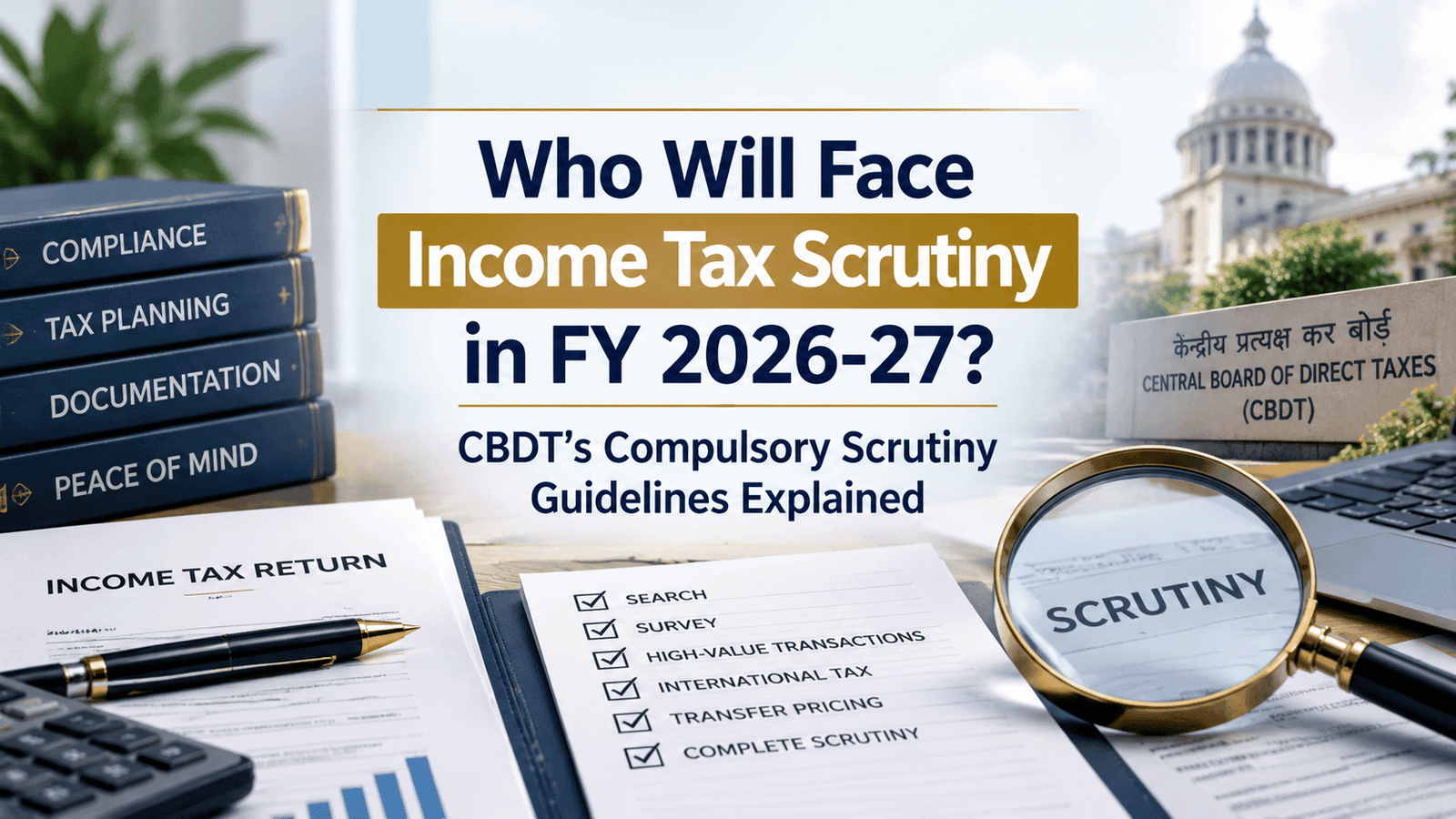
For Financial Year 2026-27, the Central Board of Direct Taxes (CBDT) has issued guidelines identifying categories of income-tax returns that are subject to compulsory selection for complete scrutiny. The guidelines were issued on 4 June 2026 and operate in the transition period where returns filed under the Income-tax Act, 1961 are being dealt with alongside the new Income-tax Act, 2025 framework.
This does not mean that every taxpayer falling into one of these categories has done something wrong. Compulsory selection is a departmental selection mechanism. It means that specified cases are required to be considered for complete scrutiny under the parameters prescribed by CBDT.
For businesses, professionals, high-value taxpayers and taxpayers involved in search, survey, international taxation or certain specified transactions, understanding these parameters can help in preparing documentation before a scrutiny notice arrives.
The important question is therefore not simply, “Will my return be selected?”
A better question is:
“If my return is selected, are my books, disclosures, tax positions and supporting documents strong enough to explain every significant item?”
What Is Compulsory Scrutiny?
Income-tax scrutiny is a detailed examination of a taxpayer’s return and related information by the Income Tax Department.
In a normal return-filing process, the taxpayer submits the return and the department processes it according to the applicable procedure.
Scrutiny is different.
Under scrutiny, the tax authorities may examine particular issues, supporting documents, books of account, deductions, income disclosures, transactions and other relevant information.
A complete scrutiny is broader than a limited or issue-specific examination.
CBDT’s annual scrutiny guidelines identify circumstances in which cases are mandatorily selected under specified parameters.
The 2026-27 guidelines specifically prescribe parameters for compulsory selection of returns for complete scrutiny during FY 2026-27.
This is important because taxpayers sometimes misunderstand the term “compulsory scrutiny.”
It does not mean:
- the taxpayer has been found guilty;
- tax evasion has already been established;
- additional tax is automatically payable;
- every transaction is considered suspicious; or
- the taxpayer will definitely face an adverse assessment.
It means the case falls within a category that CBDT has identified for compulsory selection according to the prescribed procedure.
Why Should Taxpayers Pay Attention to the 2026-27 Guidelines?
The scrutiny guidelines matter because they provide taxpayers and professionals with an indication of the types of cases receiving heightened attention.
For example, cases involving:
- search and seizure;
- surveys;
- information indicating tax evasion;
- specific financial or tax-risk situations;
- international taxation issues;
- transfer-pricing matters; and
- certain information-based risk parameters
can receive special treatment under the scrutiny-selection framework.
This does not mean that taxpayers should change legitimate tax positions merely to avoid scrutiny.
Instead, the correct response is better documentation.
If a transaction is genuine, properly recorded and supported by evidence, scrutiny becomes a process of explaining the position rather than defending an unexplained transaction.
FY 2026-27 and the Income-tax Act, 2025: An Important Transition
The 2026-27 scrutiny guidelines are particularly interesting because India is moving from the Income-tax Act, 1961 to the Income-tax Act, 2025.
The CBDT’s June 2026 guidelines state that the parameters apply to returns filed during FY 2025-26 under the Income-tax Act, 1961 and are issued pursuant to the relevant transition provision under the Income-tax Act, 2025.
Therefore, taxpayers should not casually use the words “AY 2026-27,” “FY 2026-27” and “Tax Year 2026-27” interchangeably.
The applicable year and law should always be identified before taking a tax position.
For example:
| Period | Broad framework |
|---|---|
| FY 2025-26 | Income-tax Act, 1961 framework |
| AY 2026-27 | Assessment relating to FY 2025-26 |
| FY 2026-27 | Transition into the new income-tax framework |
| Tax Year 2026-27 | New terminology/framework under the Income-tax Act, 2025 |
This distinction becomes particularly important in professional tax advice, tax notices, assessments and litigation.
Search and Seizure Cases
One of the clearest categories under compulsory scrutiny relates to search and seizure cases.
Where a search or requisition falls within the prescribed statutory framework, the associated assessment and return positions can be subject to compulsory scrutiny according to the CBDT parameters.
Search-related cases are inherently high-risk from a documentation perspective because the department may possess information or material obtained during the search process.
A taxpayer should therefore not treat the filed return as the only relevant document.
The complete tax position may need to be supported through:
- books of account;
- bank statements;
- invoices;
- agreements;
- investment records;
- property documents;
- loan records;
- confirmations;
- stock records;
- digital records;
- explanations for seized material; and
- reconciliation statements.
Where search proceedings have occurred, professional review should generally begin much earlier than the receipt of a scrutiny notice.
Survey Cases Under Section 133A
Another important category relates to survey proceedings.
The 2026-27 guidelines specifically cover cases where a survey under section 133A of the Income-tax Act, 1961 has been conducted on or after 1 April 2024, subject to the parameters and exclusions specified in the guidelines.
This is important for businesses and professionals because a survey can result in information being gathered directly from business premises.
The department may obtain information concerning:
- sales;
- purchases;
- cash;
- stock;
- accounting records;
- digital systems;
- invoices;
- customer information;
- supplier information; and
- other business records.
If the subsequent income-tax return contains information that does not align with material found during the survey, the taxpayer may need to explain the difference.
That is why reconciliation is critical.
Taxpayers Should Reconcile Survey Information With Their Books
Consider a simple example.
A business reports annual turnover of ₹8 crore.
During a survey, the department obtains information indicating that certain sales invoices were generated outside the accounting system.
The taxpayer subsequently files a return based on the books.
At this point, the important question is not simply whether the taxpayer filed the return.
The important question is whether the taxpayer can explain:
- what those invoices represented;
- whether they were duplicated;
- whether they were cancelled;
- whether they related to another accounting period;
- whether the revenue was already included elsewhere; and
- how the GST and income-tax records reconcile.
A good reconciliation can sometimes resolve an apparent mismatch.
A weak or unsupported explanation can create a much larger issue.
Transfer Pricing and International Taxation
Businesses with international transactions should pay particular attention to scrutiny risk.
International taxation can involve multiple layers of documentation.
For example, an Indian company may have transactions with:
- a foreign parent company;
- an overseas subsidiary;
- an associated enterprise;
- a foreign group service provider;
- an overseas financing entity; or
- a related foreign distributor.
The tax treatment may involve transfer pricing, withholding tax, permanent establishment issues, treaty provisions or other international-tax questions.
The important point is that the accounting entry alone is usually not enough.
A transaction described as “management fee,” “technical services,” “royalty,” “interest” or “reimbursement” may require supporting evidence explaining its commercial and tax character.
Transfer Pricing Documentation Should Tell One Consistent Story
Suppose an Indian subsidiary pays ₹3 crore to its foreign parent for management and technical support.
The company has:
- a service agreement;
- invoices;
- bank payments; and
- an accounting entry.
That is a useful starting point.
But a scrutiny officer may reasonably ask:
- What services were actually provided?
- Who performed the services?
- Where were they performed?
- What evidence demonstrates receipt of services?
- How was the amount determined?
- Is the charge consistent with the agreement?
- Was withholding tax considered?
- Was the transaction reported correctly?
- Was the transfer-pricing analysis prepared?
- Does the expense benefit the Indian company?
The stronger the documentation, the easier it becomes to explain the transaction.
High-Risk Transactions Need Better Documentation
A common mistake among taxpayers is believing that scrutiny risk exists only where income has been deliberately concealed.
That is too narrow.
Large or unusual transactions can create questions even when they are completely legitimate.
Examples include:
- large unsecured loans;
- significant gifts;
- substantial property transactions;
- major capital gains;
- unusual business expenses;
- related-party transactions;
- foreign remittances;
- foreign assets;
- substantial deductions;
- large share transactions;
- unusual cash deposits; and
- significant changes in reported income.
The correct response is not to avoid legitimate transactions.
It is to maintain a clear documentary trail.
Capital Gains Can Require Detailed Supporting Records
Capital gains are another area where documentation can become extremely important.
Consider a taxpayer who sells an old property for ₹3 crore.
The taxpayer calculates the taxable capital gain after considering:
- purchase cost;
- improvement expenses;
- holding period;
- transfer expenses;
- applicable indexation or other relevant provisions;
- exemptions, if available; and
- reinvestment, where relevant.
If the tax return is selected for scrutiny, the taxpayer should be able to support the calculation.
Useful records may include:
- original purchase deed;
- payment evidence;
- stamp-duty records;
- improvement bills;
- architect or contractor invoices;
- sale deed;
- brokerage records;
- bank statements; and
- documents supporting any exemption claimed.
The calculation should also reconcile with the property transaction information available to the department.
Foreign Assets and Foreign Income Need Special Attention
Taxpayers with foreign assets or foreign income should be especially careful about disclosure.
A return can be selected for scrutiny for reasons that have nothing to do with the taxpayer intentionally hiding income.
For example, information from international reporting systems, financial institutions or other sources may not appear exactly as the taxpayer expects.
A taxpayer with:
- foreign bank accounts;
- overseas shares;
- foreign mutual funds;
- foreign employment income;
- foreign rental income;
- overseas brokerage accounts; or
- foreign company interests
should maintain detailed records.
This is particularly important because foreign-asset reporting can involve schedules and disclosures beyond simply reporting taxable income.
What Happens After a Scrutiny Notice?
Receiving a scrutiny notice does not automatically mean that the taxpayer owes additional tax.
The first step should be to understand the notice.
The taxpayer should identify:
- the assessment year or tax period;
- the provision under which the notice was issued;
- the issues mentioned;
- the information requested;
- the response deadline;
- the documents required; and
- the appropriate electronic response mechanism.
A common mistake is immediately uploading every available document without organising the response.
A better approach is to prepare an issue-wise response.
For example:
| Department’s query | Taxpayer’s response | Supporting document |
|---|---|---|
| Large unsecured loan | Explain lender and transaction | Confirmation + bank statement |
| Property sale | Explain capital gain calculation | Sale deed + computation |
| Foreign income | Explain source and tax treatment | Foreign statement + tax documents |
| Business expense | Explain commercial purpose | Invoice + agreement |
| Large deduction | Explain eligibility | Supporting certificates/documents |
This approach makes the response easier to understand.
Do Not Ignore a Scrutiny Notice
One of the worst approaches is simply not responding.
Even if the taxpayer believes the notice is incorrect, the matter should be addressed through the prescribed process.
Ignoring correspondence can create additional procedural complications.
A taxpayer who genuinely cannot respond within the required timeframe should examine the available procedural options rather than simply allowing the deadline to pass.
What Records Should Businesses Keep Ready?
Businesses should maintain a tax documentation folder throughout the year rather than attempting to reconstruct everything after receiving a notice.
At minimum, the file should include:
- trial balance;
- general ledger;
- audited financial statements;
- tax audit report, where applicable;
- GST returns;
- GST reconciliation;
- TDS returns;
- TDS certificates;
- bank statements;
- major sales invoices;
- major purchase invoices;
- fixed-asset records;
- loan confirmations;
- related-party agreements;
- expense supporting documents;
- payroll records;
- capital-gain documentation;
- foreign transaction records; and
- major tax computations.
This is particularly important for businesses with multiple branches or accounting systems.
GST and Income Tax Records Should Reconcile
A major practical area for businesses is reconciliation between GST and income-tax records.
For example, turnover reported in:
- financial statements;
- GST returns;
- GSTR-1;
- GSTR-3B;
- e-invoice data;
- e-way bill data; and
- income-tax returns
may not always be identical for legitimate reasons.
But differences should be explainable.
Consider a company with:
- financial-statement turnover of ₹50 crore;
- GST taxable turnover of ₹47 crore; and
- income-tax turnover of ₹50 crore.
There may be legitimate reasons for the difference, such as:
- exempt supplies;
- non-GST income;
- advances;
- credit notes;
- export transactions;
- accounting adjustments;
- valuation differences; or
- other classification issues.
The problem arises when the company cannot explain the difference.
Reconciliation Should Be Done Before Filing
Businesses should ideally prepare annual reconciliation before filing the income-tax return.
A useful reconciliation can include:
Books turnover
minus/plus:
- GST adjustments;
- credit notes;
- exempt supplies;
- export adjustments;
- other non-operating income;
- accounting classifications;
equals:
Turnover reported for tax purposes.
The exact reconciliation depends on the business.
The principle is simple: numbers reported to different government systems should be capable of being reconciled.
What Professionals Should Tell Clients About Scrutiny
Tax professionals should avoid frightening clients by saying:
“Your return will definitely be scrutinised.”
That is rarely an appropriate conclusion simply because a taxpayer falls within a risk category.
Instead, the discussion should focus on preparedness.
A better approach is:
- identify potential scrutiny triggers;
- review significant transactions;
- verify disclosures;
- reconcile tax data;
- document unusual items;
- confirm tax positions;
- maintain evidence; and
- prepare a response protocol.
This makes the process much more constructive.
Does Scrutiny Mean the Department Can Ask Anything?
The scope of examination depends on the nature of the proceedings and the notices issued.
A taxpayer should therefore read the notice carefully rather than assuming that every historical transaction will automatically become relevant.
At the same time, a taxpayer should not provide incomplete or misleading information merely because a particular item was not initially highlighted.
Responses should be accurate, complete and supported by appropriate documentation.
Common Mistakes During Scrutiny
Giving a Generic Reply
A response such as “all income is correctly disclosed” is rarely sufficient where the department has asked for specific evidence.
Uploading Documents Without Explanation
A large collection of files without an index or explanation can make the response harder to understand.
Contradicting the Books
The response should reconcile with the audited financial statements and return.
Ignoring GST Differences
A GST-versus-income-tax mismatch should be reviewed before submitting the response.
Providing Unsupported Explanations
An explanation without documentary evidence may not be persuasive.
Missing the Deadline
Procedural compliance matters just as much as substantive tax arguments.
How Salaried Individuals Should Prepare
Scrutiny is not limited to businesses.
Individuals can also have complex tax positions.
A salaried taxpayer with only salary income and standard deductions may have a relatively straightforward documentation profile.
But the situation changes where the taxpayer has:
- multiple properties;
- capital gains;
- foreign assets;
- foreign income;
- large investments;
- substantial deductions;
- business income;
- partnership income; or
- significant financial transactions.
Such taxpayers should retain supporting records even after the return has been filed.
A Practical Scrutiny-Readiness Checklist
Taxpayers can use the following checklist before the assessment process becomes an issue:
- Check that all income sources have been disclosed.
- Reconcile salary, interest and other income with available statements.
- Reconcile capital gains with broker or transaction statements.
- Review property transactions.
- Verify foreign income and foreign-asset disclosures.
- Check deduction eligibility.
- Reconcile GST and financial-statement figures for businesses.
- Reconcile TDS/TCS credits.
- Verify bank transactions.
- Maintain loan confirmations.
- Maintain evidence for major expenses.
- Keep related-party agreements.
- Review tax-audit disclosures.
- Maintain transfer-pricing documentation where relevant.
- Keep supporting documents for unusual transactions.
- Review prior-year tax positions where they affect the current year.
- Keep copies of filed returns and computations.
- Monitor the income-tax portal regularly.
What Should Businesses Do Now?
Businesses should not wait for a scrutiny notice before reviewing their tax records.
A useful annual tax-health check can be performed in four stages.
Stage 1: Reconcile
Compare books with:
- GST;
- TDS;
- bank records;
- financial statements; and
- income-tax reporting.
Stage 2: Identify High-Risk Items
Look for:
- unusual expenses;
- large related-party transactions;
- significant loans;
- capital gains;
- foreign transactions;
- substantial deductions; and
- major changes from previous years.
Stage 3: Document
For every significant item, ask:
“If an assessing officer asks us to prove this transaction six months from now, can we produce the evidence?”
Stage 4: Review Tax Positions
Finally, review significant interpretations or positions taken in the return.
Where a position is debatable, the file should contain the legal basis and supporting reasoning.
Why Documentation Is Becoming More Important
Modern tax administration increasingly relies on information from multiple sources.
Income-tax authorities may have access to information relating to:
- financial transactions;
- securities;
- property;
- GST;
- TDS/TCS;
- foreign transactions; and
- other reporting systems.
This means that a return is increasingly being viewed alongside a broader information environment.
For taxpayers, the practical implication is straightforward:
Consistency matters.
The taxpayer’s return, books, GST records, bank statements and supporting documents should tell the same overall story.
Frequently Asked Questions
Does compulsory scrutiny mean I have committed a tax offence?
No. Compulsory selection means that the case falls within a prescribed selection parameter. It does not itself establish tax evasion or wrongdoing.
Who has issued the FY 2026-27 scrutiny guidelines?
The Central Board of Direct Taxes (CBDT) issued the guidelines for compulsory selection of returns for complete scrutiny during FY 2026-27. The guidelines were issued on 4 June 2026.
Are survey cases automatically scrutinised?
Specified survey-related cases fall within the compulsory-selection parameters, subject to the conditions, dates and exclusions contained in the CBDT guidelines.
Can a scrutiny notice result in additional tax?
It can, depending on what the assessment establishes. But the receipt of a scrutiny notice itself does not mean additional tax is automatically payable.
What should I do after receiving a scrutiny notice?
Read the notice carefully, identify the issues and deadline, collect the relevant evidence and prepare an issue-wise response through the prescribed process.
Should businesses reconcile GST and income-tax figures?
Yes. Differences can arise for legitimate reasons, but significant differences should be identifiable and explainable.
How long should taxpayers retain supporting documents?
Taxpayers should follow the applicable statutory record-retention requirements and, as a practical matter, retain important supporting documents for as long as they may be relevant to assessment, reassessment, litigation or other proceedings.
Does every high-income taxpayer face scrutiny?
No. Income level alone should not be treated as an automatic conclusion that a taxpayer will be selected for scrutiny. Selection depends on applicable parameters and departmental processes.
Key Takeaways
- CBDT has issued FY 2026-27 guidelines for compulsory selection of returns for complete scrutiny.
- The guidelines were issued on 4 June 2026.
- The framework is particularly relevant to specified search, survey and other prescribed risk categories.
- Compulsory scrutiny does not mean that tax evasion has already been established.
- Businesses with survey or search history should maintain strong supporting documentation.
- International transactions and transfer-pricing matters require particularly careful documentation.
- Capital gains, foreign assets and major financial transactions should be supported by clear evidence.
- GST, TDS, bank and income-tax records should be capable of reconciliation.
- A scrutiny notice should never be ignored.
- Taxpayers should respond issue-by-issue rather than uploading unorganised documents.
- Businesses should perform a tax-health check before receiving a notice.
- Good documentation can make a legitimate tax position significantly easier to explain.
- The transition between the Income-tax Act, 1961 and Income-tax Act, 2025 makes correct identification of the relevant year and law especially important.
Conclusion
CBDT’s compulsory scrutiny guidelines for FY 2026-27 are a useful reminder that tax compliance is no longer simply about filing a return before the deadline.
For businesses and individuals with complex financial affairs, the quality of the underlying records is becoming increasingly important.
A taxpayer may have a perfectly legitimate transaction, a valid deduction or a defensible tax position. But if the supporting documentation is missing, inconsistent or difficult to reconcile, responding to a scrutiny notice can become unnecessarily difficult.
The better approach is to prepare before the notice arrives.
Businesses should reconcile their GST, TDS, books and income-tax data. Investors should maintain transaction records. Taxpayers with foreign assets should maintain complete disclosure documentation. Companies with related-party or international transactions should maintain agreements and supporting evidence. And anyone involved in search or survey proceedings should take particular care with the resulting documentation.
The key lesson from the 2026 scrutiny guidelines is simple:
Resources
- Income Tax Department — Official e-Filing Portal
https://www.incometax.gov.in/ - Income Tax Department — ITR Utilities and Downloads
https://www.incometax.gov.in/iec/foportal/downloads/income-tax-returns