

The biggest direct-tax development to watch on is not another change to a tax slab or another return utility. It is the operationalisation of the Foreign Assets of Small Taxpayers Disclosure Scheme, 2026 (FADS 2026).
The Central Board of Direct Taxes has notified the detailed rules and prescribed forms through Notification No. 114/2026 dated 14 August 2026, and the Income Tax Department has now enabled Form 1 on the e-Filing Portal. The Department’s latest update dated 1 September 2026 specifically confirms that the prescribed Form 1 is available for filing.
This is important for a surprisingly broad group of people: returning NRIs, former NRIs, Indian residents holding overseas investments, people with old foreign bank accounts, employees who received foreign shares or ESOPs, families holding overseas property and taxpayers who disclosed the underlying income but forgot to disclose the foreign asset in the relevant return schedule.
The scheme is a one-time compliance window. It is not a general amnesty for every kind of foreign asset or foreign income, and it should not be treated as a substitute for professional review. But for taxpayers who genuinely fall within its statutory conditions, it can provide a structured route to regularise specified past non-disclosures.
The critical date is 31 December 2026.
Not sure how FADS 2026 applies to your situation? Eligibility can depend on your residential status, source of funds, history of foreign assets and the applicable valuation rules. If you have an overseas bank account, property, shares or other foreign assets, you can review your position and available tax and compliance services before taking any action.
What is the Foreign Assets of Small Taxpayers Disclosure Scheme 2026?
The scheme was introduced through the Finance Act, 2026, and the detailed rules were subsequently notified by CBDT Notification No. 114/2026.
The rules came into force on 16 August 2026. They prescribe the valuation methodology, eligibility thresholds, electronic forms and payment procedure. The Income Tax Department has subsequently enabled the scheme on its e-Filing Portal.
The basic idea is simple.
Suppose an eligible taxpayer has a foreign asset or foreign income that was not properly disclosed in the past. Instead of leaving the position unresolved indefinitely, the scheme provides a limited window to make a prescribed declaration and pay the amount specified by the scheme.
There are essentially two broad categories.
| Category | What it covers | Maximum aggregate value | Amount payable |
|---|---|---|---|
| Category 1 | Specified undisclosed foreign assets and/or undisclosed foreign income | ₹1 crore | 30% tax + amount equal to 100% of that tax |
| Category 2 | Certain foreign assets acquired while non-resident or from income already offered to Indian tax but not disclosed in the foreign-asset schedule | ₹5 crore | ₹1 lakh fee |
The ₹1 crore and ₹5 crore limits are aggregate limits, not limits applicable separately to each individual asset. The notified rules expressly require the relevant values to be aggregated for determining eligibility.
That distinction matters.
A person cannot assume that a ₹90 lakh foreign property and ₹30 lakh undisclosed foreign income are separately within the limit. For Category 1, the combined amount would be ₹1.20 crore, which exceeds the ₹1 crore ceiling.
The notification itself gives an illustration where ₹55 lakh of foreign bank-account value plus ₹25 lakh of foreign income results in an aggregate ₹80 lakh and therefore remains within the ₹1 crore threshold.
Why this scheme matters particularly to NRIs and returning Indians
One of the most useful features of FADS 2026 is that the expression “small taxpayer” should not be misunderstood as meaning somebody whose Indian taxable income is below a particular salary or business-income threshold.
The scheme is primarily concerned with the value of specified foreign assets and foreign income.
It can also be relevant to people who are no longer resident in India.
The Finance Act provisions defining the eligible assessee cover:
- a person who was resident in India in the relevant previous year; and
- in specified circumstances, a person who is now non-resident or not ordinarily resident but was resident in India in the previous year to which the relevant foreign income relates or in the previous year in which the undisclosed foreign asset was acquired.
That is particularly relevant for a common real-life situation.
Imagine an individual who worked in India until 2018, moved to the United States in 2019, and is now an NRI. During the earlier period of Indian residence, the person acquired or held a foreign investment which should have been disclosed but was missed in the relevant return.
The fact that the person is an NRI today does not automatically take the person outside the scheme.
The relevant historical residential status and the year of acquisition or earning need to be examined.
The prescribed Form 1 itself asks for the residential status during the year of acquisition of the asset or earning of the income, with options including Resident, Non-Resident and RNOR. Where a declarant claims non-resident status in any relevant year, passport details are also required.
The first major threshold: ₹1 crore does not mean ₹1 crore of foreign assets only
Category 1 covers specified undisclosed foreign assets and undisclosed foreign income.
The combined aggregate value must not exceed ₹1 crore.
This means a taxpayer could have both an undisclosed foreign asset and undisclosed foreign income and still fall within the scheme if the prescribed aggregate value remains within ₹1 crore.
For example:
Foreign bank account value: ₹55 lakh
Undisclosed foreign income: ₹25 lakh
Aggregate: ₹80 lakh
That is within the ₹1 crore threshold.
But consider:
Foreign property: ₹90 lakh
Undisclosed foreign income: ₹30 lakh
Aggregate: ₹1.20 crore
That exceeds the statutory ceiling and therefore does not qualify under Category 1. The CBDT’s own illustration makes this point.
This is why the first step should never be “How much tax do I have to pay?”
The first question should be:
What exactly is being disclosed, and what is the aggregate value under the statutory valuation rules?
The second category is very different
Category 2 is potentially more forgiving.
It covers certain foreign assets that were:
- acquired from income accruing or arising outside India while the taxpayer was non-resident, but were not subsequently disclosed in the relevant foreign-asset schedule after becoming resident; or
- acquired from income that had already been offered to tax under the Income-tax Act, 1961, but the foreign asset itself was not disclosed in the relevant schedule.
For this category, the aggregate value of the relevant foreign assets must not exceed ₹5 crore.
The prescribed amount is a ₹1 lakh fee, rather than the 30% tax plus an equal amount framework applicable to Category 1.
This distinction could be extremely important for returning NRIs.
Example: foreign property bought while the taxpayer was an NRI
Suppose Priya worked in Dubai for several years while she was non-resident in India. She purchased a property overseas from her foreign earnings.
After returning to India and becoming resident, she did not disclose the property in the applicable foreign-asset schedule.
If the asset otherwise falls within the statutory conditions and its relevant value does not exceed ₹5 crore, the transaction may potentially fall under Category 2.
The fact that the original money was earned while she was non-resident is therefore not a minor detail. It can fundamentally change the amount payable under the scheme.
Example: income already taxed in India
Suppose an Indian resident purchased foreign mutual-fund units from income that had already been offered to tax in India. The taxpayer subsequently omitted those units from the relevant foreign-asset disclosure schedule.
If the other statutory conditions are satisfied and the aggregate value remains within ₹5 crore, Category 2 may potentially apply.
The taxpayer should not simply assume that an omitted foreign asset automatically means a 60% effective cost.
The source of the money and the historical tax treatment matter.
How does the 60% effective amount under Category 1 work?
This is one of the most misunderstood parts of the scheme.
Category 1 is not accurately described as “a 60% tax rate”.
The statutory mechanism is:
- 30% tax on the relevant undisclosed foreign asset/foreign income; plus
- an amount equal to 100% of that tax.
The practical result is an amount equivalent to 60% of the relevant value, subject to the precise statutory computation.
The notified Form 1 reflects this by calculating the aggregate amount payable at 60% of the combined value for Category 1.
For example, if the relevant aggregate value is ₹80 lakh:
30% tax = ₹24 lakh
Additional amount equal to 100% of tax = ₹24 lakh
Total = ₹48 lakh
The CBDT’s notification uses essentially this example.
That is a substantial amount. So the scheme should not be viewed as a cheap voluntary disclosure route.
Its attraction is different: for a qualifying taxpayer, it can provide a statutory mechanism for regularisation together with immunity consequences after the prescribed declaration and payment requirements are properly completed.
What is the valuation date?
The valuation date is crucial.
The notified rules define the valuation date as 31 March 2026.
It does not matter that the taxpayer files Form 1 in September, October or December 2026.
The relevant asset valuation under the rules is generally anchored to 31 March 2026.
This can create some surprising results.
A foreign share portfolio that was worth ₹80 lakh on 31 March 2026 but is worth ₹1.10 crore by December 2026 does not simply become a ₹1.10 crore asset for the scheme because of the later market increase. The scheme’s prescribed valuation date remains 31 March 2026.
Conversely, a taxpayer should not casually use the original purchase price without checking the specific valuation rule.
How are foreign assets valued?
The rules provide detailed valuation mechanisms for different asset classes.
These include:
- foreign bank accounts;
- immovable property;
- bullion;
- jewellery;
- precious stones;
- artistic works;
- quoted shares and securities;
- unquoted equity shares;
- other unquoted securities;
- partnership or LLP interests; and
- other assets.
For many assets, the rules compare acquisition cost or indexed cost with a prescribed fair-market-value methodology.
Foreign currency conversion also matters.
Where the asset is denominated in a permitted foreign currency, the rules provide for conversion into Indian currency using the relevant Reserve Bank of India reference rate on the valuation date. For certain other currencies, the rules prescribe a two-stage conversion mechanism through US dollars.
For a foreign property, therefore, a taxpayer should not simply take an approximate online property price and convert it at today’s exchange rate.
The valuation methodology prescribed by Rule 3 of the notified rules must be followed.
Foreign bank accounts require special attention
Foreign bank accounts can be particularly difficult because the valuation rules do not simply ask for the closing balance on 31 March 2026.
For a foreign bank account, the rules generally look at the aggregate deposits made from the date the account was opened up to the valuation date, subject to the prescribed adjustments.
The notification even contains an illustration showing how deposits and withdrawals are treated for valuation purposes.
This means an old overseas bank account needs reconstruction.
A taxpayer should ideally obtain:
- account-opening documents;
- historical bank statements;
- deposit and withdrawal records;
- evidence of transfers between accounts;
- documents showing the source of funds; and
- evidence of any previous declaration or tax treatment.
If an account was opened 15 years ago, finding only the current statement is unlikely to be sufficient for a robust compliance exercise.
What about foreign shares and ESOPs?
This is another area where taxpayers should be careful.
Foreign shares, securities and ESOP-related holdings can involve multiple questions:
- When were the shares acquired?
- Were they purchased, allotted or received as part of employment?
- Was the underlying employment income taxed?
- Was tax withheld overseas?
- What was the taxpayer’s residential status when the shares were acquired?
- Were the shares disclosed in the appropriate foreign-asset schedule?
- Are the shares quoted or unquoted?
- What is the applicable valuation methodology?
- Is a valuation report required?
The notified rules contain separate mechanisms for quoted shares, unquoted equity shares and other unquoted securities.
This is particularly relevant to employees of multinational companies who may have accumulated foreign shares over several years without realising that the reporting obligation continued after returning to India.
The compliance process: Form 1 is only the beginning
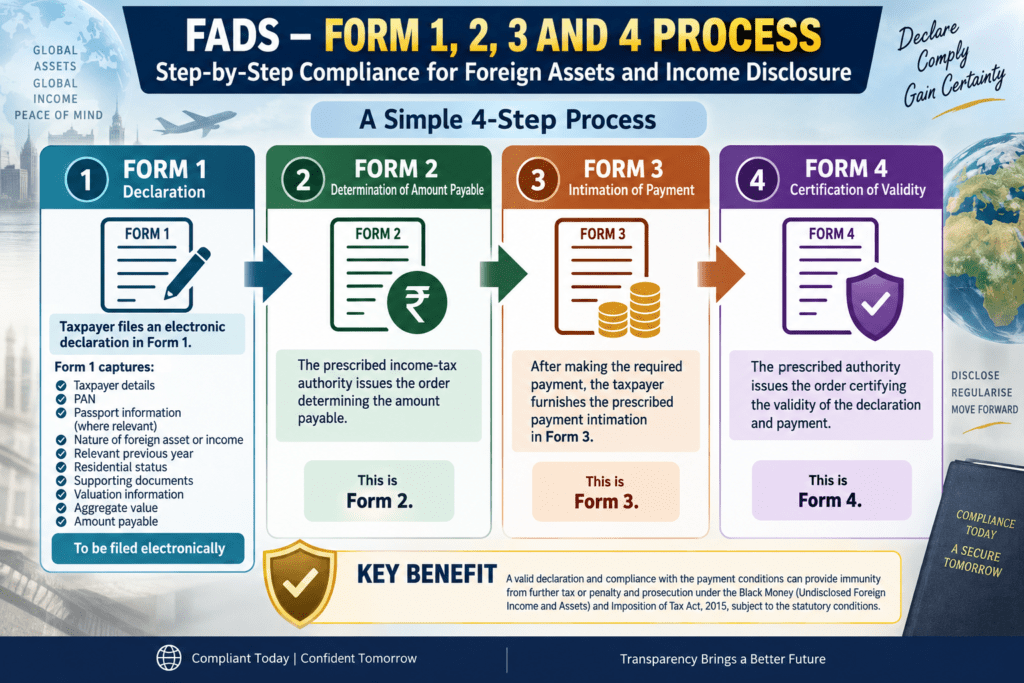
A common mistake would be to think that filing Form 1 completes the process.
It does not.
The notified framework provides a sequence involving Forms 1, 2, 3 and 4.
Form 1 — declaration
The taxpayer makes the electronic declaration in Form 1.
The form captures information such as:
- taxpayer details;
- PAN;
- passport information where relevant;
- nature of foreign asset or income;
- relevant previous year;
- residential status;
- supporting documents;
- valuation information;
- aggregate value; and
- amount payable.
The notification specifically provides for electronic filing.
Form 2 — determination of amount payable
After the declaration, the prescribed income-tax authority issues the order determining the amount payable.
This is Form 2.
Form 3 — intimation of payment
After making the required payment, the taxpayer furnishes the prescribed payment intimation in Form 3.
Form 4 — certification of validity
Finally, Form 4 is the order certifying the validity of the declaration and payment.
This final stage matters because the statutory immunity framework is linked to a valid declaration and compliance with the payment conditions. The notified Form 4 specifically refers to immunity from further tax or penalty and prosecution under the Black Money (Undisclosed Foreign Income and Assets) and Imposition of Tax Act, 2015, subject to the statutory conditions.
Do not leave payment until the last minute
There are actually two different dates to remember.
The first is the deadline for making the declaration:
31 December 2026.
The second is the payment deadline after the prescribed order determining the amount payable.
The notified rules provide that the amount is generally payable within two months from the end of the month in which the relevant Form 2 order is received.
If payment is made after that initial period, additional interest at 1% per month or part thereof applies, subject to the additional period specified by the rules. The additional period cannot simply be ignored; failure to comply within the permitted period can cause the declaration to become void.
Payments may also be made in parts, subject to the statutory framework.
This is one reason taxpayers should not wait until 30 or 31 December to begin the exercise.
The declaration deadline is not the only practical deadline.
A practical checklist before filing Form 1
Before making any declaration, a taxpayer should prepare a proper foreign-asset inventory.
Step 1: List every foreign asset
Include, as relevant:
- foreign bank accounts;
- overseas residential or commercial property;
- foreign shares;
- mutual funds;
- brokerage accounts;
- bonds;
- foreign partnership or LLP interests;
- jewellery;
- artwork;
- other specified foreign investments.
Do not rely solely on memory.
Review old tax returns, bank statements, broker statements, employment documents and passport records.
Step 2: Identify the relevant year
For each item, establish:
- year of acquisition;
- year in which income arose;
- residential status in that year;
- source of funds;
- whether the income was already offered to tax in India; and
- whether the asset was reported in the applicable return.
This step can determine whether Category 1 or Category 2 is relevant.
Step 3: Reconstruct the 31 March 2026 position
Obtain valuation evidence based on the prescribed rules.
For foreign securities, obtain appropriate market records.
For overseas property, consider whether a recognised valuation report is required.
For foreign bank accounts, reconstruct the relevant deposit history.
For foreign currency, apply the prescribed conversion mechanism rather than an arbitrary current exchange rate.
Step 4: Check the aggregate threshold
Calculate separately:
Category 1 aggregate: undisclosed foreign asset + undisclosed foreign income.
Category 2 aggregate: specified foreign assets falling within the relevant provisions.
Do not mix the categories casually.
Step 5: Check exclusions
The scheme is not available in every case.
The Finance Act expressly excludes, among other matters:
- income or assets representing, directly or indirectly, proceeds of crime where proceedings have been initiated or are pending under the Prevention of Money-laundering Act, 2002; and
- income or assets relating to an assessment year for which assessment proceedings have been completed under the Black Money (Undisclosed Foreign Income and Assets) and Imposition of Tax Act, 2015.
Pending assessment proceedings also require careful handling because the Finance Act provides for the declaration to be taken into account while finalising the relevant assessment.
This is not an area for guesswork.
Step 6: Keep documentary evidence
A good disclosure file should ordinarily contain:
- passport and immigration history where relevant;
- overseas bank statements;
- property purchase documents;
- broker statements;
- share acquisition records;
- ESOP/grant documents;
- foreign tax documents;
- Indian ITRs;
- proof of taxes already paid;
- valuation reports;
- exchange-rate workings; and
- computation of the amount payable.
The stronger the documentation, the easier it is to explain the declaration if questions arise later.
The 2026 transition: do not confuse AY 2026-27 with Tax Year 2026-27
This is worth repeating because 2026 is a transition year.
For income relating to FY 2025-26, the relevant return is generally AY 2026-27 under the Income-tax Act, 1961.
For income beginning from FY 2026-27, the new terminology under the Income-tax Act, 2025 applies, with the relevant period described as Tax Year 2026-27.
The Income Tax Department has separately clarified that existing returns and compliance relating to FY 2025-26 continue under the old Act, while the new Act applies from 1 April 2026 for the new tax year. The Department is also supporting both old and new forms during the transition.
FADS 2026 is a specific scheme introduced by the Finance Act, 2026. Its operation should therefore not be casually described as though it were simply a provision of the new Income-tax Act, 2025.
That distinction is especially important when reviewing historical returns and foreign-asset disclosures.
How this interacts with AY 2026-27 return filing
The foreign-asset disclosure issue should also be considered while preparing AY 2026-27 returns.
The Income Tax Department has progressively enabled the return utilities for AY 2026-27. As of the latest official updates, ITR-1 through ITR-7 are available through the Department’s filing utilities, with the Department specifically announcing ITR-6 availability in August 2026.
For taxpayers with foreign assets, this is an important practical reminder:
Do not treat FADS as an isolated filing exercise.
The taxpayer’s historical returns, current return, AIS information, foreign-asset schedules, tax residency position and overseas records should all tell a consistent story.
The Department has also enhanced AIS functionality so taxpayers can view certain foreign-asset information received through CRS/FATCA reporting.
That makes a voluntary review even more sensible.
A realistic example: returning NRI with an overseas apartment
Consider a taxpayer who lived in Canada for several years and became an Indian resident again in FY 2024-25.
During the period of non-residence, the taxpayer purchased an apartment in Canada from foreign earnings. The property was worth ₹3 crore under the prescribed valuation framework on 31 March 2026.
After returning to India, the taxpayer failed to include the property in the relevant foreign-asset schedule.
If the statutory conditions are satisfied, this fact pattern potentially falls into the ₹5 crore Category 2 framework, rather than the Category 1 framework.
The potential amount under Category 2 is the prescribed ₹1 lakh fee, not 60% of the property value.
But that conclusion cannot be reached merely because the property was bought while the taxpayer was an NRI.
The taxpayer still needs to establish:
- the historical residential status;
- source of acquisition;
- relevant year;
- that the asset was not disclosed as required;
- that it fits the statutory category;
- that the ₹5 crore aggregate threshold is satisfied; and
- that no exclusion applies.
That is the difference between reading a headline and actually applying the law.
Another example: foreign shares bought from untaxed foreign income
Now consider a taxpayer who has an overseas brokerage account containing foreign shares acquired from income that was never properly disclosed in India.
Suppose the relevant aggregate value of the undisclosed foreign asset and foreign income is ₹75 lakh.
If the taxpayer qualifies under Category 1, the broad statutory computation would be:
₹75 lakh × 30% = ₹22.50 lakh tax
Additional amount equal to 100% of tax = ₹22.50 lakh
Total = ₹45 lakh
That is why taxpayers should not automatically choose the scheme simply because the asset is “small” in everyday terms.
The economic cost can still be significant.
What taxpayers should not do
There are several tempting shortcuts that could create more problems than they solve.
Do not use today’s market value
The prescribed valuation date is 31 March 2026.
Do not assume purchase price is always the answer
The rules contain asset-specific valuation mechanisms.
Do not ignore old foreign accounts because the balance is currently low
The bank-account valuation rule can require historical deposit analysis.
Do not assume NRI status automatically excludes you
Historical residential status can be relevant to eligibility.
Do not assume every omitted foreign asset qualifies
The scheme contains thresholds and exclusions.
Do not file Form 1 without understanding the payment sequence
Form 1 is only the first step.
Do not wait until 31 December 2026
Valuation, documentation, historical reconstruction and professional review can take considerable time.
Frequently asked questions
Is FADS 2026 available to NRIs?
Potentially, yes. A person who is currently non-resident or RNOR may fall within the eligible assessee definition where the statutory historical-residence conditions are satisfied. Eligibility must be tested year by year.
What is the last date to file the declaration?
The notified rules define the last date as 31 December 2026.
What is the valuation date?
The valuation date is 31 March 2026.
Is the ₹1 crore limit for each foreign asset?
No. The relevant Category 1 values are aggregated. The notified rules expressly provide that the aggregate value of undisclosed foreign assets and foreign income under Category 1 must not exceed ₹1 crore.
What is the ₹5 crore category?
It covers specified foreign assets acquired while the taxpayer was non-resident or acquired from income already offered to Indian tax but not disclosed in the relevant schedule, subject to the statutory conditions. The aggregate value must not exceed ₹5 crore and the prescribed fee is ₹1 lakh.
Is the Category 1 rate simply 60%?
Technically, no. The statutory structure is 30% tax plus an additional amount equal to 100% of the tax. This produces an effective amount of 60% of the relevant value in the prescribed computation.
What forms are prescribed?
The process uses Form 1 for declaration, Form 2 for determination of amount payable, Form 3 for payment intimation and Form 4 for certification of validity.
Can payment be made after Form 2?
Yes, but the rules prescribe the payment timeline. The initial period is two months from the end of the month in which the order is received. Additional interest can apply for permitted delayed payment, and failure to comply within the prescribed extended period can invalidate the declaration.
Does a valid declaration provide immunity?
The Finance Act provides immunity from further tax or penalty and prosecution under the Black Money Act, subject to fulfilment of the statutory conditions. It is therefore important to complete the entire process rather than stopping after Form 1.
Can someone with a foreign asset above ₹5 crore use the scheme?
Not merely by paying the prescribed fee. The ₹5 crore aggregate ceiling is a condition for Category 2 eligibility. The notification gives an example where assets aggregating ₹6.5 crore fall outside the scheme.
Key takeaways for taxpayers and tax professionals
The most important points from the latest FADS 2026 development are these:
- CBDT Notification No. 114/2026 has operationalised the detailed rules and forms.
- The rules came into force on 16 August 2026.
- The Income Tax Department has now enabled Form 1 on the e-Filing Portal.
- The final declaration deadline is 31 December 2026.
- The valuation date is 31 March 2026.
- Category 1 covers specified undisclosed foreign assets/income up to an aggregate ₹1 crore.
- Category 1 involves 30% tax plus an amount equal to 100% of that tax, producing a 60% effective amount under the prescribed computation.
- Category 2 covers specified foreign assets up to an aggregate ₹5 crore and carries a prescribed ₹1 lakh fee.
- Returning NRIs and certain current NRIs/RNORs may potentially qualify depending on their historical residential status and the nature of the asset or income.
- The process involves Forms 1, 2, 3 and 4.
- Payment after Form 2 has a prescribed timeline and delayed payment can attract 1% interest per month or part thereof, within the permitted extended period.
- The scheme has specific exclusions and should not be treated as a universal amnesty.
- Foreign-asset valuation, residential status and source-of-funds analysis are often more important than the current account balance or purchase price.
- The 2026 transition between the Income-tax Act, 1961 for FY 2025-26/AY 2026-27 and the Income-tax Act, 2025 for FY 2026-27/Tax Year 2026-27 should be kept clearly separated.
Official Sources
The primary source is the CBDT’s Notification No. 114/2026 [F. No. 370142/18/2026-TPL], dated 14 August 2026, which contains the Foreign Assets of Small Taxpayers Disclosure Scheme Rules, 2026, valuation provisions and prescribed Forms 1 to 4.
CBDT Notification No. 114/2026 — Foreign Assets of Small Taxpayers Disclosure Scheme Rules, 2026
The Income Tax Department’s latest-news page confirms the 1 September 2026 operational update and availability of Form 1.
Income Tax Department — Latest News & e-Campaigns
The Department’s e-Filing portal also confirms that Form 1 under the scheme is available and provides the filing navigation path.
The Finance Act, 2026 provisions establishing the scheme should also be read alongside the rules, particularly for eligibility, payment, immunity and exclusions.
Finance Bill 2026 — Official Income Tax Department document
Conclusion
FADS 2026 is significant because it addresses a very real compliance problem: foreign assets and foreign income that may have been missed in Indian tax returns for years, particularly where the taxpayer’s residential status changed over time.
But the scheme rewards careful compliance, not hurried disclosure.
For one taxpayer, a forgotten foreign asset could potentially fall under the ₹1 lakh Category 2 framework. For another, a similar-looking asset could fall under Category 1 and result in a substantially higher payment. The difference may depend on when the asset was acquired, where the money came from, whether the income was already taxed, the taxpayer’s residential status in the relevant year and whether the asset was required to be disclosed.
The practical message is therefore straightforward: identify the asset, reconstruct its history, determine the correct category, apply the 31 March 2026 valuation rules, check the exclusions, document the position and only then proceed with Form 1.
With 31 December 2026 as the statutory last date for declaration, taxpayers who believe they may have an old foreign-asset disclosure issue should start the review now rather than treating this as something that can safely be sorted out at the end of December.