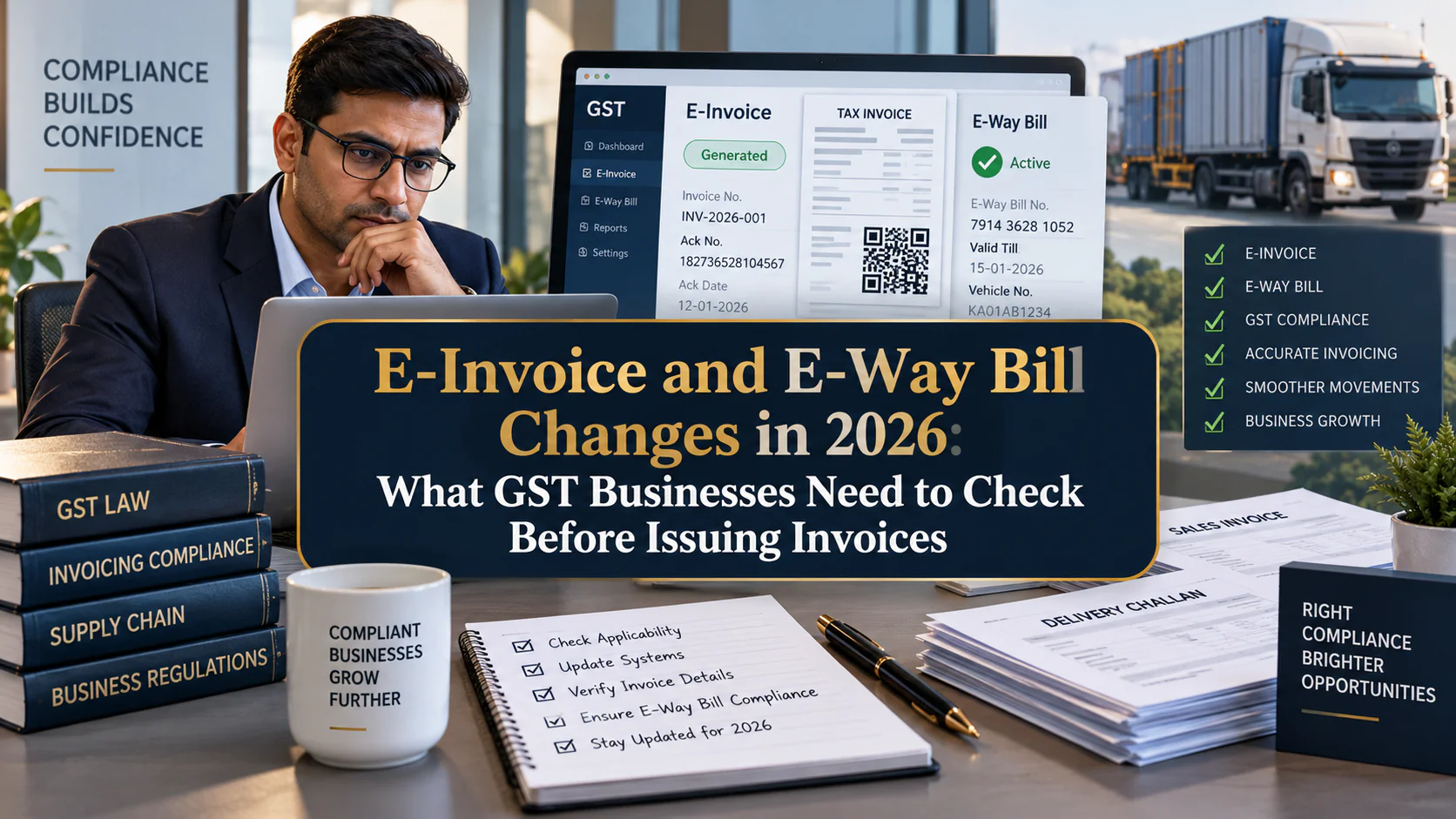
GST compliance is becoming less about simply filing returns on time and more about making sure that the invoice, e-invoice, e-way bill, accounting records and GST returns all tell the same story.
For businesses covered by e-invoicing, this is particularly important in 2026. GSTN has introduced changes to the e-invoice and e-way bill APIs with production implementation from 1 August 2026, including additional validation around GSTINs, ship-to details, export movement and e-way bill closure.
At the same time, the existing rule that taxpayers with aggregate annual turnover (AATO) of ₹10 crore or more must report invoices, credit notes and debit notes on the Invoice Registration Portal within 30 days from the document date continues to be an important operational requirement. The restriction was introduced from 1 April 2025.
For a business, these changes may sound technical. In practice, however, they affect everyday activities: raising an invoice, dispatching goods, generating an e-way bill, recording a customer’s GSTIN, managing exports and reconciling GST data.
This article explains the important e-invoice and e-way bill developments businesses should understand in 2026, what has changed, what has not changed, and what should be checked before an invoice is generated.
What Is E-Invoicing Under GST?
E-invoicing does not mean that the government prepares an invoice for the taxpayer.
The supplier still prepares the commercial invoice through its accounting or ERP system. Where e-invoicing provisions apply, specified invoice details are then reported to an Invoice Registration Portal (IRP). The system validates the information and generates an Invoice Reference Number (IRN) along with a QR code.
The information is also made available to connected GST systems, reducing the need for taxpayers to manually enter the same invoice information multiple times.
This is why e-invoicing should not be treated as an isolated compliance activity.
A mistake in the accounting system can eventually affect:
- the e-invoice;
- the IRN;
- the e-way bill;
- GSTR-1 data;
- the recipient’s purchase records;
- GSTR-2B reconciliation; and
- the company’s books of account.
In other words, invoice creation has become part of the GST control environment.
Who Needs to Pay Attention to E-Invoicing in 2026?
The e-invoicing framework applies based on the applicable turnover criteria and notified categories under GST law.
The e-invoice system states that aggregate turnover in any preceding financial year from FY 2017-18 onwards is relevant for determining applicability. The framework covers specified registered persons, with exemptions applying to notified categories.
One important operational point is the ₹10 crore AATO threshold for the 30-day reporting restriction.
From 1 April 2025, taxpayers having AATO of ₹10 crore or more cannot report an invoice, credit note or debit note on the IRP if more than 30 days have passed from its date.
This means that businesses should not think of e-invoicing as something that can always be corrected at the end of the month.
For a covered taxpayer, timely reporting needs to be built into the invoice-generation process.
The 30-Day E-Invoice Reporting Rule
Consider a company that has AATO of ₹25 crore.
It issues an invoice dated 1 September 2026.
For a document covered by the e-invoicing requirement, the business should ensure that the document is reported within the permitted 30-day period.
If the system restriction applies and the invoice is presented after the permitted period, IRN generation can be blocked.
This creates a very practical problem.
Suppose the accounting team raises the invoice on 1 September but the e-invoice team does not report it because of an internal approval issue. If the problem is discovered much later, the business may not be able to simply generate the IRN after the 30-day window.
Therefore, the internal process should be:
Invoice approved → invoice generated → e-invoice reported → IRN received → invoice released/communicated → e-way bill generated where required → accounting and GST records reconciled.
The exact workflow can vary by business, but the important point is that the reporting deadline should be monitored automatically.
What Changed in the E-Invoice and E-Way Bill APIs From 1 August 2026?
GSTN issued an advisory covering changes to the e-invoice API, e-way bill by IRN API and voluntary closure of e-way bills. The changes were scheduled for production implementation from 1 August 2026.
The changes are particularly relevant for businesses using ERP systems, APIs, GSPs, ASPs, private IRPs or other automated integrations.
Some of the important changes include additional validations and changes relating to shipping details.
Ship-to GSTIN Validation
Where shipping details are provided and an e-way bill is required, ShipDtls.Gstin has been made conditionally mandatory in the relevant API workflow.
This is important for businesses where the billing address and delivery address are different.
For example:
A supplier receives an order from Company A.
Company A asks the supplier to deliver the goods directly to its project site or warehouse.
The invoice may contain the customer’s GSTIN as the bill-to party, while the goods physically move to a different location.
The accounting and ERP system must therefore correctly distinguish:
- Bill To;
- Ship To;
- recipient GSTIN;
- state;
- PIN code; and
- transport details.
A weak master-data process can therefore result in validation errors or incorrect documentation.
Bill-To and Ship-To Details Need Greater Attention
Businesses often treat the customer’s billing address as the most important customer information.
For GST movement documentation, that is not always enough.
A business may have:
- head office in Delhi;
- registered GSTIN in Delhi;
- warehouse in Haryana;
- project site in Rajasthan; and
- customer accounts managed centrally.
The invoice and movement documentation need to reflect the actual transaction structure.
A practical internal checklist should therefore ask:
- Who is the legal recipient?
- Which GSTIN belongs to the recipient?
- Where are the goods actually being delivered?
- Is the ship-to party different from the bill-to party?
- Is the ship-to GSTIN required?
- Does the state code match the location?
- Does the PIN code correspond to the stated destination?
- Are the ERP and GST portal values consistent?
The 2026 API changes make these checks more important for automated systems.
What About Export E-Way Bills?
Exports can involve a different documentation flow because the final destination may be outside India.
The 2026 API changes include specific handling for export e-way bills. The advisory notes that ship details may be replaced in export e-way bill cases where the e-way bill is generated through the relevant IRN process.
Exporters should therefore review their ERP configuration rather than assuming that domestic invoice logic can simply be copied into export transactions.
Before processing an export transaction, the business should verify:
- export customer details;
- document type;
- invoice value;
- shipping details;
- port-related information;
- GST treatment;
- e-invoice applicability;
- e-way bill requirement;
- shipping bill documentation; and
- reconciliation between commercial and GST records.
The exact requirements can vary depending on the transaction structure and applicable GST provisions.
Voluntary Closure of E-Way Bills
Another useful change is the introduction of a facility for voluntary closure of e-way bills after delivery, with an associated e-way bill closure API.
This may appear like a small technology change, but it can be useful for businesses with large volumes of goods movement.
Consider a company generating hundreds or thousands of e-way bills each month.
If movement is completed but the e-way bill remains open in the system, the business may have unnecessary administrative exposure or reconciliation issues.
A controlled closure process can help the logistics and tax teams maintain cleaner records.
Businesses using API-based systems should check whether their software provider has incorporated the relevant functionality and whether the internal workflow records:
- e-way bill number;
- delivery date;
- closure status;
- reason/remarks where applicable; and
- corresponding invoice and transport records.
Why GSTIN Validation Is Becoming More Important
GST compliance increasingly depends on accurate master data.
A wrong GSTIN is not merely a clerical mistake.
It can affect:
- e-invoice generation;
- e-way bill generation;
- GSTR-1;
- recipient credit;
- reconciliation;
- customer records; and
- departmental verification.
Suppose a company has two customers with similar names:
ABC Industries Private Limited
and
ABC Industrial Solutions Private Limited
If the wrong GSTIN is selected in the ERP, the invoice may be legally and commercially problematic even though the invoice value is correct.
This is why businesses should not allow employees to manually type GSTINs repeatedly.
Customer GSTINs should ideally be maintained in a controlled master and periodically verified.
How E-Invoice Data Connects With GST Returns
One of the major advantages of e-invoicing is that invoice information can flow into GST systems.
The IRP framework is designed to share relevant invoice information with the GST portal and e-way bill system. The GST portal can then use the data for return-related processes.
This means that an invoice entered incorrectly at the source can create a chain of problems.
For example:
Wrong invoice value
↓
Wrong e-invoice
↓
Wrong GSTR-1 data
↓
Recipient sees incorrect transaction
↓
Reconciliation difference
↓
Possible amendment or clarification
The best GST compliance strategy is therefore not simply to correct errors at the return-filing stage.
It is to prevent the error at the invoice-generation stage.
A Simple Example: How a Small Error Becomes a GST Problem
Assume XYZ Private Limited sells goods worth ₹5,00,000 plus applicable GST.
The accounting team selects the wrong customer GSTIN while creating the invoice.
The e-invoice is generated successfully because the selected GSTIN itself is valid.
The problem is discovered later when the actual customer does not see the expected transaction in its records.
The supplier now has to investigate:
- whether the invoice was reported correctly;
- whether amendment is possible in the relevant context;
- whether a credit note and fresh invoice are required;
- whether the e-way bill needs corresponding treatment;
- whether GSTR-1 has already been filed; and
- whether the recipient has claimed or attempted to claim ITC.
The lesson is simple:
A valid GSTIN is not necessarily the correct GSTIN.
Businesses need both system validation and human review.
What Should Businesses Do Before Generating an E-Invoice?
A practical pre-invoice checklist can prevent many downstream problems.
Customer Master
Check:
- Legal name;
- GSTIN;
- state;
- registered address;
- billing address;
- shipping address;
- customer type;
- place of supply where relevant.
Invoice Data
Check:
- Invoice number;
- invoice date;
- document type;
- taxable value;
- GST rate;
- tax amount;
- HSN/SAC;
- quantity;
- unit;
- discount;
- reverse-charge applicability where relevant.
Shipping Data
Check:
- Dispatch location;
- delivery location;
- ship-to GSTIN where applicable;
- PIN code;
- state;
- transporter details;
- vehicle details where applicable;
- transport document details.
System Controls
Check:
- ERP integration;
- API credentials;
- IRP configuration;
- error logs;
- failed IRN reports;
- duplicate invoice controls;
- e-way bill integration;
- cancellation/amendment workflow.
What Should Businesses Do After Generating the E-Invoice?
The compliance process should not stop when the IRN is generated.
The business should verify that:
- IRN was successfully generated.
- QR code/details were correctly received.
- Invoice status is recorded in the ERP.
- E-way bill was generated where required.
- Invoice data flows correctly to the relevant GST return records.
- Any API error is resolved promptly.
- Cancelled documents are properly tracked.
- Credit notes and debit notes are handled correctly.
- Delivery documentation matches the invoice.
- Monthly reconciliation is performed.
This is particularly important for high-volume businesses where thousands of invoices are generated through automated systems.
What Businesses Using ERP or API Integration Should Check in 2026
The August 2026 changes are especially relevant to technology teams and businesses using automated integrations. GSTN specifically advised taxpayers, ERP vendors, GSPs, ASPs, private IRPs and system integrators to review the revised API specifications and complete testing before production implementation.
A business using automation should therefore ask its software provider:
- Has the 2026 API specification been implemented?
- Has the production environment been updated?
- Are ship-to GSTIN validations handled correctly?
- Are bill-to and ship-to GSTINs distinguished?
- Are export e-way bill changes supported?
- Is voluntary e-way bill closure available where relevant?
- Are API errors being captured?
- Is there an automated retry mechanism?
- Are failed IRNs visible to the accounts team?
- Is there a daily exception report?
The last question is especially important.
Automation does not eliminate compliance responsibility. It changes where the responsibility sits.
A Good Daily GST Exception Report
Instead of asking the finance team to manually inspect every invoice, management can create an exception report containing:
| Exception | Why It Matters |
|---|---|
| Invoice without IRN | Possible e-invoice compliance issue |
| IRN generation failed | Invoice process may be incomplete |
| E-way bill not generated | Goods movement may require attention |
| Wrong GSTIN | Customer and ITC reconciliation risk |
| Bill-to/ship-to mismatch | Validation and documentation risk |
| Invoice older than permitted reporting window | IRN generation restriction risk |
| Cancelled invoice not updated in ERP | Books and GST data may diverge |
| Duplicate invoice number | Possible system/control issue |
| GST return mismatch | Reconciliation issue |
| API error | Technology/compliance exception |
This approach is much more useful than simply keeping a folder containing PDF invoices.
Common Mistakes Businesses Should Avoid
Waiting Until GSTR-1 Filing
E-invoice compliance is not something that should be reviewed for the first time when the GST return is being prepared.
Manual GSTIN Entry
Repeated manual entry increases the possibility of errors.
Ignoring Failed IRNs
An invoice that failed to generate an IRN should appear in an exception report and be resolved.
Assuming the ERP Is Always Correct
Software follows its configuration. If the master data or tax logic is wrong, automation can simply produce errors faster.
Ignoring Ship-to Information
Businesses with multiple warehouses, branches, project sites or customer delivery locations need stronger controls.
Treating E-Way Bill as a Logistics-Only Issue
The e-way bill is connected to the tax invoice and movement of goods. Finance, tax and logistics teams should therefore coordinate.
Monthly GST Compliance Review for E-Invoice Businesses
A monthly review can be structured around five reconciliations.
Invoice to E-Invoice
Compare accounting invoices with IRNs generated.
E-Invoice to GSTR-1
Check whether reported invoices have flowed correctly into return data.
Invoice to E-Way Bill
For applicable goods movement, compare invoice and e-way bill information.
Sales Register to GST Return
Reconcile taxable turnover and tax amounts.
Credit Notes and Debit Notes
Check that adjustments are properly reflected across books, e-invoices and returns.
This type of reconciliation is especially valuable before year-end.
What About Businesses Below the ₹10 Crore AATO Level?
The 30-day reporting restriction discussed above specifically applies to taxpayers with AATO of ₹10 crore or more from 1 April 2025.
The GST Council newsletter clarified that there was no corresponding 30-day reporting restriction for taxpayers with AATO below ₹10 crore at the time the restriction was introduced.
However, businesses should not interpret this as meaning that they can ignore e-invoice rules altogether.
Applicability and exemptions are determined under the relevant GST provisions and notifications.
A business should determine its e-invoicing applicability based on the prescribed rules rather than simply looking at its current year’s turnover.
What Should a CFO or Business Owner Do Now?
For management, the practical response is straightforward.
First, identify whether the business is covered by e-invoicing.
Second, identify the turnover history used for determining applicability.
Third, review whether the business has customers and delivery locations that require complex bill-to/ship-to handling.
Fourth, ask the ERP or GSP provider whether the August 2026 API changes have been implemented.
Fifth, create an exception report for failed IRNs and e-way bills.
Sixth, reconcile e-invoice data with GSTR-1 and the sales register.
Finally, document responsibility.
Someone should own the daily review.
GST compliance becomes risky when everybody assumes that somebody else is checking it.
Practical 2026 E-Invoice Compliance Checklist
Before closing each month, businesses can use this checklist:
- Confirm e-invoice applicability.
- Review AATO used for applicability.
- Check the 30-day reporting rule where applicable.
- Verify customer GSTINs.
- Review bill-to and ship-to details.
- Check HSN/SAC and tax rates.
- Verify invoice numbering.
- Reconcile invoices with IRNs.
- Review failed IRN transactions.
- Reconcile applicable e-way bills.
- Check export transactions separately.
- Review cancelled invoices.
- Review credit and debit notes.
- Reconcile e-invoice data with GSTR-1.
- Review API/system error reports.
- Confirm that ERP integrations incorporate applicable 2026 changes.
- Maintain evidence of reconciliations and corrections.
Frequently Asked Questions
Is e-invoicing the same as generating an invoice electronically?
No. A normal electronic invoice can be generated through accounting software, but e-invoicing under GST involves reporting specified invoice information to an authorised IRP and obtaining an IRN and QR code where the mandate applies.
Does every GST-registered taxpayer need to generate e-invoices?
No. E-invoicing applies to specified taxpayers and categories under the applicable GST provisions, with notified exemptions. Businesses should determine applicability based on the prescribed turnover criteria and their status.
What is the 30-day e-invoice rule?
For taxpayers with AATO of ₹10 crore or more, the IRP reporting restriction requires covered invoices, credit notes and debit notes to be reported within 30 days from the document date. The restriction applies from 1 April 2025.
Does the 30-day restriction apply to businesses below ₹10 crore AATO?
The specific restriction introduced from 1 April 2025 was for taxpayers with AATO of ₹10 crore or more. The GST Council’s published material stated that the same reporting restriction was not applicable to taxpayers below ₹10 crore at that time.
What changed from 1 August 2026?
GSTN introduced changes to e-invoice API, e-way bill by IRN API and voluntary e-way bill closure functionality. The changes include additional validations concerning ship-to GSTIN, bill-to/ship-to information, export e-way bills and e-way bill closure.
Does an e-invoice automatically solve GST reconciliation?
No. E-invoicing improves data flow, but businesses still need to reconcile invoices, books, GST returns, e-way bills and customer records.
Why is ship-to information important?
Where billing and delivery locations differ, accurate ship-to information helps ensure that the invoice and movement documentation correctly describe the transaction. The 2026 API changes introduce additional validation around shipping information in relevant scenarios.
Can a business rely entirely on its ERP for GST compliance?
No. An ERP can automate compliance, but management remains responsible for correct master data, tax configuration, exception handling and reconciliation.
What should a business do if an IRN fails?
The reason for failure should be identified and corrected promptly. The business should maintain an exception report so that failed transactions do not disappear from the compliance process.
Are e-way bills relevant only to the logistics department?
No. E-way bills are connected with tax invoices and movement of goods. Finance, GST and logistics teams should have a coordinated process.
Key Takeaways
The 2026 e-invoice environment is increasingly focused on data quality, timely reporting and system-level validation.
The most important points for businesses are:
- Check e-invoice applicability carefully, including the relevant turnover history and exemptions.
- Remember the 30-day reporting restriction for taxpayers with AATO of ₹10 crore or more.
- Review the August 2026 API changes if your business uses ERP, GSP, ASP, private IRP or API-based integration.
- Keep GSTIN master data accurate, particularly for customers with similar names or multiple registrations.
- Do not ignore ship-to information where billing and delivery locations differ.
- Review export e-way bill workflows separately rather than assuming domestic processes are sufficient.
- Use exception reports for failed IRNs, e-way bills and API errors.
- Reconcile e-invoices with GSTR-1 and books regularly.
- Make finance, tax, IT and logistics teams work together on GST controls.
- Treat e-invoicing as a business-control process, not merely a portal activity.
Conclusion
GST compliance is moving steadily toward a model where transaction data is validated closer to the point at which the transaction happens.
For businesses, that is actually an opportunity.
A company with clean customer masters, properly configured ERP systems, automated exception reports and regular reconciliations can make GST compliance considerably more predictable.
The businesses most likely to face problems are not necessarily those with the highest turnover. They are often the ones where finance, IT and operations work independently and nobody owns the complete invoice-to-return chain.
The practical approach for 2026 is therefore simple: generate the right invoice, report it on time, validate the movement documentation, reconcile the data and investigate exceptions before they become return-level problems.
For businesses covered by e-invoicing, the changes implemented from August 2026 make it particularly worthwhile to review ERP/API configurations, ship-to logic, export workflows and e-way bill processes now rather than waiting for an error to appear during a GST reconciliation or departmental verification.