A GST demand order showing “NIL” or “Zero” demand may sound like good news. In many cases, however, it is not.
There are situations where a taxpayer has already paid an amount before the adjudication order is passed, while still disputing whether the tax, interest or penalty was actually payable. The adjudicating authority may therefore pass an order recording the demand as NIL because the amount has already been paid.
The taxpayer may still disagree with the findings in that order.
Until recently, this created a frustrating practical problem. The taxpayer could have a genuine dispute and a legal right to appeal, but the GST portal could prevent the filing of Form GST APL-01 because the system saw the demand amount as zero.
That position has now changed.
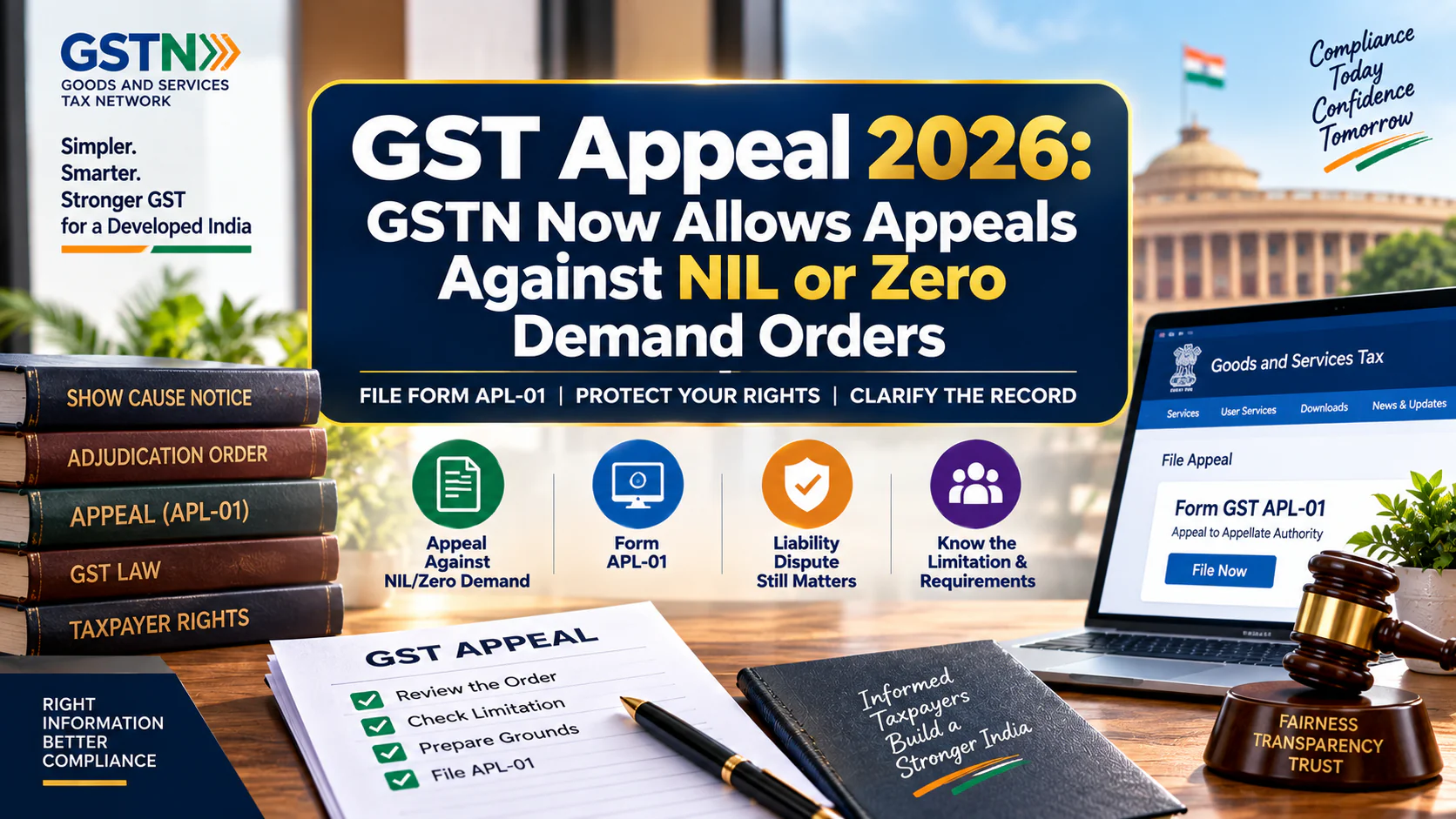
On 7 September 2026, GSTN issued an advisory stating that the earlier portal validation restricting appeals against demand orders showing a NIL or Zero demand amount has been removed. Taxpayers can now file Form GST APL-01 against such orders where a liability dispute exists and payment had been made before the demand order was issued.
This is an important GST compliance update for businesses, professionals and taxpayers who have paid disputed amounts during adjudication but still want to challenge the underlying order.
The change is particularly relevant because an appeal is not merely about whether money is still outstanding. A taxpayer may want to challenge the legal findings, taxability, classification, ITC denial, interest, penalty or other conclusions recorded in the order.
What Has Changed in September 2026?
The key change is portal functionality.
GSTN has removed the earlier system validation that prevented taxpayers from filing an appeal in Form GST APL-01 when the demand order reflected a NIL or Zero demand, even though a dispute regarding liability continued to exist.
The situation generally arose where:
- a taxpayer received a show cause notice or similar proceedings;
- the taxpayer paid the amount before the adjudication order;
- the payment was not necessarily an admission of liability;
- the adjudicating authority subsequently passed an order;
- because the amount had already been paid, the demand reflected in the order became NIL or Zero; and
- the GST portal treated the zero demand as a reason to block the appeal.
GSTN’s 7 September 2026 advisory removes that technical restriction.
The taxpayer can now proceed with Form GST APL-01, subject to the normal legal requirements applicable to the appeal.
Why Is a NIL Demand Order Sometimes Worth Appealing?
This is the point that can easily be misunderstood.
A taxpayer does not necessarily appeal only because money is still recoverable from them.
An order may contain findings that affect the taxpayer even if the monetary demand shown as outstanding is zero.
For example, imagine that a GST officer issues a notice proposing ₹8 lakh of tax along with interest and penalty.
The taxpayer, worried about interest and recovery proceedings, pays the amount while maintaining that the liability is incorrect.
The adjudicating authority later passes an order.
Since ₹8 lakh has already been paid, the order may show the outstanding demand as NIL.
But the taxpayer still believes that:
- the underlying supply was wrongly classified;
- the ITC was wrongly denied;
- the demand was based on an incorrect interpretation;
- the transaction was not taxable in the manner alleged;
- the interest calculation was wrong; or
- the penalty was not legally justified.
The taxpayer may therefore still have something meaningful to challenge.
The September 2026 GSTN update recognises this practical situation at the portal level.
The Difference Between “Demand” and “Dispute”
This distinction is central to understanding the update.
Demand answers the question:
How much remains payable?
Dispute answers a different question:
Does the taxpayer agree with the findings and liability determined in the order?
Those two questions do not always have the same answer.
A demand can be zero because the amount has already been paid.
That does not necessarily mean that the taxpayer agrees with the order.
This is why a taxpayer should not automatically close a GST matter merely because the GST portal or order shows NIL demand.
The actual order needs to be read carefully.
What Was the Earlier Problem on the GST Portal?
GSTN had already recognised this issue earlier in 2026.
The GST Council’s April 2026 newsletter explained that NIL-demand situations could arise where payments were made at the show-cause-notice stage without admission of liability. When the adjudication order subsequently recorded NIL demand, the portal could prevent the taxpayer from filing Form APL-01 because the system could not process the appeal against a zero-value demand.
At that stage, taxpayers were advised to approach the adjudicating authority for rectification so that the appropriate demand could be reflected and the appeal could then be filed.
That workaround was not particularly convenient.
Consider a taxpayer whose appeal limitation period is already running.
If the taxpayer first has to obtain rectification of the order and only thereafter file the appeal, there is an obvious practical risk of delay.
The September 2026 change removes that additional portal hurdle.
What Does the September 2026 GSTN Advisory Actually Say?
The advisory is quite specific.
It covers cases where:
- there is a dispute regarding liability;
- the demand amount is reflected as NIL or Zero in the demand order;
- payment was made by the taxpayer before issuance of the demand order; and
- the taxpayer wants to appeal against that order.
GSTN has removed the previous validation and enabled taxpayers to file Form GST APL-01 against such orders.
The advisory does not create a completely new appellate remedy.
Rather, it fixes a portal-level restriction that was preventing taxpayers from using the existing appeal mechanism in this particular situation.
That distinction is important.
The September 2026 update should therefore not be described as “GST has introduced a new right of appeal.”
The more accurate description is:
GSTN has enabled the GST portal to accept APL-01 appeals in eligible cases where the order records NIL or Zero demand despite an underlying dispute.
How Does Section 107 of the CGST Act Fit Into This?
The statutory appeal mechanism is contained in Section 107 of the Central Goods and Services Tax Act, 2017.
Section 107(1) provides the first appellate remedy against a decision or order passed by an adjudicating authority. The appeal is ordinarily required to be filed within three months from the date on which the decision or order is communicated to the person.
Section 107(4) permits the Appellate Authority to allow a further period of one month where sufficient cause is shown for the delay.
This means a taxpayer should not look at the September 2026 portal change as permission to wait indefinitely.
The limitation period continues to matter.
If an appealable order has already been communicated, the taxpayer should calculate the applicable limitation from the relevant communication date and act promptly.
Does the New GSTN Update Remove the Need to Check Limitation?
No.
This is one of the most important practical points.
The portal may now allow an APL-01 appeal against an eligible NIL or Zero demand order.
That does not mean the taxpayer has unlimited time to file.
Section 107 continues to prescribe the statutory limitation framework.
Therefore, if you have an old NIL-demand order that you wanted to challenge, do not simply assume that the new portal functionality automatically revives every expired remedy.
The exact date of communication of the order, the applicable limitation period, any previous proceedings and any judicial or statutory exclusion affecting limitation should be examined separately.
This becomes particularly important where the original order is several months old.
What About the Pre-Deposit?
The normal Section 107 appeal requirements continue to be relevant.
Section 107(6) requires payment of the admitted amount arising from the order and a prescribed pre-deposit in respect of the disputed tax component before the appeal can be filed. The statutory framework provides for a 10% pre-deposit of the remaining tax in dispute, subject to the applicable statutory ceiling.
The exact calculation should therefore be made from the order and the nature of the dispute.
A NIL demand situation can be unusual because the amount may already have been paid before the order.
That does not mean every NIL-demand appeal will automatically have identical pre-deposit consequences.
The taxpayer should examine:
- what the order actually determines;
- what amount was already paid;
- whether the payment relates to tax, interest, penalty or another component;
- what amount remains disputed;
- whether the appeal involves a tax demand, penalty-only demand or another issue; and
- which version of the law applies to the particular proceedings.
This last point is important because GST appeal provisions have been amended over time.
A Practical Example: ₹12 Lakh Paid Before the Order
Consider a hypothetical case.
ABC Private Limited receives a GST show cause notice proposing:
| Particular | Amount |
|---|---|
| Tax | ₹9,00,000 |
| Interest | ₹1,00,000 |
| Penalty | ₹2,00,000 |
| Total | ₹12,00,000 |
The company believes the proposed tax demand is incorrect.
However, to avoid immediate financial pressure and while reserving its position, it deposits the amount before the adjudication order.
The adjudicating authority subsequently passes an order.
Because the amount has already been paid, the demand reflected as outstanding may be NIL.
ABC still believes the order is legally incorrect.
Earlier practical problem
The portal could prevent ABC from filing APL-01 because the system treated the demand as zero.
Position after 7 September 2026
The portal validation has been removed for the relevant NIL/Zero-demand situation.
ABC can now proceed with filing the appeal in Form GST APL-01, subject to the statutory requirements and applicable limitation.
The company should still preserve evidence showing:
- the original notice;
- the payment made;
- the date of payment;
- the adjudication order;
- the grounds on which liability is disputed; and
- any correspondence explaining the nature of the payment.
Payment Does Not Automatically Mean You Agree With Everything in the Order
Businesses sometimes hesitate to challenge an order because they already paid the amount.
That is exactly why the facts surrounding the payment matter.
Suppose a taxpayer pays an amount during adjudication but clearly maintains that the liability is disputed.
The payment and the taxpayer’s legal position should be documented carefully.
For example, internal records may show:
“Amount deposited pending adjudication and without acceptance of the proposed liability.”
The exact wording should reflect what actually happened.
Businesses should not create artificial “under protest” documents after the event merely because they have now decided to appeal.
The safest approach is to maintain contemporaneous records.
What Documents Should Be Kept for a NIL-Demand Appeal?
Before filing the appeal, prepare a complete file.
Basic order documents
Keep:
- show cause notice;
- reply to the notice;
- documents submitted during adjudication;
- hearing submissions;
- adjudication order;
- order communication record; and
- demand/order details available on the GST portal.
Payment documents
Keep:
- GST challan;
- electronic cash ledger records;
- electronic liability ledger;
- bank statement;
- payment reference;
- DRC-related records, wherever applicable; and
- correspondence accompanying the payment.
Substantive evidence
Depending on the dispute, retain:
- tax invoices;
- purchase orders;
- agreements;
- delivery documents;
- e-way bills;
- e-invoices;
- GSTR-1 records;
- GSTR-3B records;
- GSTR-2B records;
- reconciliation statements;
- books of account; and
- relevant correspondence with customers or suppliers.
The appellate authority needs to understand not merely that the taxpayer disagrees, but why the original order should be modified or annulled.
How to File APL-01 After the September 2026 Change
A practical workflow can look like this.
Step 1: Identify the order
Download and preserve the complete demand/adjudication order.
Do not rely solely on the amount displayed in the portal’s demand ledger.
Read the actual order.
Step 2: Confirm that the case falls within the GSTN advisory
Check whether:
- a liability dispute exists;
- payment was made before the order;
- the order consequently reflects NIL or Zero demand; and
- the appeal concerns that order.
Step 3: Check the limitation period
Calculate the appeal deadline from the communication of the order.
Do this before preparing the grounds.
Step 4: Determine the disputed amount
Prepare a reconciliation showing:
Demand proposed → amount paid → amount admitted → amount disputed → amount shown as outstanding.
This can make the appeal file much easier to understand.
Step 5: Prepare the statement of facts
Explain the chronology clearly.
A good statement of facts should normally answer:
- What transaction was involved?
- What did the department allege?
- What did the taxpayer reply?
- What payment was made?
- When was it made?
- What did the adjudicating authority decide?
- Why is the taxpayer still aggrieved?
Step 6: Draft specific grounds of appeal
Avoid vague grounds such as:
“The order is wrong and against law.”
Instead, identify the specific errors.
For example:
- incorrect interpretation of the relevant GST provision;
- incorrect classification;
- incorrect valuation;
- incorrect denial of ITC;
- failure to consider submitted evidence;
- incorrect computation of tax or interest;
- violation of principles of natural justice, where factually applicable; or
- incorrect imposition of penalty.
Step 7: File Form GST APL-01
The GST Rules prescribe Form GST APL-01 for an appeal to the Appellate Authority under Section 107(1).
Step 8: Preserve acknowledgement
After filing, preserve the acknowledgement and all supporting records.
Do not assume that clicking “submit” is the end of the compliance process.
The appeal procedure also contains requirements relating to supporting documents and acknowledgement.
What If the GST Portal Still Does Not Allow the Appeal?
GSTN’s September 2026 advisory specifically says that taxpayers facing queries or difficulties while filing such appeals may raise a ticket with the GST Helpdesk.
If the portal continues to display an error, take screenshots.
Keep:
- date and time of the attempted filing;
- order number;
- GSTIN;
- exact error message;
- browser or portal details if relevant; and
- screenshots of the demand/order status.
This is useful because technical difficulties can become important evidence when limitation is approaching.
A taxpayer should not simply wait until the deadline passes and then explain that the portal did not work.
Need Help With a GST Notice or Appeal?
GST notices, adjudication orders and appeals can involve strict timelines and detailed documentation. If your business needs help reviewing a GST order, preparing a response or understanding the applicable compliance requirements, professional assistance can help you approach the matter with greater clarity.
Explore GST Services →Should Businesses Revisit Old NIL-Demand Orders?
Yes, this is one of the most useful practical consequences of the update.
If your business previously had a GST order where:
- a disputed amount was paid before the order;
- the order subsequently showed NIL or Zero demand; and
- the portal prevented APL-01 filing,
the matter deserves a fresh review.
The September 2026 change may remove the specific technical barrier that previously prevented filing.
However, do not assume that every historical NIL-demand order is automatically appealable today.
The limitation position needs to be examined separately.
If there was a previous attempt to file an appeal, rectification application, writ petition or other proceeding, those facts may also affect the legal position.
Common Mistakes Taxpayers Should Avoid
Assuming “NIL demand” means the matter is closed
A zero outstanding balance does not necessarily mean the taxpayer agrees with the order.
Ignoring the actual adjudication order
The portal’s demand figure is only one part of the picture.
Read the order and understand the findings.
Waiting because the amount has already been paid
Payment does not by itself eliminate the need to consider an appeal.
Missing the limitation period
The September 2026 portal improvement does not eliminate the statutory appeal limitation.
Filing weak grounds
An appeal should explain the specific legal and factual errors being challenged.
Losing the payment trail
The payment made before the order is often central to understanding why the final demand appears as NIL.
Treating the GST portal as the legal record
Portal data is important, but the underlying notice, order, replies and evidence remain critical.
How This Update Helps GST Professionals
The change is also relevant for Chartered Accountants, tax consultants, advocates and GST practitioners.
Earlier, a practitioner handling a NIL-demand order could face a procedural dilemma.
The taxpayer had a dispute, but the portal validation could prevent APL-01 filing.
The practitioner might then need to pursue rectification simply to make the appeal technically possible.
That consumed time and introduced another dependency into the appellate process.
The September 2026 change makes the workflow more straightforward:
Review order → check limitation → prepare grounds → file APL-01 → preserve acknowledgement.
That is a much cleaner compliance process.
Is Every Zero-Demand Order Now Appealable?
No.
This is an important qualification.
The GSTN advisory deals with the specific situation where a dispute regarding liability exists, the demand is reflected as NIL or Zero, and payment had been made before the demand order.
It does not mean that every document containing the word “NIL” automatically becomes appealable.
A taxpayer should first establish that there is an appealable decision or order and that the statutory conditions for appeal are satisfied.
The substantive merits of the case also remain relevant.
GSTN has changed the portal validation.
It has not declared that every NIL-demand order is automatically correct, incorrect or appealable irrespective of the underlying law.
Does the Update Change GST Tax Liability?
No.
The 7 September 2026 advisory is a procedural and portal-related change.
It does not itself change:
- GST rates;
- ITC eligibility;
- place-of-supply rules;
- valuation provisions;
- taxability of supplies;
- interest provisions; or
- substantive penalty provisions.
Its significance is that taxpayers can now use the GST portal to pursue an appeal in the specified NIL/Zero-demand situation.
What Businesses Should Do Now
Businesses should consider adding a NIL-demand review to their GST litigation checklist.
Monthly or quarterly GST litigation review
Review all recent adjudication orders and identify those where:
- payment was made before the order;
- the order shows NIL or Zero demand;
- the taxpayer disagrees with the findings; or
- the taxpayer previously could not file APL-01 because of the portal validation.
Maintain a litigation register
A simple internal register can contain:
| Particular | Details |
|---|---|
| GSTIN | Relevant GSTIN |
| Order number | Order reference |
| Order date | Date of order |
| Communication date | Date received |
| Original demand | Amount proposed/determined |
| Amount paid | Payment made |
| Demand shown | NIL/Zero |
| Appeal required | Yes/No |
| Limitation date | Calculated deadline |
| APL-01 status | Pending/File/Completed |
| Remarks | Key legal issue |
This is particularly useful for businesses with multiple GST registrations or multiple departmental proceedings.
Frequently Asked Questions
Can I now appeal against a GST order showing NIL demand?
Yes, where the case falls within the situation covered by GSTN’s 7 September 2026 advisory: a liability dispute exists, the demand is reflected as NIL or Zero, and payment was made before the demand order. GSTN has removed the earlier portal validation and enabled filing of Form GST APL-01.
Which form is used for the appeal?
The first appeal to the Appellate Authority is filed in Form GST APL-01 under Section 107.
Do I need to obtain rectification first?
For the specific NIL/Zero-demand portal problem addressed by the 7 September 2026 advisory, the earlier requirement of obtaining rectification merely to overcome the portal restriction is no longer necessary. The portal has been enabled to accept the appeal directly.
What if I paid the disputed GST before the order?
Payment before the order can result in the order reflecting NIL or Zero demand. If you continue to dispute the liability and the case falls within the GSTN advisory, you can now proceed with APL-01, subject to the applicable legal requirements and limitation.
What is the normal time limit for a GST first appeal?
Under Section 107, an appeal is ordinarily filed within three months from communication of the decision or order. The Appellate Authority can allow a further period of one month where sufficient cause is shown.
Does the new advisory extend the appeal limitation period?
No. The GSTN advisory removes a portal restriction; it should not be treated as a general extension of the statutory limitation period.
What should I do if the portal still gives an error?
GSTN has advised affected taxpayers to raise a ticket with the GST Helpdesk. Keep screenshots and details of the attempted filing, especially if the limitation period is approaching.
Is a NIL-demand order automatically a favourable order?
Not necessarily. The taxpayer may still dispute the findings recorded in the order, particularly where the amount was paid before the order.
Does filing the appeal mean the original GST liability automatically disappears?
No. Filing an appeal is a challenge to the order. The taxpayer must comply with the applicable statutory pre-deposit and procedural requirements.
Should businesses review old GST orders?
Yes, particularly where an appeal was not filed because the GST portal previously rejected APL-01 solely because the order showed NIL or Zero demand. The limitation position should be checked before taking action.
GST NIL-Demand Appeal Checklist for 2026
Before filing, confirm the following:
- The order is available and has been reviewed.
- The date of communication has been identified.
- The original dispute is still being challenged.
- Payment made before the order has been reconciled.
- The order reflects NIL or Zero demand.
- The case falls within the GSTN advisory.
- The appeal limitation has been calculated.
- Grounds of appeal have been prepared.
- Statement of facts has been prepared.
- Supporting documents have been collected.
- Applicable pre-deposit has been calculated.
- Form GST APL-01 has been prepared.
- Portal filing has been completed.
- Acknowledgement has been preserved.
- Any technical error has been documented and reported promptly.
Key Takeaways
- GSTN issued an important advisory on 7 September 2026 concerning appeals against NIL or Zero demand orders.
- The earlier GST portal validation blocking such appeals has been removed.
- Eligible taxpayers can now file Form GST APL-01 even where the demand order reflects NIL or Zero demand, provided the underlying liability remains disputed and the relevant payment was made before the order.
- The change addresses a practical portal problem rather than creating a completely new statutory appeal right.
- Section 107 of the CGST Act continues to govern the first appeal mechanism.
- The normal appeal limitation remains important: ordinarily three months from communication of the order, with a further one-month period that may be allowed for sufficient cause.
- Businesses should not assume that every NIL-demand order is automatically appealable.
- The actual adjudication order, payment records, limitation period and nature of the dispute must be reviewed.
- The earlier rectification workaround is no longer necessary merely to overcome the specific portal restriction addressed by the September 2026 advisory.
- Businesses that previously could not file an appeal because of the NIL/Zero demand validation should review those matters promptly.
- Any technical problem while filing can be raised with the GST Helpdesk.
Official Sources
The most important source for this particular September 2026 update is the GSTN advisory dated 7 September 2026. The advisory states that the earlier portal validation has been removed and taxpayers can file Form GST APL-01 in the specified NIL/Zero-demand cases.
GSTN Advisory No. 671 – Enabling Filing of Appeals in Cases Involving NIL or Zero Demand Amount
For the statutory appeal provisions, taxpayers should also refer to Section 107 of the CGST Act, 2017 and the applicable CGST Rules governing Form GST APL-01.
CBIC – GST Appeals and Revision Rules
GST Portal – Official GST Services
Conclusion
A GST order showing NIL or Zero demand should not automatically be treated as the end of the matter.
For taxpayers who paid an amount before the adjudication order but continued to dispute the underlying liability, the earlier GST portal restriction could create a very real procedural problem. The taxpayer might have a grievance and a statutory appeal mechanism, but the portal could still prevent the filing of APL-01 because there was no outstanding demand.
GSTN’s 7 September 2026 advisory removes that particular obstacle.
For businesses, the practical lesson is simple: review the order, not just the demand balance.
If the liability remains disputed, check the communication date, calculate the limitation period, preserve the payment and adjudication records, prepare proper grounds and determine the applicable pre-deposit before filing.
The September 2026 change is therefore more than a small portal enhancement. It brings GST system functionality closer to the practical operation of the appellate mechanism and gives taxpayers a more direct route to challenge eligible NIL or Zero demand orders.
For any business that has previously been unable to file a GST appeal because the portal treated the demand as zero, now is the right time to review the file rather than assuming the matter is closed.