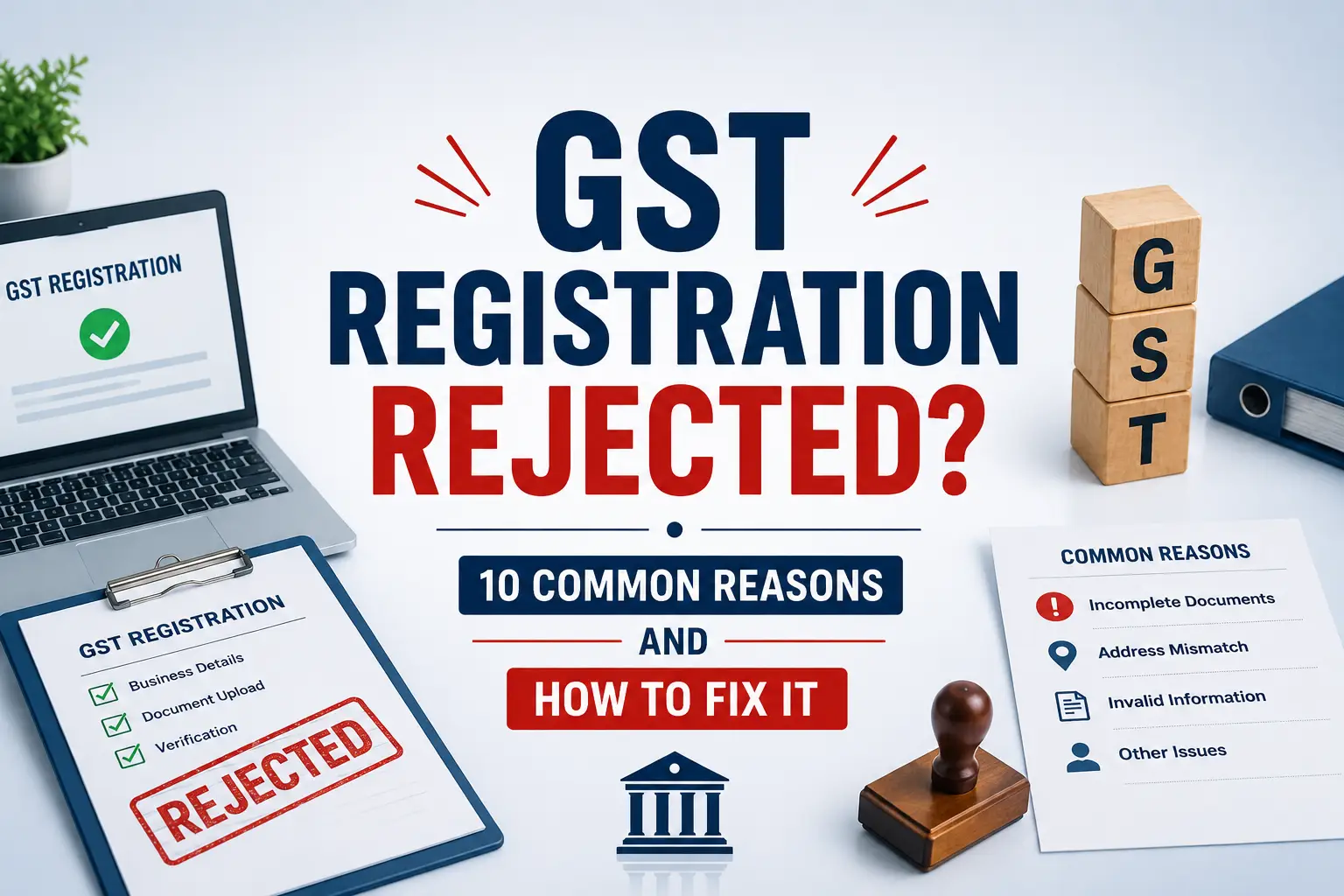
Applying for GST registration may look like a straightforward online process. You enter your business details, upload the required documents, complete verification and wait for your GSTIN.
However, in practice, many applicants receive a GST REG-03 clarification notice or, eventually, a GST REG-05 rejection order.
The good news is that a GST registration rejection does not necessarily mean that your business is ineligible for GST registration. In many cases, the problem is simply an inconsistency in the application, inadequate proof of the business premises, incomplete documents or an unsatisfactory response to the clarification notice.
Moreover, the Government has issued specific instructions to reduce unnecessary queries and improve the GST registration process. CBIC Instruction No. 03/2025-GST dated 17 April 2025 specifically addresses difficulties faced by genuine applicants and states that officers should avoid presumptive queries and unnecessary requests for documents.
Therefore, if your GST registration has been rejected, do not panic. Instead, understand the reason, correct the underlying issue and choose the appropriate remedy.
👉 Need Help With GST? Get Expert AssistanceTable of Content
- What Happens After You Apply for GST Registration?
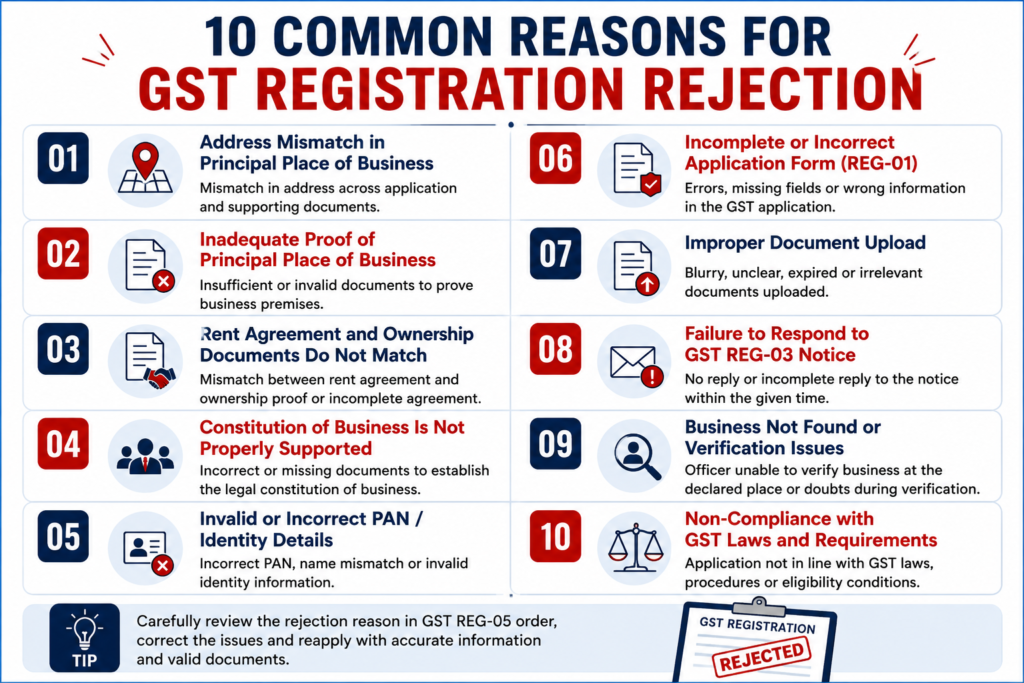
- 10 Common Reasons for GST Registration Rejection
- 1. Address Mismatch in Principal Place of Business
- 2. Inadequate Proof of Principal Place of Business
- 3. Rent Agreement and Ownership Documents Do Not Match
- 4. Constitution of Business Is Not Properly Supported
- 5. Name or Details of Authorised Signatory Do Not Match
- 6. Documents Are Blurred, Incomplete or Unreadable
- 7. Wrong or Inconsistent Business Activities
- 8. Aadhaar Authentication or Physical Verification Issues
- 9. Previous GSTIN Linked to PAN Has Been Cancelled or Suspended
- 10. GST REG-03 Notice Was Not Replied to Properly
- A Simple GST Registration Rejection Checklist
- What Should You Do After GST Registration Is Rejected?
- Can You Apply for GST Registration Again After Rejection?
- Important 2025 CBIC Instructions Every GST Applicant Should Know
- GST Registration: Important Timelines at a Glance
- How to Avoid GST Registration Rejection in the First Place
- Final Takeaway
What Happens After You Apply for GST Registration?
Generally, the GST officer examines the information and documents submitted with FORM GST REG-01.
If everything is satisfactory, the registration can be approved.
On the other hand, if the officer finds a deficiency or requires clarification, a notice may be issued in FORM GST REG-03. The applicant is generally required to respond through FORM GST REG-04 within seven working days.
If the officer is satisfied with the response, registration can be approved. However, if the applicant does not respond within the prescribed period, or the officer is not satisfied with the response, the application may be rejected through FORM GST REG-05, with reasons recorded in writing.
This makes one point particularly important:
A GST REG-03 notice should not be ignored.
Your response to the clarification notice can often determine whether your application gets approved or rejected.
10 Common Reasons for GST Registration Rejection
1. Address Mismatch in Principal Place of Business
One of the most common issues relates to the Principal Place of Business (PPOB).
For example, suppose the GST application mentions:
123, ABC Market, Delhi
but the electricity bill or rent agreement shows:
123-A, ABC Market, New Delhi
Even though both addresses may refer to the same premises, the mismatch can create doubts during verification.
Similarly, problems can arise where:
- The PIN code is incorrect
- The building or floor number is missing
- The address in the application differs from the supporting document
- The electricity bill relates to another property
- The rent agreement contains a different address
- The address is incomplete or vague
CBIC’s 2025 instruction specifically states that clarification may be sought where the business address does not match the uploaded document or where the address is incomplete or vague.
How to fix it
First, compare the address in REG-01 with every supporting document.
Then make sure that:
- House/shop/office number is correct
- Street/locality is correctly mentioned
- City and State are correct
- PIN code is correct
- The supporting document clearly relates to the same premises
Furthermore, avoid abbreviations or incomplete descriptions that make the premises difficult to identify.
2. Inadequate Proof of Principal Place of Business
Another major reason for GST clarification or rejection is insufficient documentation for the business premises.
The exact documents depend on whether the premises are:
- Owned
- Rented/leased
- Owned by a relative
- Shared
- Used with the consent of another person
CBIC’s 2025 instruction provides detailed guidance on acceptable documentation. For owned premises, for example, one appropriate ownership-related document such as a latest property tax receipt, municipal khata copy or electricity bill may generally suffice.
For rented premises, a valid rent/lease agreement together with an appropriate document establishing the lessor’s ownership is generally relevant.
How to fix it
Prepare the documentation according to the nature of occupancy.
Owned property
Generally provide an appropriate document such as:
- Property tax receipt
- Municipal khata
- Electricity bill
- Similar document prescribed under applicable local law
Rented property
Generally provide:
- Valid rent/lease agreement
- Appropriate ownership proof of the lessor
Relative’s property
Generally provide:
- Consent letter
- Identity proof of the person giving consent
- Appropriate ownership proof
CBIC has specifically stated that officers should not unnecessarily demand documents such as the lessor’s PAN, Aadhaar or photographs where the prescribed documentation is already sufficient.
Therefore, applicants should focus on providing relevant and legally acceptable evidence, rather than simply uploading a large number of unrelated documents.
3. Rent Agreement and Ownership Documents Do Not Match
This is a particularly common problem for businesses operating from rented premises.
Suppose the rent agreement is executed for:
Shop No. 12, ABC Complex
but the electricity bill uploaded as ownership proof relates to:
Shop No. 14, ABC Complex
The officer may reasonably ask for clarification.
Similarly, if the rent agreement is expired, unsigned, incomplete or executed with a person whose ownership cannot be established, the application may face difficulty.
How to fix it
Before submitting the application, check:
- Name of lessor
- Name of tenant
- Complete property address
- Property number
- Agreement validity
- Signatures
- Ownership document
- Consistency between all documents
If the agreement is unregistered, CBIC’s 2025 instruction provides for additional identity documentation of the lessor in the circumstances specified in the instruction.
Consequently, the documentation should be prepared according to the actual nature of the tenancy rather than using a generic rent agreement format.
4. Constitution of Business Is Not Properly Supported
GST registration applications differ depending upon whether the applicant is:
- Proprietorship
- Partnership firm
- LLP
- Private limited company
- Public company
- Trust
- Society
- Association
- Other legal entity
Therefore, the supporting documents must correctly establish the constitution of the business.
For example, in the case of a partnership firm, the partnership deed is an important document.
Similarly, a company would ordinarily rely on its incorporation and constitutional records.
CBIC’s 2025 instruction specifically states that, for a partnership applicant, the Partnership Deed is required for establishing the constitution of the business and that officers should not unnecessarily demand documents such as Udyam, MSME, shop-establishment or trade-licence certificates merely for this purpose.
How to fix it
Make sure the constitution selected in REG-01 exactly matches the legal status of the entity.
For example:
Partnership → Partnership Deed
Company → Incorporation/constitutional documents
LLP → LLP incorporation and related constitutional documents
Trust/Society → Registration/constitution documents
Also, make sure the names of partners, directors, trustees or authorised persons are consistent across the application and supporting documents.
5. Name or Details of Authorised Signatory Do Not Match
Another reason for clarification is inconsistency in the identity details of the authorised signatory.
For example:
- Name differs between PAN and GST application
- Date of birth is incorrect
- PAN details do not match
- Mobile number/email details are incorrect
- Authorisation document is incomplete
- Photograph or identity information is unclear
The problem becomes more significant when the authorised signatory is not properly authorised by the business entity.
How to fix it
Before filing REG-01, verify:
- PAN
- Legal name
- Date of birth, where applicable
- Mobile number
- Email ID
- Authorised signatory details
- Authorisation letter/resolution, where applicable
For companies and other entities, ensure that the person filing the application has proper authority to act on behalf of the entity.
In addition, upload clear and legible documents.
6. Documents Are Blurred, Incomplete or Unreadable
Sometimes the underlying information is correct, but the uploaded documents are poor quality.
For instance:
- Electricity bill is partially cut
- Rent agreement pages are missing
- Ownership document is blurred
- Signature is not visible
- PAN card is unreadable
- Supporting document is uploaded upside down or incompletely
CBIC’s 2025 instruction specifically states that officers may seek clarification where a document is incomplete or not legible.
How to fix it
Before uploading, open every PDF or image and check it yourself.
Ask:
Can a third person clearly read the document?
If the answer is no, replace it.
Furthermore, make sure that multi-page agreements are uploaded completely where necessary.
The GST portal’s current document checklist also specifies accepted document categories and file formats/sizes for several registration documents.
7. Wrong or Inconsistent Business Activities
The GST application requires the applicant to provide details about the nature of the business and goods/services.
Problems can arise when the business activity selected does not reasonably correspond with the documents or information submitted.
For example, an applicant may declare one type of business but provide documents that suggest a substantially different activity.
However, this does not mean that an officer should reject an application merely because of assumptions about what activities can or cannot be conducted from a particular premises.
In fact, CBIC’s 2025 instruction specifically says that officers should not raise presumptive queries such as whether the stated activity can be conducted from a particular premises unless it is related to the information/documents submitted.
How to fix it
Describe your actual business activity accurately.
Do not select random business activities simply to complete the application.
Similarly:
- Select appropriate HSN/SAC codes
- Explain the business model clearly
- Keep the declared activity consistent with supporting documents
- Avoid unnecessary codes that do not relate to the business
8. Aadhaar Authentication or Physical Verification Issues
GST registration may involve Aadhaar authentication and, in certain circumstances, physical verification of the business premises.
Under the current framework, applications can be subjected to additional verification based on factors such as risk parameters, failure/non-option of Aadhaar authentication or a decision to conduct physical verification with the required approval. CBIC’s 2025 instruction states that such cases can take up to 30 days, with physical verification procedures prescribed for the premises.
Therefore, an applicant should not automatically assume that every GST application will be completed within a few days.
How to fix it
If physical verification is initiated:
- Ensure the business premises actually exist
- Keep the address accessible
- Ensure the business/signage, where applicable, can be identified
- Keep relevant documents available
- Ensure the authorised person or someone knowledgeable about the business can assist during verification
Most importantly, the address declared in the application should correspond to the actual place of business.
9. Previous GSTIN Linked to PAN Has Been Cancelled or Suspended
This issue can sometimes be overlooked.
If another GSTIN linked to the applicant’s PAN has been cancelled or suspended, the officer may seek clarification regarding the circumstances.
CBIC’s 2025 instruction specifically identifies a cancelled or suspended GSTIN linked to the applicant’s PAN as a circumstance in which clarification may be sought.
How to fix it
Do not simply ignore the old GST registration.
Instead:
- Identify the GSTIN linked with the PAN.
- Check its current status.
- Determine why it was cancelled or suspended.
- Explain the circumstances in the REG-04 response.
- Provide supporting documents wherever relevant.
For example, if an earlier business was closed and its GST registration was cancelled, explain the facts clearly rather than leaving the officer to assume that the new application is connected with suspicious activity.
10. GST REG-03 Notice Was Not Replied to Properly
This may be the most avoidable reason for rejection.
Suppose the officer asks:
“Please provide clarification regarding proof of principal place of business.”
A weak response might simply say:
“Documents already submitted.”
That may not address the actual issue.
Instead, the applicant should explain the issue and provide the relevant evidence.
For example:
“The principal place of business is a rented premises. The rent agreement dated XX/XX/XXXX is enclosed along with the electricity bill establishing ownership of the premises by the lessor. The address mentioned in the GST application corresponds with the premises stated in the agreement.”
That is much stronger.
Under the GST Rules, the applicant generally gets seven working days to furnish the clarification in REG-04 after receiving REG-03. If no reply is furnished within the prescribed period, or if the officer is not satisfied with the response, the application may be rejected through REG-05.
How to fix it
Treat REG-03 like a formal clarification requirement.
Your response should:
- Address every query separately
- Explain the facts
- Attach supporting evidence
- Correct genuine mistakes
- Clearly identify the documents uploaded
- Avoid unnecessary arguments
- Maintain consistency with REG-01
A Simple GST Registration Rejection Checklist
Before submitting a fresh application or responding to REG-03, use this checklist:
- PAN details checked
- Legal name matches PAN/constitutional documents
- Constitution of business correctly selected
- Principal Place of Business correctly entered
- PIN code verified
- Rent/lease agreement checked
- Ownership proof checked
- Consent letter prepared, where applicable
- Authorised signatory details verified
- Authorisation/resolution uploaded where applicable
- Business activity correctly described
- HSN/SAC details reviewed
- All documents are complete
- All documents are legible
- Documents are internally consistent
- Previous GSTIN status checked
- Aadhaar authentication completed, where applicable
- REG-03 notice read carefully
- REG-04 response addresses every query
- Supporting documents attached
- Response submitted within seven working days
What Should You Do After GST Registration Is Rejected?
A rejection does not mean that you should immediately submit another application without understanding what went wrong.
Instead, follow these steps.
Step 1: Download the REG-05 Order
First, obtain the rejection order and carefully read the reason.
Do not rely only on the status showing “Rejected.”
The actual reason mentioned in REG-05 is much more important.
Step 2: Identify the Exact Deficiency
Determine whether the problem relates to:
- Address
- Ownership
- Rent agreement
- Constitution
- Authorised signatory
- Aadhaar authentication
- Physical verification
- Previous GST registration
- Incomplete documents
- Unsatisfactory REG-04 response
Once you identify the actual problem, the solution becomes much easier.
Step 3: Correct the Documents
If the problem was documentary, correct the documents first.
For example, if the address was incomplete, correct the address.
If the rent agreement was inadequate, prepare the appropriate documentation.
If the constitution document was missing, upload the relevant constitutional document.
Step 4: Consider the Appropriate Remedy
Depending on the facts and the nature of the order, an applicant may consider the available legal remedy, including an appeal under Section 107 of the CGST Act where applicable.
Section 107 generally provides a three-month period from communication of the decision or order for an aggrieved person to file an appeal, subject to the statutory provisions regarding condonation of delay.
An appeal is therefore not something that should be casually ignored if the rejection appears unjustified.
At the same time, whether to appeal or make a fresh application should be decided after examining the actual REG-05 order and the circumstances of the case.
Can You Apply for GST Registration Again After Rejection?
In practice, a fresh application may be considered after correcting the deficiencies, but simply submitting the same application again without addressing the rejection reason is unlikely to solve the underlying problem.
Therefore, if you decide to make a fresh application, first identify:
What was wrong with the previous application?
Then fix it.
For example:
Previous issue: Address mismatch
Solution: Correct address + matching proof
Previous issue: Incomplete rent documentation
Solution: Proper rent agreement + appropriate ownership proof
Previous issue: Poor REG-04 response
Solution: Detailed point-wise clarification
Previous issue: Previous GSTIN issue
Solution: Explain and resolve the earlier registration issue
The objective should not be merely to obtain a new ARN. The objective should be to eliminate the reason that caused the original rejection.
Important 2025 CBIC Instructions Every GST Applicant Should Know
A particularly important development is CBIC Instruction No. 03/2025-GST dated 17 April 2025.
The instruction was issued because the Board had received representations about difficulties faced by applicants, including unnecessary clarifications and demands for documents not prescribed in the registration application process.
The instruction emphasizes that:
- Documents should be carefully scrutinised for completeness and relevance.
- Address details should be cross-verified.
- Genuine applications should not be unnecessarily delayed.
- Presumptive queries should not be raised.
- Minor deficiencies unrelated to establishing the place of business or constitution should not become unnecessary hurdles.
- REG-03 queries should be based on specified grounds.
- Additional documents beyond the prescribed list should not ordinarily be demanded without the required approval.
This is important because GST registration is intended to be a verification process, not an exercise in collecting every possible document from an applicant.
GST Registration: Important Timelines at a Glance
| Situation | Important timeline |
|---|---|
| Officer finds deficiency and issues REG-03 | Generally within 3 working days under Rule 9 framework |
| Reply to REG-03 through REG-04 | 7 working days |
| Approval after satisfactory clarification | 7 working days from receipt of clarification |
| Risk/physical-verification cases under 2025 instruction | Up to 30 days |
| Rejection through REG-05 after unsatisfactory/no reply | As prescribed under the registration procedure |
| Appeal under Section 107 | Generally 3 months from communication of order |
The precise processing route can vary depending on Aadhaar authentication, risk parameters and physical verification.
How to Avoid GST Registration Rejection in the First Place
The easiest GST rejection to deal with is the one that never happens.
Therefore, before filing the application, spend a few extra minutes checking the consistency of your documents.
1. Keep one master address
Use the same complete address wherever possible across:
- GST application
- Rent agreement
- Electricity bill
- Ownership documents
- Consent letter
- Other relevant records
2. Do not upload random documents
More documents do not automatically mean a stronger application.
Instead, upload relevant, clear and sufficient documents.
3. Check the constitution carefully
A proprietorship, partnership, LLP, company, trust and society do not have identical documentation requirements.
4. Take REG-03 seriously
Once a clarification notice arrives, act quickly.
Do not wait until the last day.
5. Answer the question actually asked
If the officer asks about the address, explain the address.
If the query concerns ownership, provide ownership-related evidence.
If the issue concerns the authorised signatory, address that specific issue.
6. Keep a copy of everything
Maintain:
- REG-01
- ARN
- Uploaded documents
- REG-03
- REG-04
- Supporting documents
- REG-05, if issued
This creates a clear record of the registration process.
Final Takeaway
GST registration rejection can be frustrating, especially when you believe that all documents have already been submitted.
However, in many cases, the rejection can be traced to a relatively specific issue: address mismatch, inadequate premises proof, inconsistent constitutional documents, identity discrepancies, incomplete documents or an ineffective response to REG-03.
Moreover, the 2025 CBIC instructions provide important safeguards against unnecessary queries and clarify what officers should examine during the registration process.
Therefore, if your GST registration has been rejected, do not simply submit the same application again.
First, read the REG-05 order carefully.
Next, identify the exact deficiency.
Then, correct the documentation or explanation.
Finally, choose the appropriate course of action—whether that means responding during the clarification stage, making a corrected application or considering an appeal under the applicable provisions.
Most importantly, remember that GST registration is a documentation-and-verification exercise. The stronger the consistency between your application, business premises and supporting documents, the smoother the registration process is likely to be.
Disclaimer: This article is intended for general educational purposes and reflects the GST registration framework and official guidance available at the time of writing. For a rejected application, the exact REG-05 order and facts of the taxpayer should be examined before deciding whether to reapply or appeal.