Businesses purchasing goods from Indian suppliers often focus on GST, purchase invoices, input tax credit and payment terms. TDS can sometimes become an afterthought.
That can create problems when purchases from a particular resident seller cross the applicable threshold.
For businesses with substantial procurement, TDS on purchase of goods remains an important compliance area in 2026. The familiar provision under Section 194Q of the Income-tax Act, 1961 has effectively moved into the new Income-tax Act, 2025 framework from 1 April 2026. The new Act consolidates most non-salary TDS provisions into Section 393, using tables instead of the large number of individual TDS sections used under the earlier legislation.
This transition is particularly important because businesses may still encounter the old terminology—“Section 194Q”—in accounting software, ERP systems, vendor master data and internal checklists, while transactions from 1 April 2026 are governed by the new Act.
The basic commercial question remains simple:
If my business purchases more than ₹50 lakh of goods from one resident seller, do I have to deduct TDS?
The answer is often yes—but only after checking all the conditions.
This article explains the rules, threshold, rate, applicability, timing, exemptions, transition from Section 194Q to the Income-tax Act, 2025, practical examples and compliance checklist for businesses.
What Is TDS on Purchase of Goods?
TDS on purchase of goods is a withholding-tax mechanism under which a qualifying buyer deducts tax from payments made or credited to a resident seller when the prescribed conditions are satisfied.
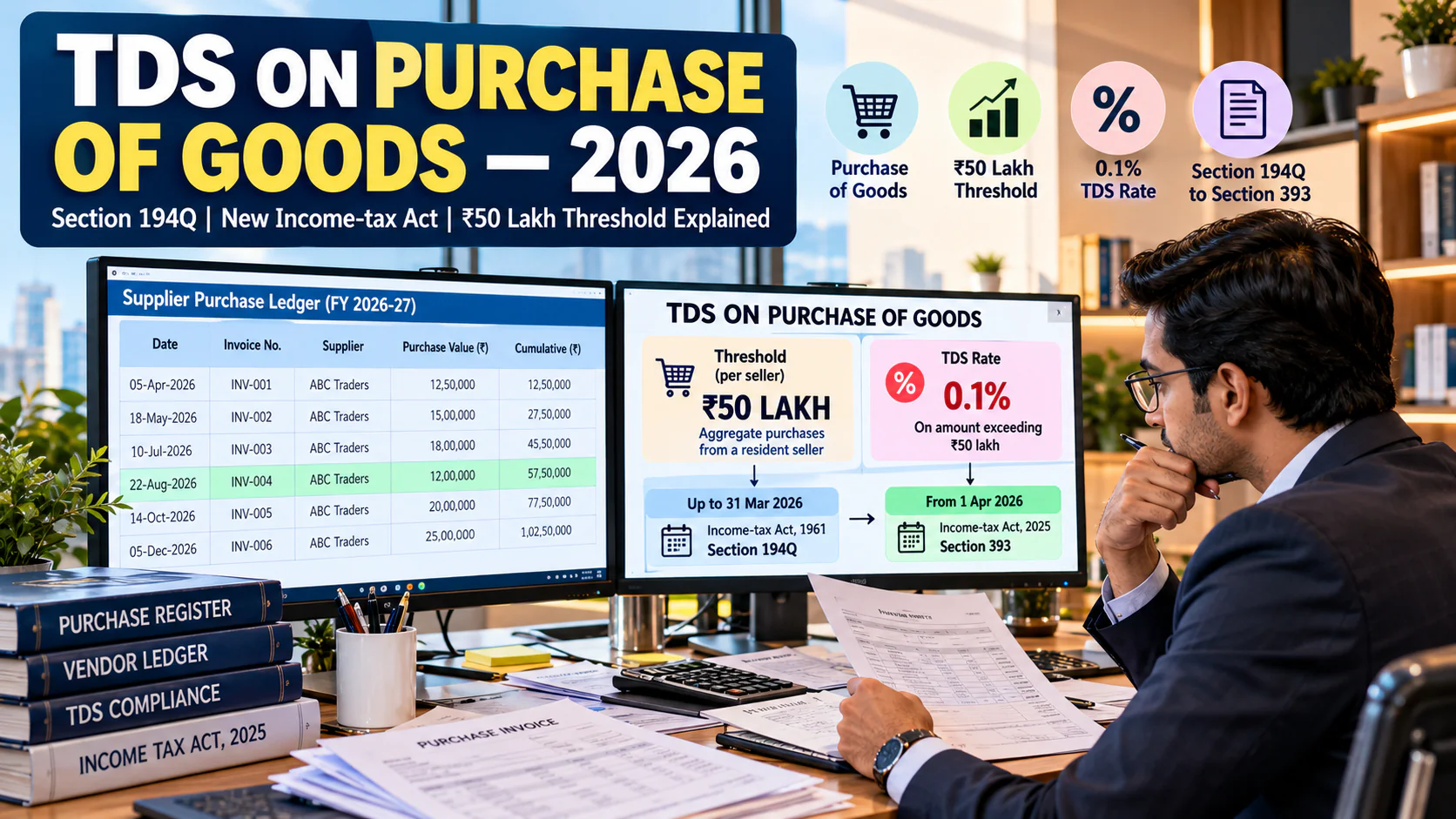
Under the earlier Section 194Q, a buyer carrying on business was required to deduct TDS where the aggregate value of goods purchased from a resident seller exceeded ₹50 lakh during the relevant previous year, subject to the buyer meeting the prescribed turnover condition. The rate was 0.1% of the amount exceeding ₹50 lakh.
For example, suppose:
- Purchases from Supplier A = ₹75 lakh
- Threshold = ₹50 lakh
- Amount exceeding threshold = ₹25 lakh
- TDS rate = 0.1%
TDS would therefore be:
₹25,00,000 × 0.1% = ₹2,500
The important point is that the 0.1% is not normally applied to the entire ₹75 lakh.
It applies to the amount exceeding the ₹50 lakh threshold.
What Has Changed in 2026?
The biggest change for businesses is not the commercial concept of TDS on purchases.
It is the change in the legislation and section numbering.
The Income-tax Act, 2025 came into force from 1 April 2026. The Income Tax Department explains that the earlier TDS provisions from Sections 192 to 194T have broadly been consolidated into two provisions:
- Section 392 — TDS on salaries
- Section 393 — TDS on other specified payments
Section 393 uses tables covering different categories of payments, payees and applicable rates. The Department has stated that the rates and thresholds are largely the same as under the earlier framework.
The Income-tax Act, 2025 specifically maps the old purchase-of-goods provision to Section 393(1), Table Sl. No. 8(ii). The new Act’s definition of “buyer” also refers to the purchase of goods under that provision and retains the ₹10 crore preceding-year turnover concept.
Therefore, businesses should distinguish between:
| Transaction period | Relevant framework |
|---|---|
| Up to 31 March 2026 | Income-tax Act, 1961 / Section 194Q |
| From 1 April 2026 | Income-tax Act, 2025 / Section 393 |
The Income Tax Department has specifically instructed deductors that transactions on or after 1 April 2026 should use the applicable Section 393 table reference rather than old section numbers.
Who Is Required to Deduct TDS on Purchase of Goods?
There are several conditions that should be checked.
1. The payer must be a buyer carrying on business
The provision is aimed at qualifying business buyers.
The earlier Section 194Q framework specifically required the buyer to be carrying on business and also prescribed a preceding-year turnover condition.
2. The buyer’s preceding-year turnover must exceed ₹10 crore
This is one of the most important filters.
The buyer is generally covered where its total sales, gross receipts or turnover from business exceeded ₹10 crore during the immediately preceding financial/tax year, subject to the applicable statutory framework.
This means a small business cannot automatically become liable for purchase-of-goods TDS merely because purchases from one supplier cross ₹50 lakh.
The buyer-level turnover condition must also be examined.
3. The seller should be a resident
The provision concerns purchases from a resident seller.
Therefore, the nature and residential status of the payee should be verified before applying the domestic purchase TDS provision.
4. Purchases from the seller exceed ₹50 lakh
The threshold is generally tested with reference to the aggregate value of goods purchased from the seller during the relevant year.
The Income Tax Department’s guidance states that TDS applies when the aggregate purchase value from the seller exceeds ₹50 lakh, with TDS at 0.1% on the amount exceeding ₹50 lakh.
The ₹50 Lakh Threshold: How Does It Actually Work?
This is where many accounting teams make mistakes.
The threshold is not generally a ₹50 lakh exemption that resets for every invoice.
It is an aggregate seller-wise threshold.
Suppose a company purchases from Supplier A:
| Invoice | Purchase |
|---|---|
| April | ₹18 lakh |
| June | ₹12 lakh |
| August | ₹15 lakh |
| October | ₹10 lakh |
| December | ₹20 lakh |
| Total | ₹75 lakh |
Once the cumulative purchases cross ₹50 lakh, the excess becomes relevant for TDS.
Total purchases = ₹75 lakh
Threshold = ₹50 lakh
Excess = ₹25 lakh
TDS = ₹25 lakh × 0.1%
TDS = ₹2,500
Therefore, businesses should maintain a supplier-wise cumulative purchase tracker instead of checking every invoice independently.
Does GST Count for the ₹50 Lakh Threshold?
This is an area where businesses should exercise care rather than applying a blanket formula.
The purchase-value calculation should be determined in accordance with the applicable TDS provisions, including the treatment of GST and the timing of credit/payment.
Businesses should therefore avoid simply taking the total invoice value from their accounting system without considering the applicable tax-treatment rules and the nature of the transaction.
For automated ERP implementation, the TDS configuration should be reviewed against the exact statutory requirement rather than relying solely on a generic “purchase value” field.
When Does TDS Have to Be Deducted?
The basic timing principle is important.
Under the earlier Section 194Q framework, TDS was required at the time of:
- credit of the amount to the seller’s account; or
- payment,
whichever occurred earlier.
This means that TDS is not necessarily postponed until the supplier is actually paid.
Example
Supplier invoice:
₹60 lakh
The invoice is credited in the books on 10 September.
Payment is made on 25 November.
If the threshold and other conditions are satisfied, the TDS obligation is triggered based on the applicable earlier event.
Businesses should therefore ensure that their accounts-payable process and TDS engine are aligned.
What About Advance Payments?
Advance payments should not be ignored.
The official Income Tax Department guidance on Section 194Q specifically notes that the provision can apply to advance payments because deduction is linked to the earlier of credit or payment.
For example:
A company places a large order and pays ₹20 lakh advance to a supplier.
If the relevant conditions are satisfied, the TDS analysis should be performed at the advance-payment stage rather than waiting for the final invoice.
This is particularly important for:
- machinery purchases;
- bulk inventory purchases;
- raw-material contracts;
- annual supply agreements;
- large project procurement;
- advance payments to regular vendors.
What Is the TDS Rate?
The standard rate for qualifying purchase-of-goods transactions is 0.1% on the amount exceeding the ₹50 lakh threshold, subject to the applicable provisions.
For example:
Purchase from Supplier B = ₹1.20 crore
Excess over ₹50 lakh:
₹1.20 crore − ₹50 lakh = ₹70 lakh
TDS:
₹70 lakh × 0.1% = ₹7,000
The amount may look small.
But the compliance risk is not small.
A business that repeatedly misses TDS can face:
- interest;
- late-payment consequences;
- late filing fees;
- notices;
- reconciliation problems;
- potential expense-disallowance implications under applicable provisions;
- vendor disputes.
The compliance process should therefore be designed around accuracy rather than the absolute amount of TDS.
Important 2026 Change: TCS on Sale of Goods
Another important development is the removal of the earlier TCS provision relating to certain large sales of goods under Section 206C(1H).
The Finance Bill 2025 memorandum explained that Section 206C(1H) had created an overlapping mechanism because a seller could have TCS obligations while the buyer could simultaneously have TDS obligations under Section 194Q.
The provision relating to TCS on sale of specified goods under Section 206C(1H) was subsequently omitted with effect from 1 April 2025.
This makes the current compliance environment simpler in one respect.
Businesses should nevertheless distinguish this from other TCS provisions that continue to exist.
2026 Transition: Section 194Q vs Section 393
The transition from the old Act to the new Act is particularly important for accounting teams.
Consider two purchases:
Purchase 1 — March 2026
Invoice credited:
25 March 2026
Payment:
April 2026
Because the relevant TDS-triggering event occurred before 1 April 2026, the old Act framework applies. The Income Tax Department’s transition guidance confirms that where the earlier event of credit or payment occurred on or before 31 March 2026, the Income-tax Act, 1961 governs the TDS obligation.
Purchase 2 — April 2026
Invoice credited:
10 April 2026
Payment:
20 April 2026
This transaction falls under the Income-tax Act, 2025.
The relevant provision should therefore be identified from Section 393 and the applicable table.
The Income Tax Department has specifically warned that quoting old section numbers for transactions governed by the new Act can result in system-level validation issues.
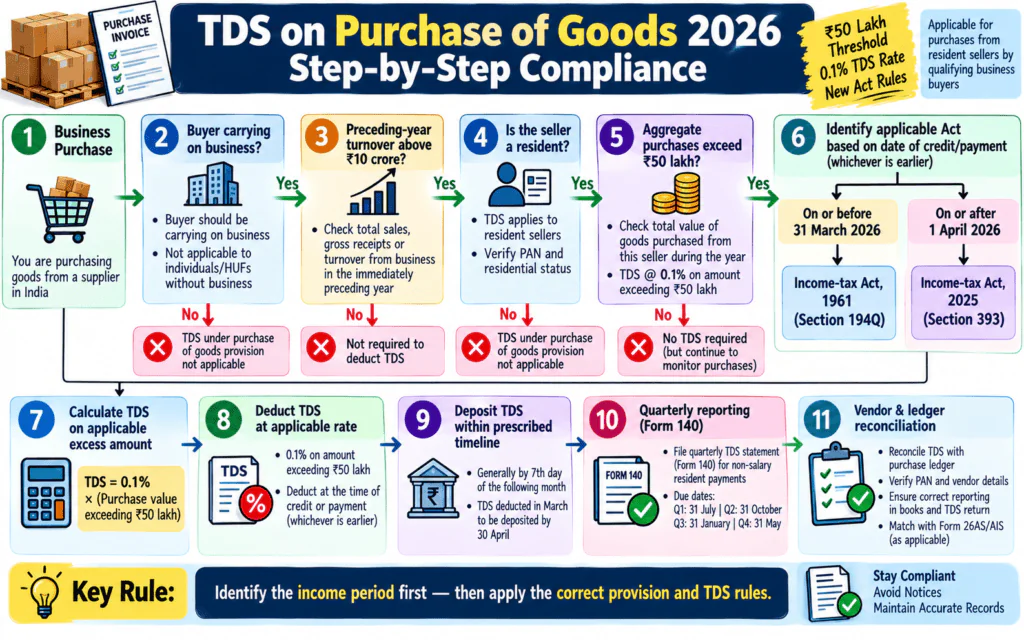
Mid-Blog Flowchart: How to Check Purchase-of-Goods TDS
[FLOWCHART IMAGE — replace the usual mid-blog photograph here]
The practical decision process is:
Step 1: Is the buyer carrying on business?
↓
Step 2: Did the buyer cross the prescribed preceding-year turnover threshold?
↓
Step 3: Is the seller a resident?
↓
Step 4: Are the purchases covered by the purchase-of-goods TDS provision?
↓
Step 5: Have aggregate purchases from that seller exceeded ₹50 lakh?
↓
Step 6: Identify the applicable Act based on the date of the earlier credit/payment event.
↓
Step 7: Calculate TDS on the applicable excess amount.
↓
Step 8: Deduct, deposit and report the TDS within the prescribed timelines.
↓
Step 9: Reconcile TDS with vendor records, books and the tax portal.
What Happens If the Seller Does Not Provide PAN?
PAN verification should be part of the vendor onboarding process.
The Income Tax Department’s guidance for the earlier Section 194Q framework states that a higher TDS rate could apply where PAN is not furnished, with the applicable higher-rate rules determined under the relevant provisions.
The key practical lesson is:
Do not wait until the TDS return is being prepared to discover that the vendor’s PAN is missing or incorrect.
PAN should be validated during:
- vendor creation;
- purchase-order approval;
- invoice processing;
- TDS calculation;
- quarterly TDS return preparation.
What Are the TDS Deposit Timelines?
For ordinary TDS, the general payment timeline continues to be linked to the month in which tax is deducted.
The Income Tax Department states that under the earlier framework, non-government deductors generally had to deposit TDS by the 7th day of the following month, with TDS deducted in March generally payable by 30 April.
The Income-tax Act, 2025 does not introduce a policy change to these general timelines; the Income Tax Department explains that the Income-tax Rules, 2026 retain the relevant framework.
For a business deducting TDS on a purchase transaction during September 2026, for example, the tax should generally be deposited within the applicable prescribed timeline.
The accounts team should not confuse:
- date of invoice;
- date of credit;
- date of payment;
- date of TDS deduction;
- date of TDS deposit;
- quarterly return due date.
Each is a separate compliance event.
TDS Return Filing Under the New Act
The transition also changes the forms used for TDS reporting.
The Income Tax Department explains that Form 140, earlier known as Form 26Q, is the quarterly TDS statement for non-salary payments to residents under the Income-tax Act, 2025.
The current stated quarterly due dates are:
| Quarter | Period | Due date |
|---|---|---|
| Q1 | April–June | 31 July |
| Q2 | July–September | 31 October |
| Q3 | October–December | 31 January |
| Q4 | January–March | 31 May |
These dates are important for businesses preparing their 2026-27 TDS compliance calendar.
Example: Complete TDS Calculation
Assume:
ABC Ltd.
- Previous-year turnover: ₹18 crore
- Supplier: Resident Indian company
- Aggregate purchases during the year: ₹1.10 crore
- Purchases before threshold: ₹50 lakh
- Excess purchases: ₹60 lakh
TDS:
₹60,00,000 × 0.1%
= ₹6,000
The business should then ensure that:
- the seller’s PAN is correctly recorded;
- the applicable Act is identified;
- the TDS amount is deducted at the correct event;
- the TDS is deposited within the prescribed time;
- the transaction is included in the relevant TDS statement;
- the vendor’s books are reconciled;
- the TDS credit eventually reflects correctly.
Example: Why Vendor-Wise Tracking Matters
Suppose a company purchases from five vendors:
| Vendor | Annual purchases |
|---|---|
| Vendor A | ₹82 lakh |
| Vendor B | ₹46 lakh |
| Vendor C | ₹1.25 crore |
| Vendor D | ₹28 lakh |
| Vendor E | ₹55 lakh |
The company should not simply compare the total procurement of ₹3.36 crore with ₹50 lakh.
The threshold is examined with reference to the relevant seller.
Therefore:
- Vendor A → threshold crossed
- Vendor B → threshold not crossed
- Vendor C → threshold crossed
- Vendor D → threshold not crossed
- Vendor E → threshold crossed
This is why vendor-wise TDS tracking is critical.
Common Mistakes Businesses Make
Mistake 1: Checking only individual invoices
TDS on purchase of goods is not simply an invoice-by-invoice test.
The aggregate purchase value from the seller matters.
Mistake 2: Ignoring the buyer’s turnover
Crossing ₹50 lakh of purchases from a vendor does not by itself answer the question.
The buyer’s own eligibility must also be checked.
Mistake 3: Applying TDS to every supplier
Not every supplier automatically becomes subject to purchase-of-goods TDS.
The statutory conditions need to be checked.
Mistake 4: Continuing to use 194Q for new-Act transactions
For transactions governed by the Income-tax Act, 2025, the relevant Section 393 table reference should be used.
The Income Tax Department has specifically highlighted this transition.
Mistake 5: Ignoring advances
TDS may be triggered by payment before the invoice is formally recorded because the timing rule is based on the earlier event.
Mistake 6: Not reconciling vendor-wise purchases
ERP purchase data, vendor ledgers and TDS calculations should be periodically reconciled.
Mistake 7: Assuming the new Act completely changed TDS rates
The new Act reorganises and simplifies the TDS provisions, but the Income Tax Department has stated that the rates and thresholds are largely unchanged.
Practical Compliance Checklist for Businesses
A finance team can implement the following monthly checklist.
Vendor master
- Verify PAN.
- Verify residency status.
- Identify whether the vendor is a government entity or other excluded category where relevant.
- Maintain GSTIN and other vendor identifiers separately.
Purchase monitoring
- Maintain supplier-wise cumulative purchases.
- Track purchases against the ₹50 lakh threshold.
- Include relevant advances.
- Review unusual or one-time high-value purchases.
TDS calculation
- Confirm buyer turnover eligibility.
- Confirm seller status.
- Identify applicable law based on transaction timing.
- Calculate TDS only on the relevant amount.
- Check higher-rate provisions where applicable.
Payment and reporting
- Deduct TDS at the appropriate time.
- Deposit TDS within the applicable due date.
- File the appropriate quarterly statement.
- Reconcile TDS payable with the books.
- Reconcile vendor deductions with Form 26AS/AIS where relevant.
ERP controls
The ERP or accounting system should ideally provide:
- vendor-wise purchase accumulation;
- automatic threshold alerts;
- TDS applicability flags;
- PAN validation;
- transaction-date based Act selection;
- TDS ledger reconciliation;
- exception reports.
This becomes particularly important in 2026 because the legal transition also requires accounting and compliance systems to recognise the new section structure.
The Income Tax Department itself states that deductors need to update systems to reflect the new section numbering, terminology and reporting requirements under the Income-tax Act, 2025.
What Businesses Should Do Now
For businesses with significant procurement, the safest approach is not to wait until the quarterly TDS return.
Instead, review the purchase ledger every month.
A practical process would be:
Purchase register → Vendor-wise aggregation → ₹50 lakh threshold check → Buyer eligibility check → Act/section identification → TDS calculation → Deduction → Deposit → Return → Reconciliation
This simple workflow can prevent many avoidable errors.
Businesses should also update their internal SOPs.
If the old SOP says:
“Check Section 194Q”
it should now explain that transactions governed by the Income-tax Act, 2025 must be mapped to the relevant provision in Section 393.
The old section number can still be retained as a reference for historical transactions and legacy documentation.
Frequently Asked Questions
Is TDS applicable when purchases from one supplier are exactly ₹50 lakh?
The statutory trigger is based on purchases exceeding ₹50 lakh. Therefore, a purchase total exactly at ₹50 lakh does not cross the threshold.
What if purchases become ₹51 lakh?
The excess is ₹1 lakh.
At 0.1%, the TDS would generally be:
₹1,00,000 × 0.1% = ₹100
subject to all other applicability conditions.
Does the ₹10 crore turnover test relate to the buyer or seller?
It is the buyer’s preceding-year business turnover condition that is relevant to determining whether the buyer falls within the provision.
Does Section 194Q still apply in 2026?
For transactions governed by the Income-tax Act, 1961, Section 194Q remains the relevant historical provision. For transactions from 1 April 2026 governed by the new Act, the corresponding purchase-of-goods TDS provision is contained in Section 393’s table structure.
Does TDS apply to advance payment?
The earlier Section 194Q framework applied the earlier-of-credit-or-payment rule, meaning advance payments could trigger deduction.
Has the 0.1% rate changed because of the new Income-tax Act?
The Income Tax Department states that TDS rates and thresholds are largely the same under the new Act. The purchase-of-goods rate remains based on the applicable statutory table and should be verified for the transaction concerned.
Is TCS under Section 206C(1H) still applicable?
The earlier TCS provision relating to sale of goods under Section 206C(1H) was omitted with effect from 1 April 2025.
What form is used for the quarterly TDS statement under the new Act?
For non-salary TDS on resident payments, the Income Tax Department identifies Form 140, earlier known as Form 26Q, as the quarterly statement under the Income-tax Act, 2025.
Should a business update its ERP for the new Act?
Yes. The Income Tax Department has specifically advised that systems should be updated for new section numbering, terminology and reporting requirements.
Get expert guidance on income tax filing, tax compliance, notices, planning and related matters.
Explore Income Tax Services →Key Takeaways
- TDS on qualifying purchases of goods remains an important compliance requirement in 2026.
- The familiar Section 194Q framework applied under the Income-tax Act, 1961.
- From 1 April 2026, the new Income-tax Act, 2025 governs new transactions.
- The corresponding purchase-of-goods provision is incorporated into Section 393’s tabular framework.
- The ₹50 lakh seller-wise threshold remains a critical number.
- The buyer’s preceding-year turnover condition also needs to be checked.
- The standard rate is 0.1% on the applicable amount exceeding the threshold.
- The earlier-of-credit-or-payment principle is important.
- Advance payments should not automatically be ignored.
- Businesses should maintain supplier-wise cumulative purchase data.
- PAN and vendor-master accuracy are essential.
- TDS deposit and quarterly reporting deadlines must be monitored separately.
- Form 140 is the new quarterly non-salary resident TDS statement under the Income-tax Act, 2025.
- ERP and accounting systems should be updated for the new Act.
- Section 206C(1H) TCS on sale of goods was omitted from 1 April 2025.
- Businesses should reconcile purchase ledgers, TDS ledgers, vendor accounts and tax records regularly.
The biggest practical lesson is simple:
Do not wait for the TDS return filing date to discover that a supplier crossed the ₹50 lakh threshold months earlier.
A monthly vendor-wise review can make purchase TDS substantially easier to manage.
Resources / Official Sources
- Income Tax Department — Section 194Q: The official provision covering TDS on purchase of goods under the earlier Income-tax Act, 1961.
Income Tax Department — Section 194Q - Income Tax Department — TDS on Purchase of Goods: Official guidance explaining the ₹50 lakh threshold, 0.1% rate, buyer conditions and timing of deduction.
Income Tax Department — TDS on Purchase of Goods - Income Tax Department — Tax Payments & TDS Transition FAQs: Official guidance on the transition from the Income-tax Act, 1961 to the Income-tax Act, 2025, including Section 393 and applicable dates.
Income Tax Department — Tax Payments FAQs - Income Tax Department — TDS Compliance FAQs: Official guidance on the transition, system changes and the earlier-of-credit-or-payment principle.
Income Tax Department — TDS Compliance - Income Tax Department — Form 140: Official guidance for the new quarterly TDS statement corresponding to the earlier Form 26Q.
Income Tax Department — Form 140 User Manual