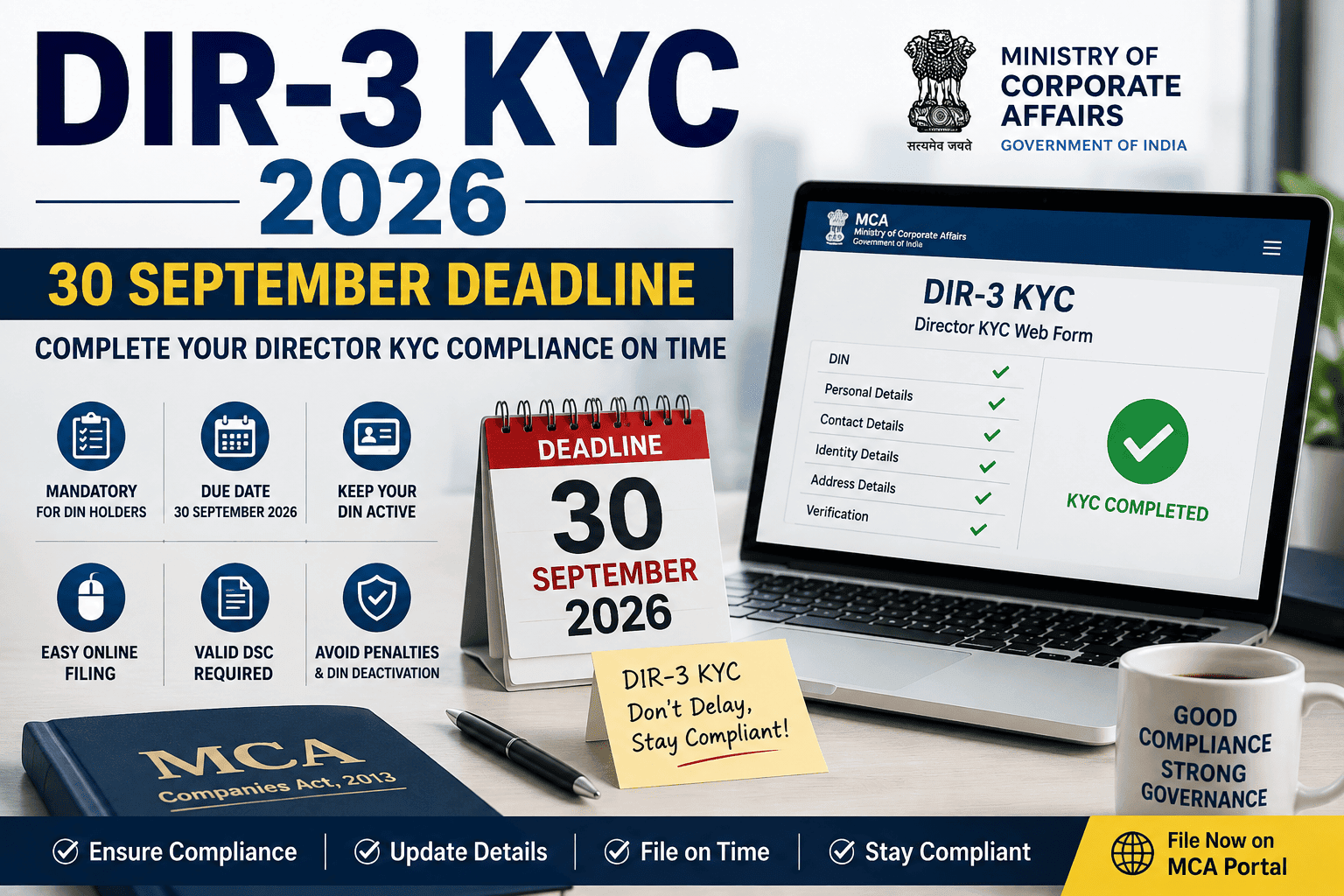
For many company directors, DIR-3 KYC is the kind of compliance that is easy to postpone because nothing seems to happen when you ignore it for a few weeks.
There is no GST payment involved. No tax calculation is required. Your company may be operating normally. Your DIN may have been allotted years ago.
But MCA treats director KYC as a separate annual compliance requirement.
For the 2025-26 financial year, directors whose DIN is covered by the applicable rule need to ensure that their KYC compliance is completed by 30 September 2026. The Ministry of Corporate Affairs’ official instruction kit states that a person who holds a DIN is required to file the applicable KYC webform by 30 September of the immediate next financial year.
That makes September an important month for companies, directors, company secretaries, accountants and compliance professionals.
The bigger issue, however, is not simply remembering the date.
The real question is:
Do you need DIR-3 KYC, DIR-3 KYC-WEB, or some other MCA action—and are the mobile number, email, PAN, passport, address and digital-signature details actually consistent with the MCA records?
A surprisingly large number of last-minute KYC problems come from outdated contact details, inactive DINs, DSC issues or mismatches between the information maintained by MCA and the information the director is trying to submit.
This guide explains the DIR-3 KYC 2026 deadline, who needs to comply, the difference between DIR-3 KYC and DIR-3 KYC-WEB, what documents and information should be kept ready, what happens after non-compliance, and how companies can complete the process without waiting until the final week.
Get professional assistance with DIR-3 KYC, DIN compliance and MCA filings.
Get KYC Assistance →What is DIR-3 KYC?
DIR-3 KYC is part of the MCA’s director identification and KYC framework.
Its purpose is to keep the information associated with a Director Identification Number, or DIN, updated in the MCA system.
The requirement operates under Rule 12A of the Companies (Appointment and Qualification of Directors) Rules, 2014. The MCA’s official instruction kit specifically identifies DIR-3 KYC as the KYC mechanism for directors and states that a person holding a DIN is required to complete the KYC requirement by 30 September of the immediate next financial year.
The information is not limited to a person’s name.
Depending on the applicable filing route, the process involves details such as:
- DIN;
- director’s name;
- father’s name;
- citizenship;
- nationality;
- residential status;
- date of birth;
- gender;
- PAN or passport information, as applicable;
- mobile number;
- email address;
- residential address; and
- other prescribed KYC information.
The objective is to keep the MCA’s director database current and usable for corporate-compliance and enforcement purposes.
What is the DIR-3 KYC deadline for 2026?
For the relevant annual KYC cycle, the key deadline is:
30 September 2026.
The MCA’s instruction kit provides the rule that the applicable KYC filing is due on or before 30 September of the immediate next financial year.
This means companies should not wait until September 29 or 30 to begin the process.
The filing may be quick when everything is correct.
But if there is:
- a DSC problem;
- an email mismatch;
- an incorrect mobile number;
- an inactive DIN;
- PAN-related inconsistency;
- a name mismatch;
- an address issue; or
- difficulty accessing the MCA account,
the time required can increase considerably.
Who needs to complete DIR-3 KYC?
The rule applies to individuals holding DINs, subject to the applicable provisions.
The MCA’s instruction kit specifically states that a person who has been allotted a DIN up to 31 March of a financial year is required to file the applicable KYC webform by 30 September of the immediate next financial year.
For a company compliance team, the practical approach should therefore be:
Do not check only whether a director is currently active in the company. Check the DIN status and KYC status.
A person may have resigned from one company but still hold a DIN.
Similarly, someone may not be involved in day-to-day management but can still have an ongoing DIN-related compliance obligation.
DIR-3 KYC vs DIR-3 KYC-WEB: What is the difference?
This is one of the most important distinctions.
Not every director has to repeatedly complete the full KYC form from scratch every year.
The MCA framework provides for DIR-3 KYC-WEB as a simplified KYC confirmation mechanism in subsequent years where the director’s previously submitted information continues to remain unchanged.
The underlying rule was amended to provide that where an individual has already submitted DIR-3 KYC for a previous financial year, submission of DIR-3 KYC-WEB through the web service for a subsequent financial year can constitute compliance for that year.
In practical terms, the distinction can be understood like this:
| Situation | Likely route |
|---|---|
| First-time KYC / applicable detailed KYC filing | DIR-3 KYC |
| Previous KYC already completed and details remain unchanged | DIR-3 KYC-WEB may be applicable |
| Mobile/email needs updating | DIR-3 KYC is relevant |
| Additional change requiring full KYC information | Detailed KYC route may be required |
| KYC not completed earlier and DIN is deactivated due to non-filing | Applicable MCA KYC process needs to be completed |
The exact filing option displayed by MCA should be checked before submission.
What if your mobile number or email address has changed?
This is where directors need to be careful.
A person might think:
“My KYC was completed last year, so I can simply use the web confirmation.”
That may not be appropriate if the director’s personal mobile number or email address needs to be changed.
The MCA’s official instruction kit specifically states that a director wishing to update the personal mobile number or email address is required to use the DIR-3 KYC filing route.
This is an important practical distinction.
Suppose Rahul completed his KYC last year using his old personal email address.
In 2026, he has changed his email address.
He should not simply assume that the unchanged-information web service is sufficient.
The appropriate KYC filing mechanism should be used to update the information.
What information should directors keep ready?
Before starting the filing, the director should keep the relevant information and supporting documents available.
Personal identification details
Review:
- full legal name;
- father’s name;
- date of birth;
- nationality;
- citizenship;
- residential status; and
- gender, where required.
PAN or passport
The applicable identification details should correspond with the relevant official records.
Do not type information from memory.
Use the actual document.
Mobile number
Use the director’s personal mobile number as required by the MCA process.
Email address
Use an email address that the director can access.
Avoid using a generic accounts department email merely because it was used in an earlier filing unless the applicable MCA requirements permit it.
Residential address
Review the address carefully.
Particular attention should be given to:
- house/flat number;
- street;
- locality;
- city;
- state;
- country; and
- postal code.
A small data-entry error can create unnecessary complications.
What documents may be required?
The exact document requirements can depend on the filing route and circumstances.
The MCA’s instruction kit requires supporting documents in the prescribed format where applicable and highlights the importance of ensuring that the DIN holder is properly registered and that the required DSC is valid.
A director should therefore keep accessible:
- PAN card;
- passport, where applicable;
- proof of address, where required;
- current mobile number;
- current email address;
- DSC;
- DIN;
- MCA login credentials; and
- any information needed to resolve a mismatch.
For foreign nationals or non-resident directors, additional documentation or authentication requirements may apply depending on the circumstances.
Why DSC causes so many last-minute problems
A Digital Signature Certificate is not merely a technical accessory.
It is part of the electronic filing process.
The MCA instruction kit specifically requires the signing authority to have a valid and non-expired/non-revoked DSC. It also states that the DSC should be registered on the MCA portal against the relevant DIN or membership information, as applicable.
A company may therefore discover at the last minute that:
- the DSC has expired;
- the DSC token is not recognised;
- the DSC is registered incorrectly;
- the signatory information does not match; or
- the required software environment is not working.
This is why a September 30 compliance deadline should be treated as a deadline for completion, not the day on which the process begins.
What happens if DIR-3 KYC is not completed?
Non-compliance can affect the status of the DIN.
The MCA instruction kit specifically recognises DIN status such as “Deactivated due to non-filing of DIR-3-KYC” as a possible status in the KYC workflow.
That is important because a deactivated DIN can create practical problems for the individual and potentially for companies where that person is required to act as a director.
The consequences should therefore not be viewed simply as:
“I will pay a late fee later.”
The operational status of the DIN matters.
Does a director lose the DIN permanently?
No.
The fact that a DIN has been deactivated because of non-filing should not be confused with permanent cancellation of the DIN.
The MCA system provides a mechanism for KYC compliance in cases where the DIN status is deactivated due to non-filing, subject to the applicable rules and filing requirements.
However, it is much better to complete the KYC within the normal compliance window than to create a status problem that later has to be regularised.
Is DIR-3 KYC a company compliance or director compliance?
It is primarily a director-level KYC compliance linked to the DIN.
That distinction matters.
A company may have filed all its annual returns and financial statements on time.
That does not necessarily mean every director’s DIN-level KYC obligation has been satisfied.
Similarly, a director may have several directorships.
The KYC obligation is connected to the DIN and the individual, not simply to one particular company.
This is why a proper company compliance checklist should contain a separate section for:
Director KYC / DIN status
rather than burying it under annual company filings.
Example: one director, three companies
Suppose Priya is a director in three private companies:
- Alpha Private Limited;
- Beta Private Limited; and
- Gamma Private Limited.
All three companies have their own annual compliance schedules.
Priya’s DIN, however, is personal to her.
If her DIR-3 KYC requirement is due, the compliance should not be treated as three separate KYC filings simply because she is associated with three companies.
The company secretarial team should instead coordinate with Priya and ensure that the DIN-level requirement is appropriately completed.
What if a director has changed address?
This is another common situation.
Suppose Amit moved from Chandigarh to Delhi during the year.
His MCA records still contain the old address.
He should not blindly confirm the old information simply because it was used successfully last year.
The KYC process is intended to keep the information current.
If a change requires the detailed filing route, the director should update the relevant information through the prescribed process.
A compliance system is useful only when the underlying data is accurate.
What if the director is an NRI or foreign national?
Companies with overseas directors should start the KYC process earlier.
There can be additional practical issues involving:
- foreign address;
- passport details;
- country information;
- digital signature;
- authentication;
- document formats;
- notarisation or apostille requirements, where applicable; and
- access to the MCA filing environment.
The exact requirements depend on the individual’s circumstances and the form being filed.
The important lesson is simple:
Do not leave foreign-director KYC until the final week.
A domestic director can often resolve a documentation problem quickly.
An overseas director may need substantially more time.
A practical DIR-3 KYC checklist for September 2026
Companies can use the following checklist immediately.
Step 1: Prepare the DIN list
Extract the DINs of all current and relevant former directors connected with your compliance review.
Step 2: Check DIN status
Identify whether each DIN is:
- active/approved;
- deactivated due to KYC non-filing; or
- subject to another status requiring attention.
Step 3: Check previous KYC status
Determine whether the director has previously completed DIR-3 KYC.
Step 4: Identify changes
Ask the director whether any of the following changed:
- mobile;
- email;
- address;
- name;
- identification details; or
- other prescribed information.
Step 5: Select the correct filing route
Determine whether the director needs the detailed DIR-3 KYC filing or the applicable web-based confirmation.
Step 6: Check DSC
Do this early.
Do not wait until September 29.
Step 7: Verify PAN/passport information
Make sure the information is entered exactly as required.
Step 8: Check attachments
Ensure documents meet the required format and size specifications.
Step 9: Complete authentication
Follow the applicable OTP and DSC verification process.
Step 10: Save the evidence
Keep:
- SRN;
- acknowledgement;
- filing copy;
- date of filing; and
- any relevant MCA communication.
A simple internal tracker for companies
A company can maintain a small compliance table:
| Director | DIN | Previous KYC | Changes? | Filing Route | DSC | Status | Filed On |
|---|---|---|---|---|---|---|---|
| Director A | XXXXXXXX | Yes | No | KYC-WEB | Valid | Pending | — |
| Director B | XXXXXXXX | Yes | Email changed | DIR-3 KYC | Valid | Pending | — |
| Director C | XXXXXXXX | No | — | DIR-3 KYC | Renewal needed | Pending | — |
| Director D | XXXXXXXX | Previous non-filing | — | Regularisation route | Valid | Deactivated | — |
This type of tracker is far more useful than simply writing “DIR-3 KYC due” in a calendar.
It tells the compliance team what is actually blocking the filing.
Five common DIR-3 KYC mistakes
Mistake 1: Assuming every director uses the same form
The filing route can depend on whether the director has previously completed KYC and whether information needs to be updated.
Mistake 2: Using an old email address
A director may no longer have access to the email used previously.
This should be identified early.
Mistake 3: Ignoring DSC validity
A valid DSC is an important part of electronic filing.
Mistake 4: Waiting for the company accountant
The director himself may need to provide personal information or authentication.
The finance team cannot always complete everything independently.
Mistake 5: Treating the September 30 date as a reminder date
September 30 should be the completion deadline, not the day the company starts collecting documents.
What should companies do in the next 7 days?
If you manage compliance for several companies, a simple priority system works well.
Priority A: Foreign or non-resident directors
Contact them first.
Documentation can take longer.
Priority B: Directors whose email/mobile has changed
These may require the detailed filing route rather than a simple confirmation.
Priority C: DINs with previous KYC issues
Check the current status immediately.
Priority D: Directors with valid and unchanged details
These are generally easier to process, but should still be completed rather than left until the deadline.
How DIR-3 KYC fits into the larger MCA compliance calendar
September is not only about director KYC.
Companies and LLPs have multiple compliance obligations throughout the year.
Depending on the entity, the compliance calendar can include:
- annual financial statements;
- annual returns;
- director KYC;
- auditor-related filings;
- event-based forms;
- registered-office compliance;
- beneficial ownership disclosures;
- significant beneficial owner compliance;
- deposits and outstanding loans reporting;
- charge creation/modification/satisfaction;
- shareholding-related filings; and
- other sector-specific or event-driven filings.
The biggest mistake is to manage these as isolated forms.
A better system is to maintain an entity-wise compliance calendar.
A better compliance system for small companies
A small private company does not necessarily need an expensive compliance platform.
It needs ownership.
Create four columns:
Compliance → Person Responsible → Due Date → Status
For DIR-3 KYC, add:
Director → DIN → KYC route → DSC status → Filing date
That simple structure can prevent a large number of avoidable last-minute problems.
Frequently asked questions
What is the DIR-3 KYC deadline in 2026?
The applicable annual KYC filing deadline is 30 September 2026, based on the MCA’s rule requiring the KYC filing by 30 September of the immediate next financial year.
Is DIR-3 KYC mandatory for every person who has ever received a DIN?
The requirement depends on the applicable rule and the person’s DIN status. Companies should review the current DIN/KYC position rather than assuming that resignation from a company eliminates all DIN-related compliance.
What is DIR-3 KYC-WEB?
It is a web-based KYC confirmation mechanism that can be used for subsequent financial years where the individual has already submitted DIR-3 KYC and the applicable conditions for the web service are satisfied.
What if my mobile number or email has changed?
The MCA instruction kit states that a person wishing to update the personal mobile number or email address should submit DIR-3 KYC rather than relying only on the web-based confirmation mechanism.
Can DIR-3 KYC be filed if the DIN is deactivated because of non-filing?
The MCA instruction kit specifically recognises “Deactivated due to non-filing of DIR-3-KYC” as a DIN status within the KYC workflow. The appropriate regularisation filing should be checked on the MCA portal.
Is DSC required?
The MCA’s instruction kit states that the signing authority must have a valid, non-expired and non-revoked DSC and that the DSC should be registered on the MCA portal as required.
Does a director need to file DIR-3 KYC separately for every company?
The KYC obligation is linked to the DIN and individual rather than being a separate KYC requirement for each company in which the person serves as director.
What documents should I keep ready?
At minimum, keep the relevant identity information, PAN/passport details where applicable, address information, personal mobile and email details, DSC and supporting documents required by the filing route.
What happens if I miss the deadline?
Non-compliance can result in DIN deactivation due to non-filing, and the subsequent regularisation process may involve additional filing requirements and fees. The safest approach is to complete the applicable KYC before the deadline.
Can an NRI director complete DIR-3 KYC?
Yes, subject to the applicable MCA requirements and documentation. NRI and foreign-national directors should begin early because authentication and document requirements can require additional time.
Official Sources
The primary source for DIR-3 KYC requirements is the Ministry of Corporate Affairs.
The MCA’s official Instruction Kit for Form DIR-3-KYC explains the purpose of the form, the 30 September annual deadline, document requirements, DSC requirements and important validation checks.
The underlying rule is Rule 12A of the Companies (Appointment and Qualification of Directors) Rules, 2014. The MCA’s published amendment material explains the introduction of the DIR-3-KYC-WEB mechanism and the 30 September deadline framework.
The MCA portal should be treated as the final source for the filing interface, current DIN status, applicable filing route and any portal-level instructions in force when the filing is actually made.
Key takeaways
- 30 September 2026 is the key annual DIR-3 KYC deadline for the relevant director KYC cycle.
- DIR-3 KYC is a DIN-level compliance, not simply a company-level annual filing.
- Directors with unchanged information may be eligible for DIR-3 KYC-WEB where the applicable conditions are satisfied.
- A director who needs to update personal mobile or email information should use the applicable detailed KYC filing route.
- DSC validity should be checked well before filing.
- PAN, passport, address and other personal information should be reviewed carefully.
- Non-filing can lead to the DIN being shown as deactivated due to non-filing of DIR-3 KYC.
- NRI and foreign-national directors should start earlier because documentation and authentication can take longer.
- Companies should maintain a director-wise KYC tracker instead of relying on a single calendar reminder.
- Completing the filing early is considerably safer than discovering a DSC, email or identity mismatch on 30 September.
Conclusion
DIR-3 KYC is not a complicated compliance requirement when the director’s information is current and the MCA records are in order.
The trouble usually begins when companies leave it until the last few days.
A director may have changed an email address two years ago. A DSC may have expired. A DIN may already have a non-filing status. A foreign director may need additional documentation. Or the company may simply be unsure whether the director needs the detailed DIR-3 KYC form or the web-based confirmation.
These are small issues when discovered in August or early September.
They become much more frustrating when discovered on the afternoon of 30 September.
For the 2026 cycle, companies should therefore treat 30 September as the final completion date—not the starting date.
Prepare the DIN list, check each director’s KYC status, identify changes, verify DSCs, collect documents and complete the filing well before the deadline.
For directors and compliance teams, that simple discipline can turn one of the year’s easily forgotten MCA obligations into one of the easiest to close.