Limited Liability Partnerships have become a popular choice for professionals, family businesses, consultants, startups and closely held businesses that want the flexibility of a partnership with the benefit of limited liability. But there is one misconception that continues to cause trouble: an LLP may have fewer compliances than a private limited company, but it is not a low-compliance structure.
For the financial year 2025-26, LLPs still have to manage their annual return, statement of account and solvency, partner and designated-partner records, income-tax compliance and other event-based filings. And in 2026, there is another development that LLPs should not ignore: the Ministry of Corporate Affairs has revised the framework for adjudication of penalties under the Limited Liability Partnership Act, 2008.
Through Notification S.O. 696(E) dated 10 February 2026, the Central Government appointed specified Registrars of Companies as adjudicating officers under Section 76A of the LLP Act. The notification came into force from 16 February 2026 and superseded the earlier 2022 notification, while also setting out the revised jurisdiction of the adjudicating officers.
This makes timely LLP compliance even more important.
For an LLP whose financial year ended on 31 March 2026, the annual return in Form 11 was generally due by 30 May 2026, while Form 8, containing the Statement of Account and Solvency, is generally due by 30 October 2026. As of September 2026, Form 8 should therefore be high on the compliance calendar of every active LLP.
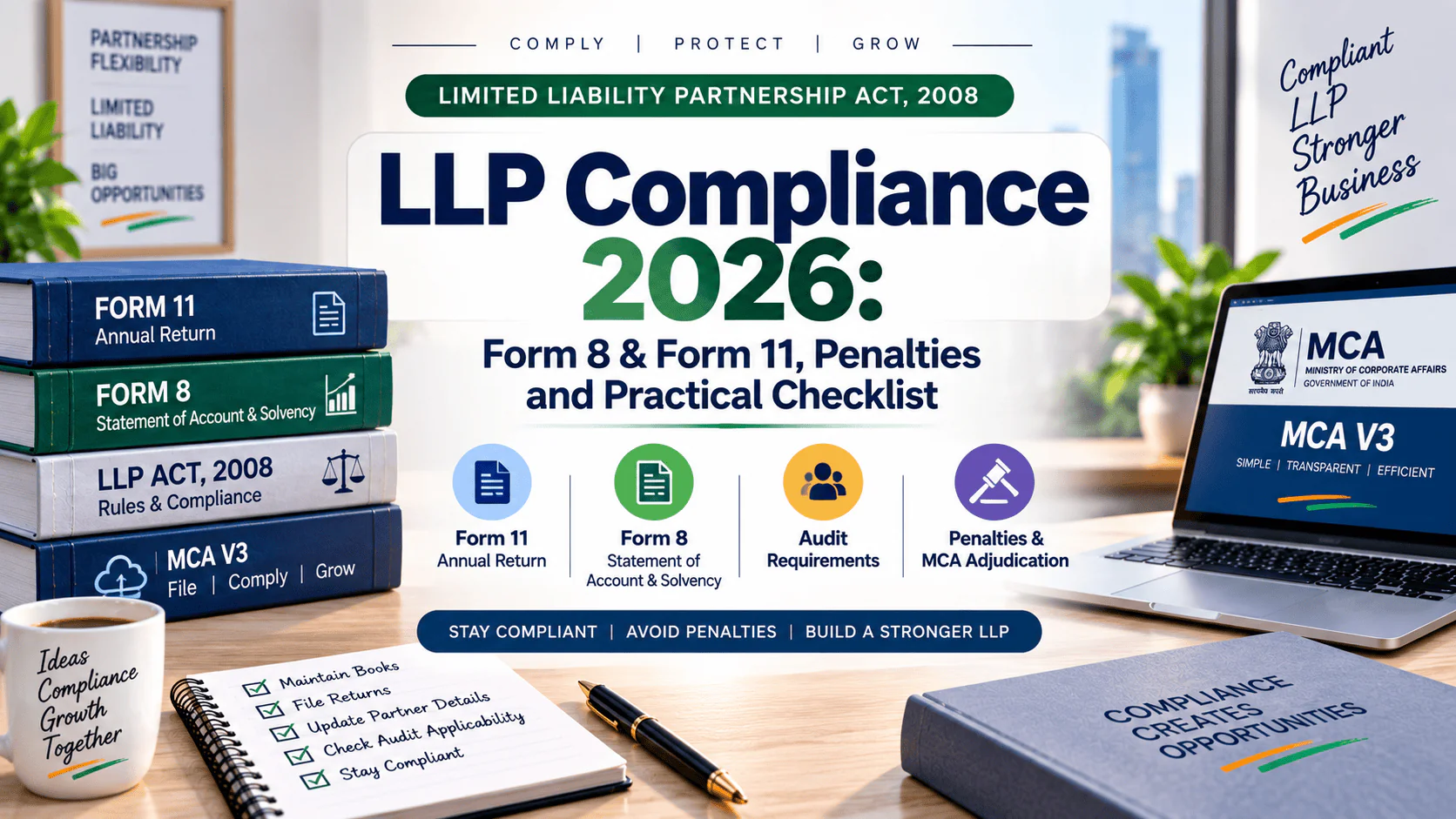
This guide explains the important LLP compliance requirements for 2026, what has changed in the adjudication framework, how Form 8 and Form 11 work, when audit is required, what penalties can arise and how an LLP can avoid last-minute compliance problems.
What is the most important LLP compliance development in 2026?
The significant development for LLPs in 2026 is the revised adjudication framework under Section 76A of the LLP Act.
The MCA’s Notification S.O. 696(E), dated 10 February 2026, appointed specified Registrars of Companies as adjudicating officers for the purposes of the LLP Act. It also mapped different States, Union Territories and districts to particular ROC jurisdictions. The notification became effective from 16 February 2026.
This is important because LLP defaults are not merely a theoretical issue.
If an LLP fails to comply with statutory filing requirements, the matter can move into the penalty and adjudication framework. The revised jurisdiction structure means LLPs and their designated partners should take MCA notices, adjudication communications and compliance-related correspondence seriously.
The MCA itself also announced changes to ROC and Regional Director jurisdictions effective from 16 February 2026, including bifurcation of certain jurisdictions in Delhi, Uttar Pradesh, Maharashtra and West Bengal.
In practical terms, an LLP should not assume that an old ROC jurisdiction map or old compliance process is necessarily sufficient.
Which LLPs are covered by annual compliance requirements?
The annual compliance framework broadly applies to LLPs registered under the Limited Liability Partnership Act, 2008.
This includes LLPs that:
- are actively carrying on business;
- have relatively small turnover;
- have no business activity during the year;
- have only professional partners;
- have foreign investment or foreign partners, subject to applicable regulations;
- are startups;
- have low capital contribution; or
- have not generated profits.
A common mistake is to think that an LLP with no business does not need annual filing.
That is generally incorrect.
An LLP’s annual filing obligations do not disappear merely because the LLP had no revenue or because the partners did not conduct business during the year.
The correct approach is to examine the LLP’s status, financial year, accounts, partner records and applicable filings before concluding that nothing is required.
The two core annual LLP filings: Form 11 and Form 8
For most LLPs, two filings form the backbone of annual MCA compliance:
| Compliance | Form | General due date |
|---|---|---|
| Annual Return | Form 11 | 30 May following the end of financial year |
| Statement of Account & Solvency | Form 8 | 30 October following the end of financial year |
For FY 2025-26, therefore:
- Form 11: generally due 30 May 2026
- Form 8: generally due 30 October 2026
The MCA’s Form 11 instruction kit provides a filing timeline of 60 days from the financial year-end. Since the financial year ends on 31 March, this results in the 30 May deadline.
For Form 8, the LLP Rules prescribe filing the Statement of Account and Solvency within the prescribed period after the end of the financial year. The MCA’s Form 8 documentation provides the filing and certification framework.
Form 11: What does an LLP annual return contain?
Form 11 is the annual return of an LLP.
It is not simply a declaration that the LLP is still active.
The form captures important information about the LLP and its partners. Depending on the structure and information available in MCA records, the filing can involve:
- LLPIN;
- financial year details;
- contribution-related information;
- partner and designated partner details;
- changes in partners during the year;
- details of bodies corporate associated with the LLP;
- contribution obligation;
- contribution actually received and accounted for;
- partner residency information;
- number of LLPs in which a partner is associated;
- number of companies in which a partner is a director;
- penalties imposed;
- compounded offences, where applicable; and
- other prescribed information.
The current MCA Form 11 instruction kit also provides for prefilled partner-related information and downloadable Excel functionality for relevant data.
That makes one practical point very important:
Do not blindly accept the prefilled information.
The designated partners should compare the MCA data with the LLP’s actual records before submission.
Form 8: Why September 2026 is an important month for LLPs
For an LLP whose financial year ended on 31 March 2026, Form 8 is generally due by 30 October 2026.
That means September is a good time to start preparing the filing instead of waiting until the last week of October.
Form 8 deals with the LLP’s Statement of Account and Solvency.
The filing broadly involves financial information concerning:
- assets;
- liabilities;
- income;
- expenditure;
- capital contribution;
- reserves;
- loans and other financial obligations;
- solvency declaration; and
- other prescribed financial information.
The MCA’s Form 8 instruction kit states that the form is used for the Statement of Account and Solvency and charge-related filing. It also requires digital signatures of the designated partners in the prescribed manner.
For a business owner, this is where bookkeeping quality becomes important.
If the books are incomplete, partner capital accounts do not reconcile, loans are not properly classified or balances do not agree with supporting documents, Form 8 preparation can become unnecessarily difficult.
Does every LLP require statutory audit?
No.
The LLP Act contains a specific audit framework.
Under the prescribed LLP rules, accounts are generally subject to audit unless the LLP qualifies for the applicable audit exemption. The MCA’s Form 8 guidance states that where total turnover exceeds ₹40 lakh or the partners’ obligation of contribution exceeds ₹25 lakh, the Form 8 certification is to be undertaken by the auditor of the LLP.
The practical test can be understood as follows:
| LLP position | LLP Act audit position |
|---|---|
| Turnover does not exceed ₹40 lakh and contribution does not exceed ₹25 lakh | Generally eligible for audit exemption |
| Turnover exceeds ₹40 lakh | Audit requirement triggered |
| Contribution exceeds ₹25 lakh | Audit requirement triggered |
| Both thresholds exceeded | Audit requirement applies |
These thresholds should not be confused with income-tax tax-audit thresholds.
That distinction is extremely important.
An LLP may be exempt from statutory audit under the LLP framework but still have a separate tax-audit requirement under the Income-tax Act, depending on its turnover, nature of activity and applicable provisions.
Therefore, the question should never simply be:
“Does my LLP need audit?”
The better questions are:
- Does the LLP Act require an audit?
- Does the Income-tax Act require a tax audit?
- Are there GST or other regulatory requirements?
- Are there contractual or lender requirements for audited accounts?
Small LLP does not mean zero compliance
A small LLP can enjoy certain benefits under the LLP framework, including reduced penalty treatment in appropriate cases.
But small LLP status does not mean that the LLP can skip annual filing.
This distinction is often misunderstood.
A small LLP may still have to file:
- Form 11;
- Form 8;
- income-tax return;
- GST returns, if registered;
- TDS-related filings, where applicable;
- partner/designated partner changes;
- LLP agreement changes;
- event-based MCA forms; and
- other applicable regulatory filings.
The LLP Act defines the concept of a “small limited liability partnership” by reference to contribution and turnover thresholds, along with prescribed conditions. The statutory framework also provides for special treatment of penalties for qualifying small LLPs.
So, small LLP is a classification—not an exemption from annual compliance.
What happens if Form 11 is filed late?
Late filing of Form 11 can result in a continuing penalty.
Section 35 of the LLP Act provides that an LLP must file its annual return within 60 days of closure of its financial year. The amended provision provides for a penalty of ₹100 for each day during which the default continues, subject to the statutory maximum for the LLP and designated partners.
In addition to the statutory penalty framework, the MCA filing system also has additional-fee logic for delayed Form 11 filings.
The current MCA Form 11 instruction kit provides a graded additional-fee structure based on the period of delay and whether the LLP falls within the applicable small-LLP category. The additional fee increases as the delay continues.
The lesson is simple:
A delay that looks harmless for a few weeks can become expensive if it is allowed to continue.
What happens if Form 8 is filed late?
Form 8 is equally important.
Section 34 of the LLP Act deals with maintenance of books, Statement of Account and Solvency and audit-related requirements. The Act provides a penalty framework for failure to comply with the filing requirement.
The practical problem with delayed Form 8 is not merely the monetary cost.
Late filing can create additional complications when the LLP needs:
- bank finance;
- investor documentation;
- due diligence;
- change in partners;
- restructuring;
- conversion;
- closure;
- foreign investment documentation;
- tender participation; or
- proof of regular statutory compliance.
A business that has grown significantly may suddenly discover that historical MCA defaults have become a problem during a transaction.
Why the 2026 adjudication framework matters to defaulting LLPs
The revised Section 76A framework is particularly relevant because it reinforces the enforcement side of LLP compliance.
Under the February 2026 notification, designated ROC officers have been appointed as adjudicating officers for LLP Act matters within specified jurisdictions. Appeals from orders of the adjudicating officers lie before the concerned Regional Director as prescribed in the relevant framework.
The notification also provides that pending proceedings and appeals are to be dealt with under the revised framework from its commencement.
This does not mean every late Form 8 or Form 11 automatically results in an adjudication proceeding.
But it does mean that LLPs should not treat MCA compliance defaults as something that can safely remain unresolved indefinitely.
A practical example: LLP with no business activity
Suppose ABC Consulting LLP was incorporated several years ago.
During FY 2025-26:
- there was no revenue;
- no employee was hired;
- there were no significant expenses;
- the partners did not conduct business; and
- the LLP remained legally active.
The partners may think:
“There was no business, so there is nothing to file.”
That is the wrong approach.
The LLP should first review its annual MCA filings, accounts, partner records and income-tax position.
If Form 11 and Form 8 are applicable, they cannot simply be ignored because turnover is zero.
The same principle applies to an LLP that has temporarily stopped operations but has not been formally closed.
A practical example: LLP with ₹35 lakh turnover
Now consider XYZ Design LLP.
For FY 2025-26:
- turnover: ₹35 lakh;
- partner contribution: ₹20 lakh;
- no other factor triggering audit under the LLP Act.
On these figures, the LLP may generally fall within the audit-exempt range under the LLP framework.
But that does not remove the annual filing requirement.
The LLP should still prepare its financial statements, complete Form 8, file Form 11 and examine its income-tax and GST obligations separately.
A practical example: LLP with ₹70 lakh turnover
Suppose another LLP has:
- turnover: ₹70 lakh;
- contribution: ₹15 lakh.
Even though the contribution remains below ₹25 lakh, the turnover exceeds ₹40 lakh.
The LLP therefore needs to examine statutory audit applicability under the LLP Act.
This is why the audit test should not be treated as requiring both thresholds to be crossed.
Crossing the relevant turnover threshold can itself trigger the audit requirement.
Other LLP compliances that should not be forgotten
Annual Form 8 and Form 11 are important, but they are not the entire LLP compliance calendar.
An LLP should also review the following.
LLP agreement and amendments
Any change in the LLP agreement, contribution, profit-sharing ratio or other important terms should be examined for the appropriate MCA filing requirements.
Form 3 is used for filing the LLP agreement or changes in the agreement, with linked filings such as Form 4 where applicable. The MCA’s current Form 3 filing guidance explains the linked filing mechanism.
Addition or cessation of partners
When a partner or designated partner joins or leaves, the MCA records should be updated within the applicable statutory timeline.
Do not wait until the annual filing to correct a partner change that should have been reported earlier.
Designated partner KYC
Designated partners holding DIN should also monitor applicable DIR-3 KYC requirements.
The MCA’s DIR-3 KYC instructions state that DIN holders covered by Rule 12A are required to complete the prescribed KYC process within the specified annual timeline, and the form is also used when updating personal mobile or email details.
Income-tax return
An LLP also has separate income-tax compliance.
The MCA filing calendar and income-tax calendar should therefore be maintained separately.
A business should never assume that completing Form 8 and Form 11 means its tax compliance is complete.
GST compliance
Where the LLP is GST registered, it must separately monitor:
- GSTR-1;
- GSTR-3B;
- annual return requirements, where applicable;
- reconciliation;
- input tax credit;
- e-invoicing;
- e-way bill requirements; and
- GST notices or departmental communications.
MCA V3: what should LLPs do before filing?
MCA has moved its filing environment to V3, and LLP users should make sure their access and digital-signature arrangements are ready before the due date.
The MCA currently advises stakeholders to create or upgrade their user profile as a Business User and associate the DSC where required. The MCA homepage also provides specific links for Form 11 filing steps and FAQs and revised Form 3 filing guidance.
Before starting a filing, check:
- MCA login credentials;
- LLPIN;
- Business User status;
- DSC validity;
- DSC association;
- designated partner details;
- PAN details;
- registered email;
- registered office details;
- previous filings;
- pending SRNs;
- resubmission requirements; and
- MCA master data.
Doing this in September is much safer than discovering a DSC or profile problem on 29 October.
LLP Form 8 and Form 11 preparation checklist for FY 2025-26
Use the following checklist before filing.
Financial records
- Finalise books for FY 2025-26.
- Reconcile bank accounts.
- Reconcile partner capital accounts.
- Verify loans and advances.
- Review receivables and payables.
- Check fixed assets and depreciation.
- Verify income and expenses.
- Review outstanding statutory liabilities.
Partner records
- Verify all designated partners.
- Check partner admission or retirement during the year.
- Verify contribution obligations.
- Verify contribution actually received.
- Check profit-sharing ratios.
- Review LLP agreement amendments.
- Verify DIN and PAN details.
MCA records
- Download the latest master data.
- Check LLP registered office details.
- Review previous Form 8 and Form 11 filings.
- Check pending SRNs.
- Check whether any form is under resubmission.
- Confirm Business User access.
- Confirm DSC validity and association.
Tax and regulatory review
- Check income-tax return status.
- Determine tax-audit applicability separately.
- Check GST registration and return status.
- Review TDS compliance, if applicable.
- Review foreign remittances and FEMA requirements, if applicable.
- Check notices from MCA, GST, Income Tax or other authorities.
LLP compliance calendar for FY 2025-26
For an LLP with a financial year ending 31 March 2026, the broad calendar is:
| Compliance | Period / deadline | Status as of September 2026 |
|---|---|---|
| Books and accounts | FY ended 31 March 2026 | Should be finalised |
| Form 11 | 30 May 2026 | Generally already due |
| Income-tax compliance | As per applicable tax provisions | Review immediately |
| DIR-3 KYC / applicable KYC | As applicable to DIN holders | Review before deadline |
| Form 8 | 30 October 2026 | Upcoming |
| GST annual/reconciliation requirements | If applicable | Review separately |
The exact tax and regulatory deadlines can vary depending on the LLP’s facts, audit status, nature of activity and government extensions. Therefore, this table should be used as a compliance-planning framework rather than as a substitute for checking the applicable filing requirements for the particular LLP.
Five mistakes LLPs should avoid in 2026
Treating an inactive LLP as a non-existent LLP
If the LLP remains registered, its statutory obligations do not automatically disappear.
Assuming small LLP means no filing
Small LLP status can affect audit and penalty treatment, but it does not generally eliminate Form 8 or Form 11.
Confusing LLP audit with income-tax tax audit
These are separate compliance tests under different laws.
Ignoring MCA master data
Incorrect partner details, contribution information or registered-office information can create problems during annual filing.
Waiting for an MCA notice
Compliance should be proactive.
The 2026 adjudication framework makes it even more sensible to resolve defaults rather than waiting for regulatory action.
Need Help With LLP Compliance?
Get professional assistance with LLP annual filings, Form 8, Form 11 and MCA compliance.
Get LLP Compliance Support →Frequently Asked Questions
Is Form 11 mandatory for every LLP?
Generally, every LLP is required to file its annual return within the prescribed period, subject to the applicable statutory framework and any specific exemption or relief that may be in force.
What is the due date for Form 11 for FY 2025-26?
The normal statutory timeline is 60 days from the end of the financial year. For a year ending 31 March 2026, this means 30 May 2026.
What is the due date for Form 8 for FY 2025-26?
Form 8 is generally due by 30 October 2026 for the financial year ended 31 March 2026.
Does a dormant or inactive LLP need to file Form 8?
An LLP should not assume that no business activity means no annual compliance. Its registered status and applicable statutory requirements should be reviewed before deciding that a filing is unnecessary.
Is audit compulsory for every LLP?
No. The LLP audit framework contains an exemption based on prescribed turnover and contribution thresholds. The MCA Form 8 guidance currently refers to ₹40 lakh turnover and ₹25 lakh contribution thresholds for the certification framework.
Is LLP audit the same as income-tax audit?
No. They arise under different laws and use different tests. An LLP should review both separately.
What changed for LLP penalty adjudication in 2026?
MCA Notification S.O. 696(E), dated 10 February 2026, appointed specified ROC officers as adjudicating officers under Section 76A of the LLP Act and revised jurisdictional mapping. It came into force on 16 February 2026.
Can late LLP filings simply be ignored if the business has stopped?
No. If the LLP remains registered, historical compliance defaults can continue to create issues. If the LLP is genuinely no longer required, the partners should examine the proper legal route for closure or strike-off rather than simply abandoning the entity.
Should Form 8 preparation start in September 2026?
Yes. For an LLP whose FY 2025-26 ended on 31 March 2026, September is a sensible time to finalise books, check audit applicability and prepare Form 8 well before the 30 October deadline.
Key takeaways
- LLP compliance is lighter than many company structures, but it is not optional.
- Form 11 is generally due by 30 May after the end of the financial year.
- Form 8 is generally due by 30 October after the end of the financial year.
- For FY 2025-26, Form 8 is therefore an important upcoming compliance as of September 2026.
- Small LLP status does not mean exemption from annual filing.
- LLP Act audit and income-tax tax audit are separate matters.
- Partner contribution and turnover should be reviewed before determining audit applicability.
- MCA V3 user access and DSC arrangements should be checked before filing.
- Partner changes and LLP agreement changes should be reported through the appropriate forms rather than being left until annual filing.
- Late filings can result in additional fees and statutory penalties.
- The 2026 Section 76A adjudication framework gives LLPs another reason to take MCA defaults seriously.
- LLPs should maintain a single compliance calendar covering MCA, Income Tax, GST, TDS and other applicable laws.
Official Sources
For the latest statutory position, LLPs should rely primarily on the MCA, the Gazette of India and the statutory text of the LLP Act.
- Ministry of Corporate Affairs – MCA Portal — official MCA portal for LLP filings, notifications, instruction kits and V3 services.
- Gazette of India – Notification S.O. 696(E) dated 10 February 2026 — official notification appointing adjudicating officers under Section 76A of the LLP Act.
- MCA Form 11 Instruction Kit — official instructions for LLP Annual Return.
- MCA Form 8 Instruction Kit — official instructions for Statement of Account & Solvency.
- India Code – Limited Liability Partnership Act, 2008 — statutory reference for the LLP Act.
Conclusion
For LLPs, compliance problems rarely start with one major mistake. They usually begin with small things: an outdated partner record, an incomplete capital account, an overlooked Form 11, a DSC that has expired, an agreement change that was never reported or a Form 8 left until the last week.
The 2026 LLP adjudication framework is a useful reminder that statutory compliance should be treated as an ongoing business responsibility, not as paperwork completed only when the MCA deadline approaches.
For FY 2025-26, any LLP that has not yet reviewed its Form 8 position should do so now. Finalise the accounts, confirm audit applicability, reconcile partner information, check MCA records and make sure the filing is ready well before 30 October 2026.
For LLPs with historical defaults, the better strategy is also clear: identify the defaults, calculate the applicable additional fees and penalties, understand the correct filing route and regularise the position instead of allowing the problem to grow.