Running a company in India does not end with issuing invoices, paying GST, filing income-tax returns or preparing financial statements. Once a company is incorporated, it has a continuing compliance relationship with the Ministry of Corporate Affairs (MCA) and the Registrar of Companies (ROC).
For many directors and founders, annual ROC filing becomes a routine exercise: accounts are finalised, the auditor signs the financial statements, the AGM is held, and the forms are filed. But this routine approach can create problems when a company has changed directors, shifted its registered office, issued shares, taken loans, entered into related-party transactions or simply failed to update its records during the year.
The annual filing season for financial year 2025-26 is therefore an appropriate time to look at the process more carefully.
For companies following the normal April–March financial year, FY 2025-26 ended on 31 March 2026. The annual financial statements and annual return for that year are generally dealt with under the Companies Act, 2013, with the relevant filing timelines running from the AGM. The MCA has also continued its transition to the V3 filing environment, and the Ministry’s current portal advises stakeholders to use the updated V3 system, including the applicable annual filing forms.
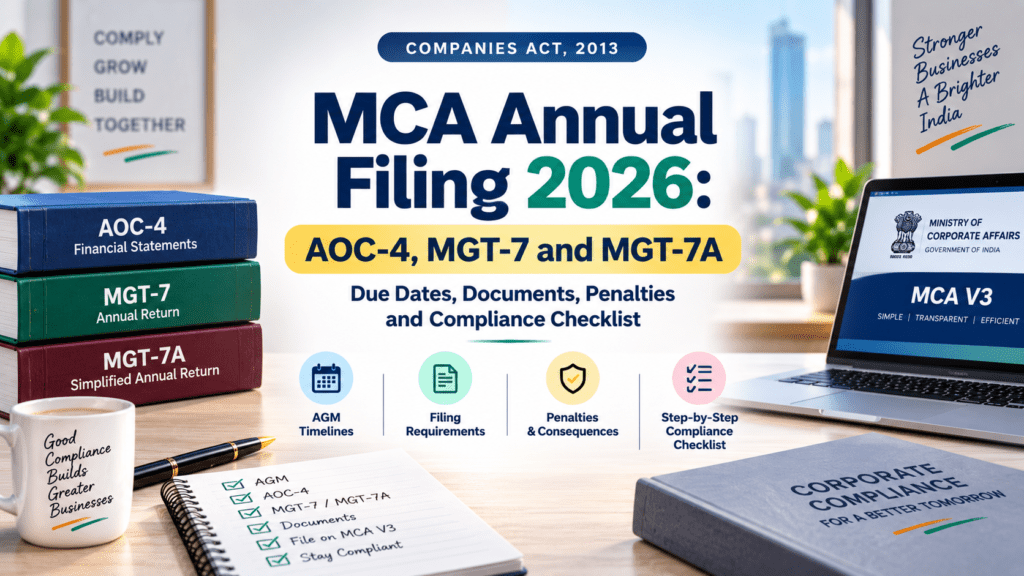
This article explains the practical annual ROC compliance process for 2026, including AOC-4, MGT-7, MGT-7A, AGM timelines, documents, common mistakes, additional fees and a sensible compliance checklist.
What Is Annual ROC Compliance?
Annual ROC compliance refers to the statutory filings and related corporate actions that a company must complete after the end of every financial year.
The two most important annual filings for most companies are:
| Filing | Main purpose | Broad statutory timeline |
|---|---|---|
| AOC-4 / applicable financial statement form | Filing financial statements and related documents | Generally within 30 days of AGM |
| MGT-7 / MGT-7A | Filing annual return | Generally within 60 days of AGM |
These timelines come from Sections 137 and 92 of the Companies Act, 2013 respectively. Section 137 requires the adopted financial statements to be filed with the Registrar within 30 days of the AGM. Section 92 requires the annual return to be filed within 60 days from the date of the AGM.
The important point is that AOC-4 and MGT-7/MGT-7A are not the same filing.
AOC-4 primarily communicates the company’s financial reporting information to the MCA.
The annual return, on the other hand, provides a snapshot of the company’s corporate structure and activities, including information relating to members, directors, shareholding and other prescribed particulars.
A company therefore should not treat the annual filing exercise as simply “uploading the balance sheet.”
Which Financial Year Does the 2026 Annual Filing Relate To?
This distinction matters.
For the current annual filing cycle, a normal Indian company with a financial year ending 31 March is generally dealing with:
FY 2025-26 — 1 April 2025 to 31 March 2026
The financial statements for this period are prepared and adopted through the company’s statutory process, including the AGM where applicable.
This is different from filings relating to FY 2026-27, which will concern transactions occurring from 1 April 2026 to 31 March 2027.
Companies should avoid mixing financial-year records, particularly where accounting software, tax records and MCA master data are being reconciled simultaneously.
When Does a Company Need to Hold Its AGM?
For most companies, the annual compliance cycle starts with the AGM.
Under Section 96 of the Companies Act, the first AGM is generally required within nine months from the close of the first financial year, while subsequent AGMs are generally required within six months from the close of the financial year, subject to the statutory conditions and extensions permitted by law.
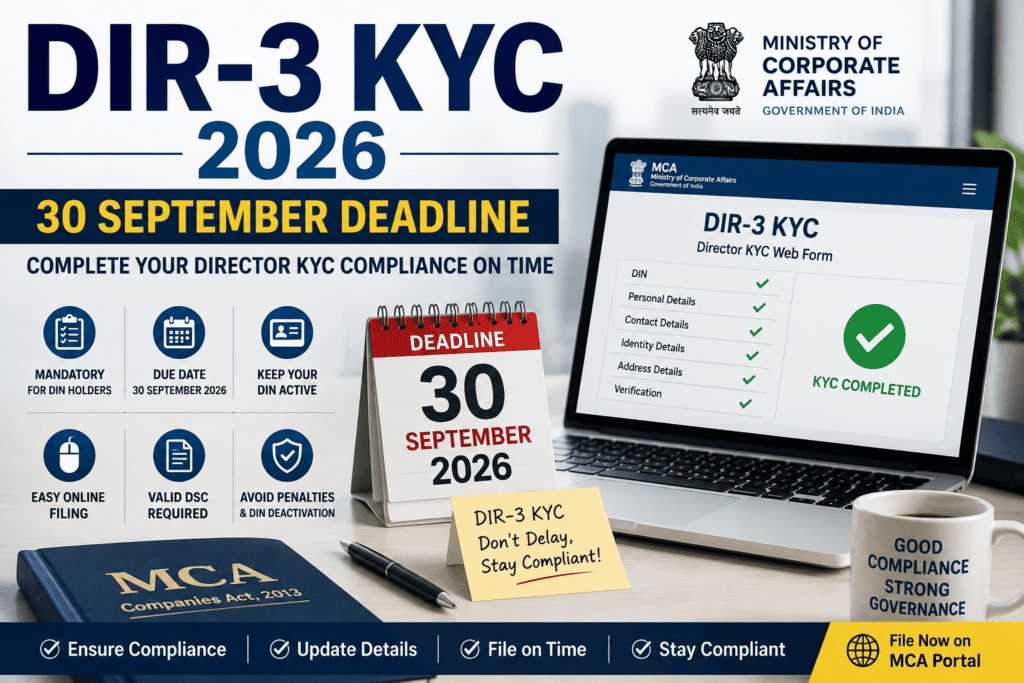
For a company whose financial year ended on 31 March 2026, a typical subsequent AGM would therefore ordinarily need to be held by 30 September 2026.
This date is particularly important because the due dates for AOC-4 and MGT-7/MGT-7A are calculated by reference to the AGM.
For example, assume a company holds its AGM on 20 September 2026.
The broad statutory filing calendar would then be:
- Financial statements: within 30 days from 20 September 2026.
- Annual return: within 60 days from 20 September 2026.
The exact filing date should be calculated carefully in accordance with the applicable statutory provisions and MCA filing rules.
What Is AOC-4?
AOC-4 is the principal form used by eligible companies for filing financial statements and associated documents with the ROC.
The purpose is not merely to report profit or loss.
The filing can involve financial statements and documents required to accompany them under the Companies Act, depending on the company’s circumstances.
For certain classes of companies, different versions or XBRL-based forms may apply. Therefore, the correct AOC-4 variant should be identified before filing rather than automatically using the same form every year.
The MCA has also continued updating its digital filing environment. The Ministry announced the final set of 38 company forms, including annual filing forms, and subsequently highlighted the availability of updated XBRL validation tools for relevant taxonomies.
What Documents Should Be Checked Before Filing AOC-4?
Before preparing the form, a company should create a complete annual filing folder.
At a minimum, the team should review:
- Final audited financial statements
- Balance sheet
- Statement of profit and loss
- Cash-flow statement, where applicable
- Notes to accounts
- Auditor’s report
- Board’s report
- Corporate Social Responsibility information, where applicable
- Consolidated financial statements, where applicable
- Related disclosures
- AGM documents
- Details of subsidiaries, associates and joint ventures, where applicable
- XBRL information, where applicable
- Other attachments prescribed for the company’s circumstances
A common practical mistake is to start preparing AOC-4 before the financial statements and Board’s Report are fully finalised.
That creates unnecessary rework.
The better approach is to first freeze the approved financial reporting package and then map the information into the MCA form.
What Is MGT-7?
MGT-7 is the annual return form applicable to companies other than those specifically covered by the abridged annual-return framework.
The annual return provides a corporate snapshot rather than simply a financial snapshot.
Depending on the company, information may include:
- Registered office details
- Principal business activities
- Share capital
- Shareholding
- Members
- Debenture holders, where applicable
- Directors and key managerial personnel
- Meetings
- Remuneration-related information
- Indebtedness
- Penalties and compounding details, where applicable
- Other prescribed information
This is why the annual return should be reconciled against the company’s statutory registers and MCA master data.
A company may have accurate books of account but still have incorrect corporate information on its annual return.
What Is MGT-7A?
MGT-7A is the abridged annual return introduced for One Person Companies and Small Companies.
The Companies (Management and Administration) Amendment Rules, 2021 provide that every company files MGT-7 except an OPC and Small Company, while an OPC and Small Company files the annual return in MGT-7A from FY 2020-21 onwards.
This distinction is important because a company should not select MGT-7A simply because it is a private limited company.
The company must actually fall within the applicable definition and conditions for an OPC or Small Company for the relevant period.
AOC-4 vs MGT-7 vs MGT-7A
One of the easiest ways to understand the annual filing cycle is to separate the filings by purpose.
| Form | What it broadly reports | Typical applicability |
|---|---|---|
| AOC-4 | Financial statements and related documents | Companies, subject to applicable form/filing requirements |
| MGT-7 | Annual return | Companies other than OPCs and Small Companies |
| MGT-7A | Abridged annual return | OPCs and Small Companies |
The key takeaway is simple:
AOC-4 tells the ROC about the company’s financial statements; MGT-7/MGT-7A provides the company’s annual corporate return.
Both need separate attention.
Why Reconciliation Before ROC Filing Matters
Imagine a private company whose books show three shareholders:
- Founder A – 50%
- Founder B – 30%
- Investor C – 20%
But during the year, the company actually issued additional shares to Investor D.
The accounting records may correctly show the proceeds received from Investor D. However, if the statutory registers, share certificates, PAS-3 filings or annual return information are not properly reconciled, the annual return may contain inconsistent information.
The same issue can arise with directors.
Suppose a director resigned in May 2026, but DIR-12 was never filed correctly.
When the annual return is prepared, the company may discover that the ROC records still show the old director.
This is why annual filing should be treated as a corporate data reconciliation exercise, not just a form-filing exercise.
A Practical Pre-Filing Reconciliation Checklist
Before starting the annual forms, management should check the following.
Company master data
Verify:
- Company name
- CIN
- Registered office
- Email address
- Authorised capital
- Paid-up capital
- Company status
- Principal business activity
Directors and KMP
Reconcile:
- Current directors
- Resignations
- Appointments
- DIN status
- KMP details
- Changes in designation
- Board resolutions
Shareholding
Check:
- Total issued shares
- Paid-up shares
- Shareholders
- Transfers
- New allotments
- Transmission
- Buy-back, if applicable
- Dematerialisation-related changes
- Beneficial ownership disclosures, where applicable
Financial information
Reconcile:
- Revenue
- Profit or loss
- Net worth
- Assets
- Liabilities
- Borrowings
- Investments
- Related-party balances
Corporate events
Check whether the company entered into transactions requiring separate ROC filings, such as:
- Appointment or resignation of directors
- Changes in registered office
- Share allotments
- Charges
- Satisfaction of charges
- Special resolutions
- Changes in capital
- Related corporate actions
A company’s annual return should not be the first time these discrepancies are discovered.
What Happens If the AGM Is Not Held?
This is an area where companies should be particularly careful.
Section 92 specifically contemplates a situation where an AGM has not been held. In such a case, the annual return is to be filed within the prescribed period from the date on which the AGM should have been held, together with a statement explaining the reasons for not holding the AGM.
Similarly, Section 137 contains provisions dealing with financial statements where the AGM has not been held.
Therefore, simply saying “the AGM was not conducted, so the annual filing is not due” is not a safe approach.
The company should examine why the AGM was not held, determine the statutory consequences and complete the necessary filings or corrective actions.
What About Additional Fees for Late Filing?
Late ROC filing can become expensive, particularly when the delay continues.
For annual return and financial statement filings, the Companies Act contains specific consequences for failure to file within the prescribed period.
The applicable fee and penalty provisions should always be checked against the law and MCA fee logic applicable on the actual date of filing.
The MCA’s fee framework also distinguishes the additional-fee treatment for forms under Sections 92 and 137 from the general additional-fee framework for other company forms. MCA materials provide for additional fees linked to delay for filings under these sections.
More importantly, directors should understand that late filing is not simply a matter of paying an extra government fee.
Persistent non-compliance can create regulatory, financing, transaction and governance problems.
A Simple Example of the Cost of Delay
Suppose a company should have filed its financial statements within the statutory period after its AGM but does not file them.
If the delay continues for several months, the additional financial burden can increase substantially depending on the applicable statutory fee and penalty provisions.
Now consider a company that has missed filings for several years.
The problem is no longer just one overdue form.
The company may have:
- Multiple years of financial statements pending
- Multiple annual returns pending
- Director-related issues
- Charge-related issues
- Difficulty completing current filings
- Potential restrictions or regulatory consequences
- Problems during due diligence
This is why annual compliance should be completed every year instead of being postponed until the company needs a bank loan, investor, merger or sale.
MCA V3: What Companies Should Keep in Mind in 2026
The MCA’s transition to the V3 filing system remains an important operational issue.
The Ministry’s current MCA portal specifically advises stakeholders to create or upgrade their user IDs under the Business User category and associate the DSC where required. The portal also provides V3-related FAQs and filing guidance.
The change is particularly relevant for companies and professionals who still have older login arrangements or are filing annual forms for the first time through the current system.
A sensible approach is to complete the following before the filing deadline:
- Check the authorised signatory’s MCA user profile.
- Confirm Business User registration where applicable.
- Verify DSC association.
- Check whether the professional’s membership details are correctly mapped.
- Review the latest MCA form version.
- Download the latest instruction kit where required.
- Complete pre-scrutiny and validation well before the final filing date.
Do not leave user-registration or DSC issues until the last day.
What About XBRL Filing?
Not every company files financial statements in XBRL.
XBRL applicability depends on the company’s class and the applicable rules.
Where XBRL applies, the process requires more than entering figures into an ordinary form. Financial data needs to be mapped to the applicable taxonomy, validated and submitted in the required format.
The MCA has specifically released updated XBRL validation tooling and noted its applicability to relevant taxonomies, including Ind AS-related filings.
Companies subject to XBRL requirements should therefore use the current taxonomy and validation tools rather than relying on an old year’s filing template.
Common ROC Annual Filing Mistakes
Filing the wrong annual return form
A company eligible for MGT-7A may incorrectly prepare MGT-7, or vice versa.
The applicability should be checked first.
Ignoring changes during the year
Changes in directors, shareholders, capital and registered office should be reconciled before annual filing.
Treating MCA data and accounting data separately
The balance sheet, statutory registers, tax records and MCA filings should tell the same story.
Copying last year’s information
Last year’s annual return is useful as a reference but should never become a copy-paste template.
Waiting until September
For companies following the normal financial year, September is often a high-pressure compliance period.
Waiting until the final week increases the risk of:
- DSC problems
- Portal issues
- Missing attachments
- Incorrect data
- Professional review delays
- Resubmission
- Late filing
Assuming that filing one form completes annual compliance
AOC-4 alone does not complete the annual ROC cycle.
The annual return and other applicable compliances must also be considered.
2026 Annual ROC Compliance Checklist
A company preparing its FY 2025-26 compliance can use the following practical checklist:
- Confirm financial year ended 31 March 2026.
- Finalise audited financial statements.
- Finalise Board’s Report and required disclosures.
- Check auditor-related records.
- Review statutory registers.
- Reconcile share capital and shareholders.
- Reconcile directors and KMP.
- Review charges and borrowings.
- Identify related-party transactions.
- Check CSR applicability, if relevant.
- Prepare AGM documentation.
- Hold AGM within the applicable statutory timeline.
- Determine correct AOC-4 variant.
- Determine MGT-7 or MGT-7A applicability.
- Validate attachments.
- Verify MCA V3 user credentials.
- Verify DSC association.
- Conduct professional review.
- File AOC-4 within the applicable period.
- File MGT-7/MGT-7A within the applicable period.
- Save SRNs and approved filings.
- Update the company’s internal compliance tracker.
What Founders Should Do Differently
Founders often look at compliance from the perspective of cost.
A better approach is to look at it from the perspective of business readiness.
A company with clean annual ROC records is easier to evaluate when it wants:
- Bank finance
- Private investment
- Strategic investment
- Acquisition
- Merger
- Business restructuring
- New shareholders
- Foreign investment
- Due diligence
- Sale of the business
A potential investor or buyer may examine years of MCA filings. Small inconsistencies can lead to additional questions and delays.
Good compliance therefore has a commercial value.
It makes the company easier to understand.
What Directors Should Review Personally
Directors should not assume that the accountant or compliance professional has automatically checked everything.
Before approving the annual filing package, directors should ask:
- Are the shareholders correctly reflected?
- Are all directors correctly reflected?
- Were all board and shareholder changes properly filed?
- Does the financial information agree with the audited accounts?
- Are there outstanding MCA notices?
- Are there old charges still appearing on the MCA master data?
- Are any annual filings overdue?
- Are there related-party transactions that require disclosure?
- Is the registered office information correct?
These questions take little time but can prevent much larger problems later.
Frequently Asked Questions
Is AOC-4 the same as the annual return?
No. AOC-4 relates primarily to filing financial statements and associated documents. The annual return is filed separately in MGT-7 or MGT-7A, depending on applicability.
What is the normal due date for AOC-4?
Under Section 137, financial statements are generally required to be filed within 30 days of the AGM. If the AGM is not held, the Act contains a separate provision dealing with filing within the prescribed period from the last date by which the AGM should have been held.
What is the normal due date for MGT-7?
The annual return is generally required to be filed within 60 days from the date of the AGM under Section 92.
Which companies file MGT-7A?
OPCs and Small Companies file MGT-7A instead of MGT-7 under the applicable annual-return rules.
Can a company skip annual filing because there was no business?
Generally, no. A company does not become exempt from its statutory annual filing obligations merely because it had no turnover or no significant business activity.
The company’s exact status and applicable exemptions, if any, should be checked separately.
What if the company missed annual filings for previous years?
The company should first identify all outstanding filings and determine the correct procedure for regularisation. Depending on the nature and period of default, additional fees, penalties, adjudication or other consequences may arise.
Does an LLP follow the same annual filing forms?
No. LLPs have a separate compliance framework under the Limited Liability Partnership Act and rules. For example, LLP Form 11 is the annual return of an LLP and the MCA instruction kit states that it is generally filed within 60 days from the financial year-end.
Should MCA master data be checked before annual filing?
Yes. It is a very useful practical step. The company’s master data should be reconciled with its current directors, registered office, capital and other corporate information before submitting annual forms.
Key Takeaways
- FY 2025-26 ended on 31 March 2026 and is the relevant financial year for the current annual filing cycle.
- AOC-4 and MGT-7/MGT-7A serve different purposes.
- Financial statements are generally filed within 30 days of the AGM.
- Annual returns are generally filed within 60 days of the AGM.
- OPCs and Small Companies use MGT-7A under the applicable rules.
- Annual filing should be reconciled with statutory registers and MCA master data.
- Director, shareholder and capital changes should be checked before filing.
- Late filing can result in additional fees and statutory consequences.
- MCA V3 user registration and DSC association should be checked before filing.
- XBRL-applicable companies should use the current applicable taxonomy and validation process.
- A company should not postpone compliance simply because it had little or no business activity.
- Clean annual ROC records can significantly help during financing, investment and due diligence.
Conclusion
Annual ROC compliance is often treated as a routine paperwork exercise, but it is really a yearly health check of a company’s legal and corporate records.
For FY 2025-26, companies should not wait until the last few days before their applicable filing deadlines. The better approach is to complete the accounts, reconcile corporate records, review MCA master data, confirm the correct forms and then file systematically.
For directors and founders, the objective should not simply be to get an SRN generated. The objective should be to ensure that the company’s financial statements, statutory registers, shareholder records, director records and MCA filings all tell the same story.
That is what turns annual ROC filing from a compliance burden into good corporate governance.
For a detailed discussion of the FY 2025-26 filing calendar, including AOC-4, MGT-7 and MGT-7A timelines, see our MCA Annual Filing 2026 guide. Companies that need assistance with annual ROC filings, statutory records, MCA forms or ongoing corporate compliance can explore our Company Law & Compliance Services.