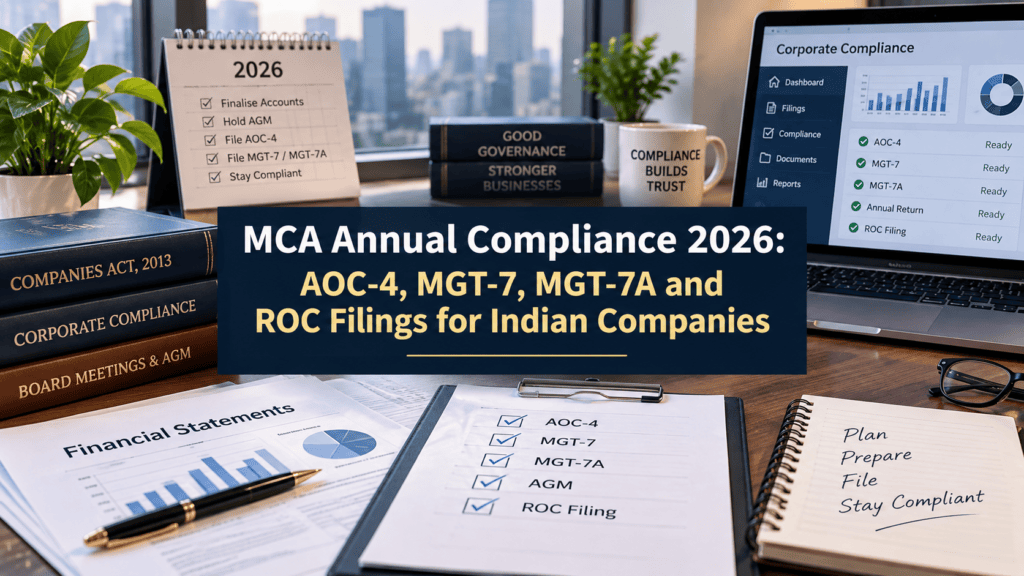
September is not just the month when companies start thinking about the festive season and year-end business targets. For many Indian companies, it is also the point at which annual ROC compliance moves from planning to action.
For companies following the April-to-March financial year, the financial year FY 2025-26 ended on 31 March 2026. The next major milestone is the Annual General Meeting (AGM), followed by filing of the financial statements and annual return with the Registrar of Companies (ROC).
The important thing to understand is that AOC-4 and MGT-7/MGT-7A do not have one universal fixed date for every company. Their statutory due dates are generally linked to the date on which the AGM is actually held, subject to the specific provisions applicable to the company.
Under the Companies Act, 2013, financial statements are generally filed with the ROC within 30 days of the AGM, while the annual return is generally filed within 60 days of the AGM.
For FY 2025-26, this means directors, founders, accountants and company secretaries should now be checking their company’s AGM schedule, financial statements, Board’s Report, auditor’s report, shareholding records and MCA master data rather than waiting until the last week.
The compliance process has also become increasingly digital. The Ministry of Corporate Affairs (MCA) has moved the final set of company forms to the MCA V3 system, including annual filing forms, and has advised stakeholders to use the Business User category and associate their Digital Signature Certificate (DSC) where required.
This guide explains the FY 2025-26 annual filing cycle in practical terms, including AOC-4, MGT-7, MGT-7A, AGM timelines, documents, common mistakes, penalties, V3 filing considerations and a practical compliance checklist.
What does annual ROC filing mean?
Annual ROC filing is the process through which a company submits prescribed corporate and financial information to the Registrar of Companies.
It is not the same thing as filing an income-tax return.
A company may have completed its income-tax return, GST returns, TDS filings and audit work, but still have separate Companies Act compliance remaining.
The two major annual filings for most companies are:
| Filing | Broad purpose |
|---|---|
| AOC-4 | Filing of financial statements and related documents |
| MGT-7 | Annual return of the company |
| MGT-7A | Simplified annual return applicable to specified OPCs and small companies |
Depending on the company’s nature and applicability, additional forms and disclosures may also be required.
For example, certain companies may have XBRL filing requirements, CSR-related filings, secretarial audit requirements, cost audit requirements or other event-based compliance.
So, annual filing should be viewed as a compliance package, not simply “file AOC-4 and MGT-7.”
Which financial year are companies filing in 2026?
The relevant financial year for the current annual filing cycle is generally:
FY 2025-26: 1 April 2025 to 31 March 2026
The financial statements for this year cover the period ending 31 March 2026.
This should not be confused with:
FY 2026-27: 1 April 2026 to 31 March 2027
For most companies, FY 2026-27 accounts will be dealt with in the following annual filing cycle.
This distinction becomes particularly important when accounting data, audit reports, Board’s Reports and statutory forms are being prepared.
When is the AGM due for FY 2025-26?
For companies other than an OPC, Section 96 of the Companies Act generally requires the AGM to be held within six months from the close of the financial year.
For a financial year ending 31 March 2026, the ordinary outer date therefore falls in September 2026, subject to the statutory provisions applicable to the company.
The first AGM has a different rule: it is generally required within nine months from the close of the first financial year.
The Registrar may also extend the time for holding an AGM, other than the first AGM, by a period not exceeding three months for special reasons.
This is why a company should not simply assume that every AGM must be held on 30 September.
The actual AGM date, whether any extension applies, and whether the company is an OPC should be checked separately.
AOC-4 due date explained
AOC-4 is the form used for filing the company’s financial statements and related documents with the ROC.
Section 137 of the Companies Act provides that financial statements duly adopted at the AGM are generally required to be filed with the Registrar within 30 days of the AGM.
For example, suppose a private limited company holds its AGM on:
20 September 2026
Its normal AOC-4 filing deadline would be:
20 October 2026
The important point is that the 30-day period is calculated from the AGM date, not automatically from 30 September.
What if the AGM is held earlier?
Suppose the company holds its AGM on 10 September 2026.
The AOC-4 deadline would generally move accordingly.
The company should not assume that because the statutory AGM season runs through September, it automatically gets 30 days after 30 September.
The filing clock is connected to the actual AGM.
What if the AGM is not held?
Section 137 also deals with situations where the AGM has not been held.
The financial statements and required documents, along with a statement explaining the facts and reasons for not holding the AGM, have to be filed within the statutory period linked to the last date on which the AGM should have been held.
This is an area where companies sometimes make a serious mistake.
Not holding an AGM does not automatically mean that all annual filing obligations disappear.
If the AGM has not taken place, the company should examine the applicable provisions carefully and document the reason for non-holding.
What is filed with AOC-4?
The exact attachments and filing requirements depend on the company and the nature of its financial statements.
Broadly, the AOC-4 filing process can involve:
- Balance Sheet
- Statement of Profit and Loss
- Cash Flow Statement, where applicable
- Notes to accounts
- Auditor’s Report
- Board’s Report
- Related documents required under the Companies Act
- Consolidated financial statements, where applicable
- Other prescribed attachments depending on the form and company category
The Companies (Accounts) Rules provide for filing financial statements with the Registrar through the prescribed AOC forms.
The company should therefore prepare the complete statutory financial statement package before beginning the final filing process.
When is MGT-7 due?
MGT-7 is the annual return filing for companies to which the applicable annual-return provisions apply.
Under Section 92, a company is generally required to file its annual return with the Registrar within 60 days from the date on which the AGM is held.
If no AGM is held, the Act provides a separate mechanism linked to the date on which the AGM should have been held, together with a statement explaining why the AGM was not held.
Example
Suppose:
- FY ends: 31 March 2026
- AGM date: 25 September 2026
Then, broadly:
AOC-4: within 30 days of 25 September 2026
MGT-7: within 60 days of 25 September 2026
This is why the two filings should be planned together but tracked with different deadlines.
What is MGT-7A?
MGT-7A is the simplified annual return form prescribed for specified One Person Companies (OPCs) and small companies.
A company should not select MGT-7A simply because it is a private limited company.
The company must actually satisfy the applicable definition and conditions for being treated as a small company or OPC for the relevant period.
This distinction matters because eligibility for small-company treatment can depend on statutory conditions and prescribed thresholds, including the applicable paid-up capital and turnover criteria and exclusions.
Therefore, before selecting MGT-7A, the company should confirm its legal status and eligibility.
MGT-7 versus MGT-7A
| Point | MGT-7 | MGT-7A |
|---|---|---|
| Nature | Annual return | Simplified annual return |
| Broad applicability | Companies not covered by MGT-7A | Specified OPCs and small companies |
| Information | More detailed | Simplified |
| Eligibility | Depends on company category | Must satisfy applicable conditions |
| Filing period | Generally 60 days from AGM | Generally 60 days from AGM |
| Best practice | Confirm applicability before filing | Confirm small-company/OPC status first |
The annual return provisions themselves require the company to provide prescribed information concerning its corporate structure, shareholding, directors, KMP, meetings and other relevant matters.
Need Help With MCA & ROC Compliance?
Get professional support for ROC filings, MCA compliance and company law requirements.
Explore Company Law Services →What information goes into the annual return?
The annual return is much more than a formality.
Section 92 covers information such as:
- Registered office
- Principal business activities
- Holding, subsidiary and associate companies
- Share capital and securities
- Shareholding pattern
- Indebtedness
- Members and debenture-holders
- Promoters
- Directors
- Key managerial personnel
- Changes during the year
- Meetings and attendance
- Remuneration
- Penalties and punishments
- Other prescribed matters
This means the annual return should be reconciled with the company’s actual records.
A company should not simply copy last year’s MGT-7 and change the financial year.
Why shareholding reconciliation is important
One of the most common practical problems in annual return preparation is mismatch in shareholding information.
Imagine a company had:
- 1,00,000 equity shares at the beginning of FY 2025-26
- A rights issue or private placement during the year
- A transfer of shares
- One shareholder’s address changed
- One director resigned
- Another director was appointed
The closing shareholding information in the annual return should reflect the position required by the applicable provisions.
The accounting records, statutory registers, share certificates, PAS-3 filings, SH-7 filings and other relevant records should therefore be reviewed together.
Annual filing and MCA V3
The MCA has continued the transition of company filings to the MCA V3 system.
MCA’s official portal states that the final set of 38 company forms, including 13 annual filing forms and six audit/cost audit forms, went live in 2025. The Ministry also advised stakeholders to create or upgrade their user IDs under the Business User category and associate the DSC where required.
For a company preparing FY 2025-26 annual filing, this means the compliance team should not rely on old V2 screenshots, old filing workflows or outdated instruction notes.
The actual MCA V3 form and its current instruction kit should be checked before filing.
What should be checked before starting MCA annual filing?
A practical pre-filing review can save significant time.
Company master data
Check:
- Company name
- CIN
- Registered office
- Email ID
- Company status
- Authorised capital
- Paid-up capital
- Directors
- Signatories
If the master data is incorrect, first determine whether a separate event-based filing is required.
Director information
Review:
- Current directors
- Resignations
- Appointments
- DIN status
- KYC status
- Disqualifications, if any
- Changes during FY 2025-26
A director change that was not properly reported should not simply be ignored during annual filing.
Share capital
Reconcile:
- Opening share capital
- Shares issued
- Shares transferred
- Shares bought back, if any
- Alteration of authorised capital
- Closing share capital
Financial statements
Ensure that the figures in the AOC-4 filing agree with:
- Audited financial statements
- Trial balance
- Balance Sheet
- Profit and Loss Account
- Notes
- Auditor’s Report
- Board’s Report
Even a small mismatch can result in resubmission or defective filing issues.
Common annual filing mistakes
Mistake 1: Treating 30 September as every deadline
30 September is an important AGM date for many companies, but AOC-4 and MGT-7 are generally calculated from the actual AGM date.
Mistake 2: Filing MGT-7A without checking eligibility
Not every private limited company qualifies as a small company.
The classification should be checked before selecting the form.
Mistake 3: Ignoring event-based filings
Annual filing does not replace filings for specific corporate events.
For example, a company may have separate filing requirements relating to:
- Appointment or resignation of directors
- Increase in authorised capital
- Allotment of shares
- Changes in registered office
- Charges
- Significant beneficial ownership
- Other statutory events
Mistake 4: Copying last year’s information
The annual return captures the company’s position and prescribed changes for the relevant year.
Old information should not simply be carried forward without reconciliation.
Mistake 5: Waiting until the last day
MCA filing can involve:
- DSC issues
- Form validation errors
- Attachment problems
- Pre-fill problems
- Payment issues
- SRN generation problems
- Resubmission requirements
A last-minute filing creates unnecessary risk.
What happens if AOC-4 is filed late?
Late filing is not merely a technical inconvenience.
Section 137 contains a statutory penalty framework for failure to file financial statements within the prescribed time. The company can be liable for a daily penalty subject to the statutory maximum, and officers in default can also face prescribed penalties.
This is one reason why companies should calculate the filing deadline carefully.
A delay of a few days can become materially more expensive if the matter is allowed to continue.
What happens if MGT-7 is filed late?
Section 92 also contains consequences for failure to file the annual return within the prescribed period.
The Act provides penalties for the company and officers in default where the annual return is not filed within the applicable statutory period and additional-fee framework.
The exact financial consequence should therefore be checked against the law and applicable MCA fee rules at the time of filing.
Companies should avoid relying on old articles or historical penalty figures because corporate-law provisions and fee structures can change.
A practical FY 2025-26 annual filing checklist
Before filing, a company can use the following checklist.
Corporate records
- Confirm FY 2025-26 closing date.
- Confirm AGM date.
- Check company master data.
- Verify registered office details.
- Review director and KMP information.
- Check DIN and DSC status.
- Reconcile share capital.
- Review share transfers and allotments.
Financial records
- Final audited financial statements.
- Auditor’s report.
- Board’s Report.
- Notes to accounts.
- Consolidated financial statements, where applicable.
- Cash Flow Statement, where applicable.
- Reconciliation between books and statutory forms.
Annual return records
- Member details.
- Shareholding pattern.
- Promoter details.
- Directors and KMP.
- Board meetings.
- General meetings.
- Attendance.
- Remuneration.
- Subsidiary/associate/holding-company information.
- Penalties and compounding information, where applicable.
MCA filing readiness
- MCA V3 Business User access.
- DSC association.
- Correct authorised signatory.
- Current email/mobile details.
- Correct form selection.
- Correct attachments.
- Form validation completed.
- Payment facility ready.
- SRN and acknowledgement retained.
A simple example for a private limited company
Consider ABC Technologies Private Limited.
Its FY 2025-26 ended on 31 March 2026.
The company completes its audit and holds its AGM on 24 September 2026.
Its broad annual filing calendar would then look like this:
| Compliance | Relevant date |
|---|---|
| Financial year end | 31 March 2026 |
| AGM | 24 September 2026 |
| AOC-4 | Generally within 30 days of AGM |
| MGT-7/MGT-7A, as applicable | Generally within 60 days of AGM |
The company should not wait until the end of November to start gathering documents simply because the annual return deadline is later than the AOC-4 deadline.
A better approach is to prepare both forms immediately after the AGM.
What if the financial statements are not adopted at the AGM?
Section 137 specifically addresses the situation where financial statements are not adopted at the AGM or an adjourned AGM.
The Act provides for filing of unadopted financial statements within the prescribed period, with the Registrar treating them as provisional until the adopted statements are filed after the adjourned AGM.
This is a technical situation and should be handled carefully.
The company should not simply skip AOC-4 because the accounts were not adopted.
The applicable provision and current form functionality should be reviewed before filing.
Why directors should take annual filing seriously
Annual ROC filing is often treated as an accountant’s routine task.
That is a mistake.
The annual return and financial statements become part of the company’s statutory record.
They can be relevant when:
- Applying for bank finance
- Raising investment
- Conducting due diligence
- Entering into a merger or acquisition
- Applying for government tenders
- Dealing with investors
- Preparing for an IPO or strategic transaction
- Responding to regulatory questions
- Conducting legal or financial due diligence
A company that consistently maintains clean MCA records is generally easier to diligence than one with unexplained gaps.
Annual filing is not the same as income-tax compliance
This distinction deserves emphasis.
A company may have:
- Filed its ITR
- Paid advance tax
- Filed GST returns
- Completed statutory audit
- Filed TDS returns
and still have pending MCA annual compliance.
The Companies Act, Income-tax Act and GST law operate through separate compliance frameworks.
The finance team should therefore maintain a consolidated compliance calendar rather than assuming that completion of one system means the company is fully compliant.
What companies should do in September 2026
For companies with FY 2025-26 closing on 31 March 2026, September is a sensible month to conduct an annual compliance health check.
A practical sequence is:
- Confirm whether the AGM has been held or when it will be held.
- Finalise audited financial statements.
- Complete Board’s Report and related documentation.
- Reconcile share capital and members.
- Review directors and KMP.
- Confirm applicable AOC-4 variant.
- Confirm MGT-7 or MGT-7A applicability.
- Prepare attachments.
- Verify MCA V3 user and DSC readiness.
- File AOC-4 within the statutory period.
- File MGT-7/MGT-7A within the statutory period.
- Save SRNs, challans and filed copies.
- Check whether any separate event-based filings remain pending.
Frequently asked questions
What is the AOC-4 due date for FY 2025-26?
AOC-4 is generally required within 30 days from the date of the AGM under Section 137. The actual deadline should therefore be calculated from the company’s AGM date rather than assuming one common date for all companies.
What is the MGT-7 due date?
MGT-7 is generally required within 60 days from the date of the AGM under Section 92. If an AGM is not held, the Act provides a separate rule linked to the date on which the AGM should have been held.
Is MGT-7A applicable to every private limited company?
No. MGT-7A is intended for specified OPCs and small companies. Eligibility should be checked under the applicable Companies Act provisions and rules before filing.
Is 30 September the AOC-4 due date?
Not necessarily. 30 September is the ordinary AGM date for many companies with a 31 March financial year, but AOC-4 is generally due within 30 days of the actual AGM.
Can AOC-4 and MGT-7 be filed on the same day?
Yes, there is no general requirement that they must be filed on separate dates. However, each form has its own statutory deadline and filing requirements.
What happens if the AGM is not held?
The company should not simply ignore annual filing. Sections 92 and 137 contain specific provisions for situations where the AGM has not been held, including filing with explanations for the non-holding of the AGM.
Does annual filing apply to dormant companies?
Dormant or inactive status does not automatically eliminate every statutory compliance requirement. The company should examine the specific provisions applicable to its status.
Has MCA moved annual filing to V3?
Yes. MCA’s official portal states that the final set of 38 company forms, including 13 annual filing forms, is live on the MCA V3 portal.
Do directors need a DSC for MCA filing?
The exact signing requirements depend on the form and company circumstances, but MCA has advised stakeholders to register/upgrade users under the Business User category and associate the DSC where required.
Can a company file annual forms after the due date?
Late filing may be possible with applicable additional fees and can also attract statutory penalties depending on the form and default. Companies should not treat additional fees as a substitute for timely compliance.
Key takeaways
- FY 2025-26 ended on 31 March 2026.
- For most companies, the FY 2025-26 annual compliance cycle now leads into the AGM and ROC filing process.
- AOC-4 generally has to be filed within 30 days of the AGM.
- MGT-7 generally has to be filed within 60 days of the AGM.
- MGT-7A is relevant to specified OPCs and small companies, subject to eligibility.
- 30 September should not automatically be treated as the AOC-4 or MGT-7 filing date.
- The actual AGM date is critical for calculating the ordinary filing deadlines.
- Annual return information should be reconciled with statutory registers and corporate records.
- Financial statement figures should agree with the audited accounts and relevant reports.
- MCA V3 is now the operative environment for the final set of company forms, including annual filing forms.
- Late filing can result in additional fees and statutory penalties.
- Annual ROC compliance is separate from income-tax, GST and TDS compliance.
- Companies should complete their annual filing preparation well before the final deadline instead of waiting for the last few days.
Official Sources
For current MCA filing instructions, forms, notices and updates, use the official Ministry of Corporate Affairs portal:
Ministry of Corporate Affairs — MCA Official Portal
The MCA portal currently provides access to FAQs for Annual Filing Forms, V3 filing guidance, DSC association information and other company/LLP filing resources.
For the statutory provisions of the Companies Act, 2013, the official India Code database can also be consulted:
Section 92 deals with annual returns, while Section 137 deals with filing of financial statements with the Registrar.
Conclusion
Annual ROC filing should not be treated as a routine upload exercise that starts a few days before the deadline.
For FY 2025-26, companies should now be thinking in terms of a complete compliance cycle: AGM, financial statements, Board’s Report, annual return, statutory registers, shareholding reconciliation, director information and MCA V3 filing readiness.
The most important practical point is that AOC-4 and MGT-7/MGT-7A are generally linked to the actual AGM date. A company that holds its AGM early will ordinarily have an earlier filing deadline as well.
For founders and directors, the safest approach is simple: close the books properly, complete the statutory review, reconcile the corporate records and file well before the applicable due dates.
Good ROC compliance is not just about avoiding additional fees. It creates a cleaner corporate record, makes future financing and due diligence easier and gives directors greater confidence that the company’s statutory obligations are being handled properly.
In 2026, with MCA’s V3 filing environment now covering the final set of company forms, there is even less reason to rely on old filing practices. Check the current MCA form, current instruction kit and current statutory position before submitting the FY 2025-26 annual filings.